
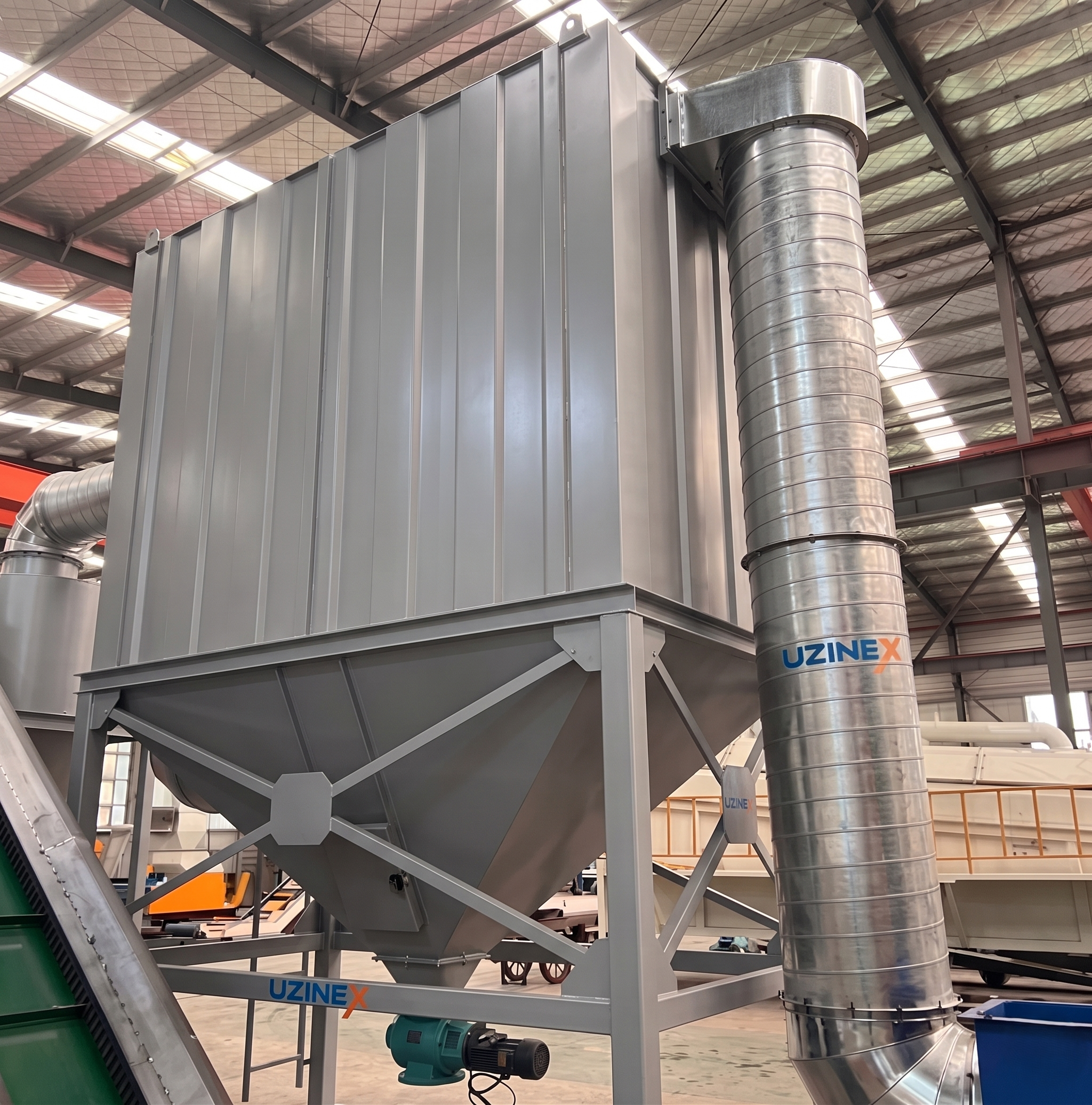
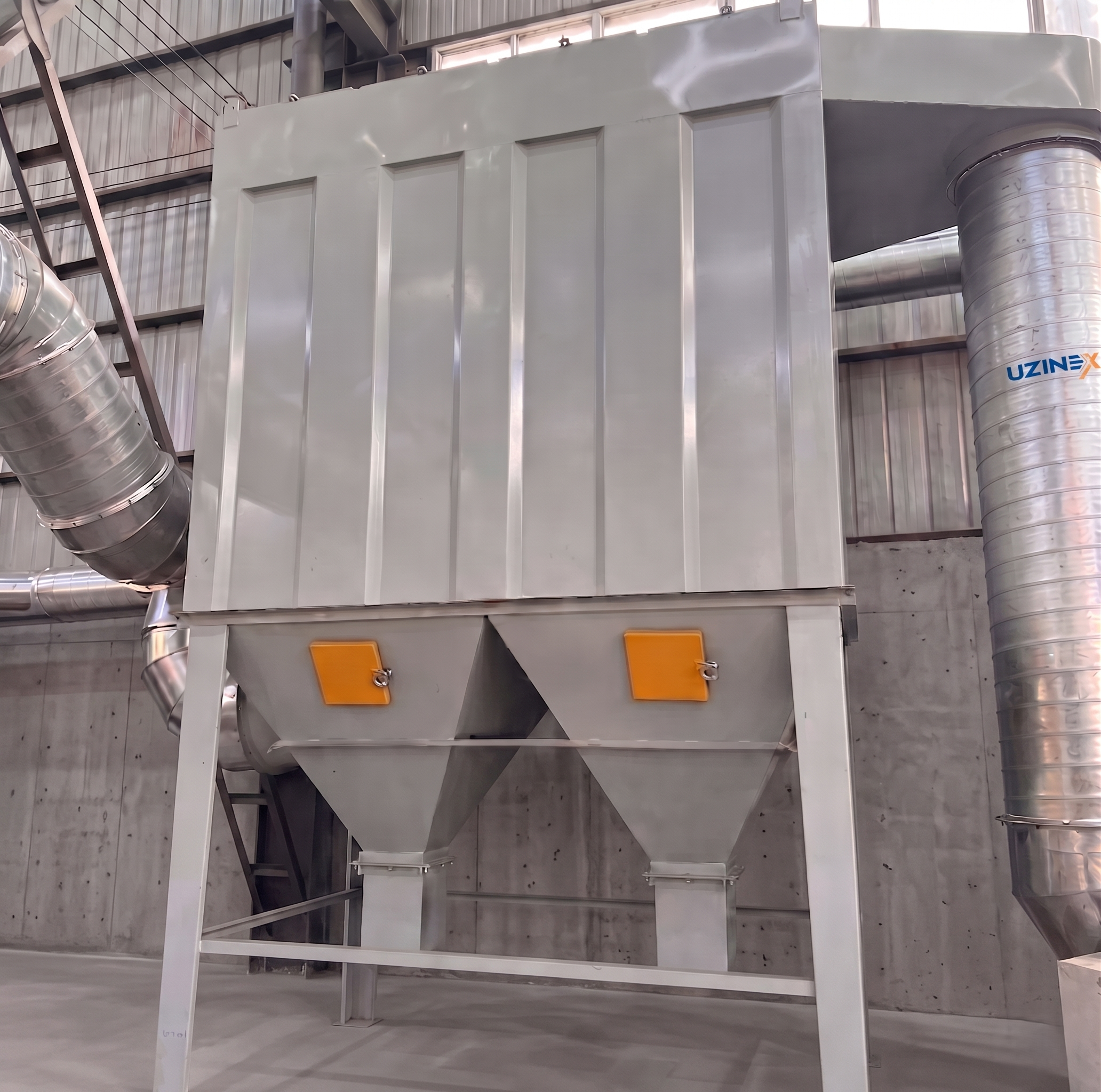
RELIABLE pulse dust collector for recycling — the environmental protection equipment with self-cleaning via compressed-air pulses for capturing the dust generated by shredders, crushers, separators and rotary screens in industrial recycling lines. Combining three simultaneous functions — compliance with environmental regulations, recovery of fine powders as a valorizable raw material, and keeping the workshop clean for personnel safety — this pulse dust collector for recycling is the infrastructure equipment without which no industrial recycling line can operate in compliance with European regulations on workplace air quality and atmospheric dust emissions.
Pulse technology fundamentally differentiates this equipment from conventional bag filters with manual or mechanical cleaning: periodic compressed-air pulses dislodge the dust accumulated on the surface of the bag filters directly into the collection hopper, keeping the filter's flow resistance constant and the extracted air flow uninterrupted throughout the shift — with no stops for manual cleaning, no progressive increase in differential pressure that reduces capture efficiency, and none of the frequent replacements of clogged filters typical of conventional non-pulse filters. Key Advantages of the RELIABLE Pulse Dust Collector for Recycling
• Triple role: environmental compliance + material recovery + personnel safety: The manufacturer explicitly documents the three simultaneous functions of this pulse dust collector for recycling . Compliance with European regulations (Directive 2004/37/EC on exposure to carcinogens, the OEL limits for inhalable dust, the national industrial air quality standards) eliminates the risk of sanctions and activity stoppages by the Labour Inspectorate and environmental authorities. Recovering fine plastic and metal powders as a raw material adds direct economic value to the collected fractions. Keeping the workshop clean protects the health of operators and prevents fires or explosions caused by fine metal dust.
• Continuous pulse self-cleaning — constant extracted flow with no stops: Periodic compressed-air pulses (controlled by a timer or a differential pressure sensor) dislodge the dust accumulated on the outer surface of the bag filters directly into the conical collection hopper. Cleaning is done row by row — one row of filters is cleaned while the others continue to filter, with no interruption of extraction. This keeps the extracted air flow constant and the filter's flow resistance stable throughout the shift, unlike conventional filters where the resistance increases progressively as clogging builds up.
• Recovery of fine plastic powder as a raw material: The fine plastic powder (below 0,1mm) generated by the WGD and LCP crushers and by the FX air separator in recycling lines is not waste — it is a raw material that can be valorized as filler powder in the plastic compounding industry, as granulation material, or as powder for producing plastic products by pressing. The conical hopper of this pulse dust collector for recycling collects these powders separately, available directly for valorization without additional cleaning or separation operations.
• Recovery of fine metal dust for re-refining: The metal dust (steel dust, aluminium powder, copper dust) generated by the D-series shredders and the WCD crushers in metal recycling lines is captured by the pulse collector and collected in the dedicated hopper. Fine aluminium and copper dust can be valorized directly at non-ferrous metal refineries as re-refining material — significant market value at current aluminium prices (1.800–2.200 €/t) and copper prices (7.000–8.000 €/t). Fine steel dust is valorized at iron smelters as a fine ferrous fraction.
• Preventing dust dispersion in the workshop — OHS compliance: The fine metal and plastic dust generated by recycling lines presents health risks for personnel (inhalation of fine PM2.5 and PM10 particles), fire risks (fine aluminium dust is flammable) and explosion risks (fine metal dust suspended in air at concentrations above the LEL). Efficient capture of dust at the source by this pulse dust collector for recycling reduces the concentration of airborne particles in the workshop air below the limits permitted by occupational safety and health regulations in Romania.
• Bag filters — high filtration efficiency for fine particles: The textile bag filters of the pulse collector capture fine particles below 1 micron with high efficiency — significantly superior to cyclone filters, which do not retain particles below 5–10 microns and discharge them into the atmosphere. For fine metal dust and plastic powder below 1mm, only pulse bag filters provide the complete capture required by European air quality regulations.
• Compatible with all equipment in the RELIABLE Uzinex range: The manufacturer explicitly documents compatibility with gravity separators and rotary screens (for the light dust of plastic, paper and sawdust) and with metal crushers and separators (for steel and aluminium dust). Each piece of equipment in the RELIABLE range generates specific dust during continuous operation — the pulse collector connects to the dusty-air discharge outlet or outlets of each piece of equipment.
• Conical collection hopper — gravity and continuous discharge of the collected dust: The steel conical hopper mounted under the bag filters collects the dust dislodged by the pulses and discharges it by gravity through the valve at the base of the cone — continuously or periodically, with no filter stops and no operator intervention for manual emptying at each cleaning cycle.
Specifications — RELIABLE Pulse Dust Collector for Recycling
| Filtration principle | Textile bag filters — high efficiency for fine particles below 1 micron |
|---|---|
| Self-cleaning principle | Pulse (periodic compressed-air pulses) — cleaning without stopping extraction |
| Cleaning control | Programmable timer or differential pressure sensor |
| Collected dust types | Fine plastic powder, steel dust, aluminium powder, copper dust, household waste, sawdust, paper, wood dust |
| Simultaneous functions | Environmental compliance + raw material recovery + workshop cleaning |
| Dust collection | Steel conical hopper — continuous or periodic gravity discharge |
| Main applications | Solid waste sorting line, metal recycling line, any RELIABLE line that generates dust |
| Associated RELIABLE equipment | FX air separator, rotary drum screen, D-series shredders, WCD/WGD/LCP crushers, magnetic separators |
| Compliance | Directive 2004/37/EC + national OEL industrial air quality standards |
| Customization | Number of filter compartments, extracted flow, hopper size — on request |
Documented Applications — Integration into RELIABLE Recycling Lines
A RELIABLE pulse dust collector for recycling is the environmental infrastructure equipment present in every industrial recycling line where dust generation is inevitable. In the solid waste sorting line, the pulse collector connects to the air outlets of the FX air separator and the rotary drum screen — both pieces of equipment use the air stream for classification and inevitably generate a dusty air stream at discharge. The collected dust — plastic powder, paper, sawdust and the fine organic fractions — is recovered from the conical hopper as a valorizable fraction or as material for thermal treatment.
In the metal recycling line, any pulse dust collector for recycling connects to the discharge outlets of the D-series shredders and the WCD and LCP crushers — equipment that generates fine steel, aluminium and copper dust at high operating speeds.
The fine metal dust collected in the conical hopper can be valorized directly at smelters and refineries without additional processing — as long as the capture system collects it with complete efficiency and separately from other types of dust in the hall. Explore the full range of Uzinex industrial equipment for integrated recycling solutions with complete dust collection systems.
WEEE and lithium battery recycling lines generate dust containing hazardous substances — lead, cadmium and cobalt dust from spent batteries, and FR4 dust (brominated epoxy) from PCBs — whose complete capture is mandatory under the specific hazardous waste management regulations. Systems of the pulse dust collector for recycling type with bag filters made of specific materials (PTFE, antistatic polyester) are the only certified solution for capturing fine hazardous dust at the concentrations imposed by European environmental regulations, in line with international standards for managing hazardous industrial waste . The Pulse Principle — How the Filter Self-Cleaning Works
The pulse mechanism is the innovation that turns a conventional bag filter into a continuous filtration system with no stops for maintenance. Understanding this mechanism explains why the pulse collector is superior to filters with manual or mechanical cleaning in industrial recycling applications with continuous dust generation:
• Normal filtration: The dusty air extracted from the recycling equipment passes from the outside of the bag filters through the textile material to the inside of the bags, where the dust is retained on the outer surface of the bags and the clean air is discharged into the atmosphere or recirculated into the hall. As dust accumulates on the surface of the bags, the flow resistance increases and the extracted air flow decreases.
• Clogging detection — differential pressure: The differential pressure sensor of this pulse dust collector for recycling measures the pressure difference between the dusty-air compartment and the clean-air compartment. When the differential pressure exceeds the set threshold (a sign that the accumulated dust is significantly reducing the flow), the pulse controller triggers cleaning.
• The compressed-air pulse — dislodging the dust: The solenoid valve of one row of filters opens instantly for 50–150 milliseconds, injecting a short, powerful compressed-air pulse into the inside of the bag in the reverse direction to the normal filtration direction. The reversed pressure wave dislodges the dust accumulated on the outer surface of the bag, which falls by gravity into the conical collection hopper.
• Sequential row-by-row cleaning: The pulse controller cleans the rows of filters sequentially — one row at a time — while the other rows continue to filter normally. This ensures a continuous extraction flow with no interruption, unlike conventional filters where the entire filtration surface is taken out of service simultaneously for cleaning.
How It Works — Dust Collection in the Recycling Line
• Connecting to the dust sources in the line: The pulse collector connects via extraction ducts to the dusty-air discharge outlets of each dust-generating piece of equipment in the line — shredders, crushers, air separators, rotary screens. The capacity of the extraction ducts is sized for the complete capture of dust at the maximum operating speed of each piece of equipment.
• Continuous extraction and filtration: The centrifugal fan of the pulse collector maintains the necessary suction in the extraction ducts, drawing the dusty air from the equipment sources through the connecting ducts and through the surface of the bag filters. The dust accumulates on the outer surface of the bags; the clean air exits through the collector's upper discharge.
• Automatic pulse cleaning during operation: The pulse controller sequentially activates the solenoid valves of the filter rows at programmed intervals or when the differential pressure threshold is reached. Each 50–150 ms pulse dislodges the dust of one filter row without interrupting the extraction of the other rows — filtration remains continuous throughout the cleaning.
• Dust collection in the conical hopper: The dust dislodged by the pulses falls by gravity into the conical hopper mounted under the filter compartment. The hopper accumulates the dust between emptyings — daily or weekly depending on the volume of dust generated by the line — and discharges it through the base valve directly into collection bags or into the transport system for the recovered fine fraction.
• Valorizing the collected dust: The collected dust is catalogued and valorized by fraction: the metal powder (aluminium, copper) goes to the refinery; the plastic powder goes to the granulation or composting lines; the hazardous dust (lead, cadmium from batteries, FR4 from PCBs) is handed over to authorized operators for hazardous waste management — each fraction treated in accordance with the specific regulations — a standard procedure for any well-integrated pulse dust collector for recycling.
Frequently Asked Questions about the RELIABLE Pulse Dust Collector for Recycling
Why is the pulse collector necessary if the FX air separator already has an air recirculation system?
The FX air separator recirculates the internal air to suspend the materials in the classification chamber, with an integrated filtration system for retaining coarse particles. Ultra-fine particles below 10–50 microns are not efficiently retained by the FX's internal filters and are discharged with the recirculated air or into the hall atmosphere. This pulse dust collector for recycling connects to the FX separator's air discharge and captures exactly these ultra-fine particles that escape the FX's internal filter — completing the capture chain to the efficiency required for compliance with emission regulations. Aluminium dust is flammable — is the pulse collector safe for this application?
Fine aluminium dust suspended in air at concentrations above 35–50 g/m³ is explosive (LEL) — this is a critical design requirement for any dust collector used on aluminium recycling lines. Pulse collectors for aluminium dust applications are configured with antistatic filters, explosion vents on the conical hopper and a rapid suppression triggering system upon detection of the hazardous concentration being exceeded. The UZINEX team evaluates the explosive dust risk when designing the line and recommends the appropriate safety configuration. How many pieces of equipment in the line can a single pulse collector serve?
A single pulse collector can serve several pieces of equipment simultaneously through the network of extraction ducts — correct sizing requires calculating the total flow of dusty air generated by all the connected equipment at maximum operating speeds. On lines with equipment distributed over large areas, several local pulse collectors positioned close to the major dust sources may be required, to minimize pressure losses in the long extraction ducts. The UZINEX team sizes the extraction system when designing the line. Must the bag filter still be replaced periodically even with pulse self-cleaning?
Yes — pulse cleaning keeps the flow resistance low and significantly extends the service life of the filters compared to non-pulse filters, but it does not eliminate periodic replacement. On abrasive materials (metal dust, mineral dust), the filter fibres wear mechanically from the repeated impact of the particles — the typical service life of a pulse filter bag ranges from 6 months to 2–3 years depending on the type and concentration of dust. Replacement bags for any RELIABLE pulse dust collector for recycling are delivered with priority from UZINEX's own stock under the 60-month warranty. How is the collector size required for the recycling line calculated?
Sizing the pulse collector is based on the total extracted air flow required (m³/h) and the dust concentration at the inlet (g/m³). The required flow is calculated from the capture speeds at the extraction inlets on each piece of equipment in the line (usually 15–25 m/s at the capture inlet). The UZINEX team performs the sizing calculation when designing the line and recommends the pulse collector model with the appropriate filtration area and fan flow for the complete capture of the dust generated by all the connected equipment. Why Buy the RELIABLE Pulse Dust Collector for Recycling from UZINEX?
• Free consultancy for sizing the dust capture system: The UZINEX team calculates the required extraction flow, sizes the pulse collector and designs the duct network for the complete capture of dust from all the equipment in the line — a correct configuration at the design stage eliminates undersizing that leaves dust in the workshop and oversizing that needlessly increases the investment cost.
• Documented compliance with European and Romanian regulations: The RELIABLE pulse collector is configured to achieve dust concentrations below the OEL limits imposed by Romanian legislation and European directives — compliance documentation available on request for Labour Inspectorate and environmental authority audits.
• Extended 60-month warranty and priority delivery of replacement filters: The 60-month warranty and UZINEX's own stock of replacement filter bags ensure the continuity of operation of the dust capture system — a recycling line cannot operate legally without an operational pulse collector.
• Direct ROI from valorizing the recovered metal dust: On lines with fine aluminium or copper dust, the dust collected in the conical hopper of this pulse dust collector for recycling is valorized directly at refineries — the revenue from the recovered metal dust can fully cover the operating cost of the capture system and contributes to the total ROI of the recycling line.
• Natively integrated with all RELIABLE equipment in the Uzinex range: The dimensions of the capture inlets, the dusty-air flows and the dust types generated by each RELIABLE piece of equipment are documented by UZINEX, allowing the capture system to be designed with precisely sized extraction ducts and installed as an integral part of the complete recycling line.
RELIABLE pulse dust collector for recycling — continuous pulse self-cleaning with no stops, bag filters with high efficiency for ultra-fine particles, conical hopper for the valorizable recovery of metal and plastic powders, a triple role documented as environmental compliance, raw material recovery and personnel safety, for any industrial recycling line that processes metals, plastic, WEEE or household waste and needs complete dust capture at the source.