
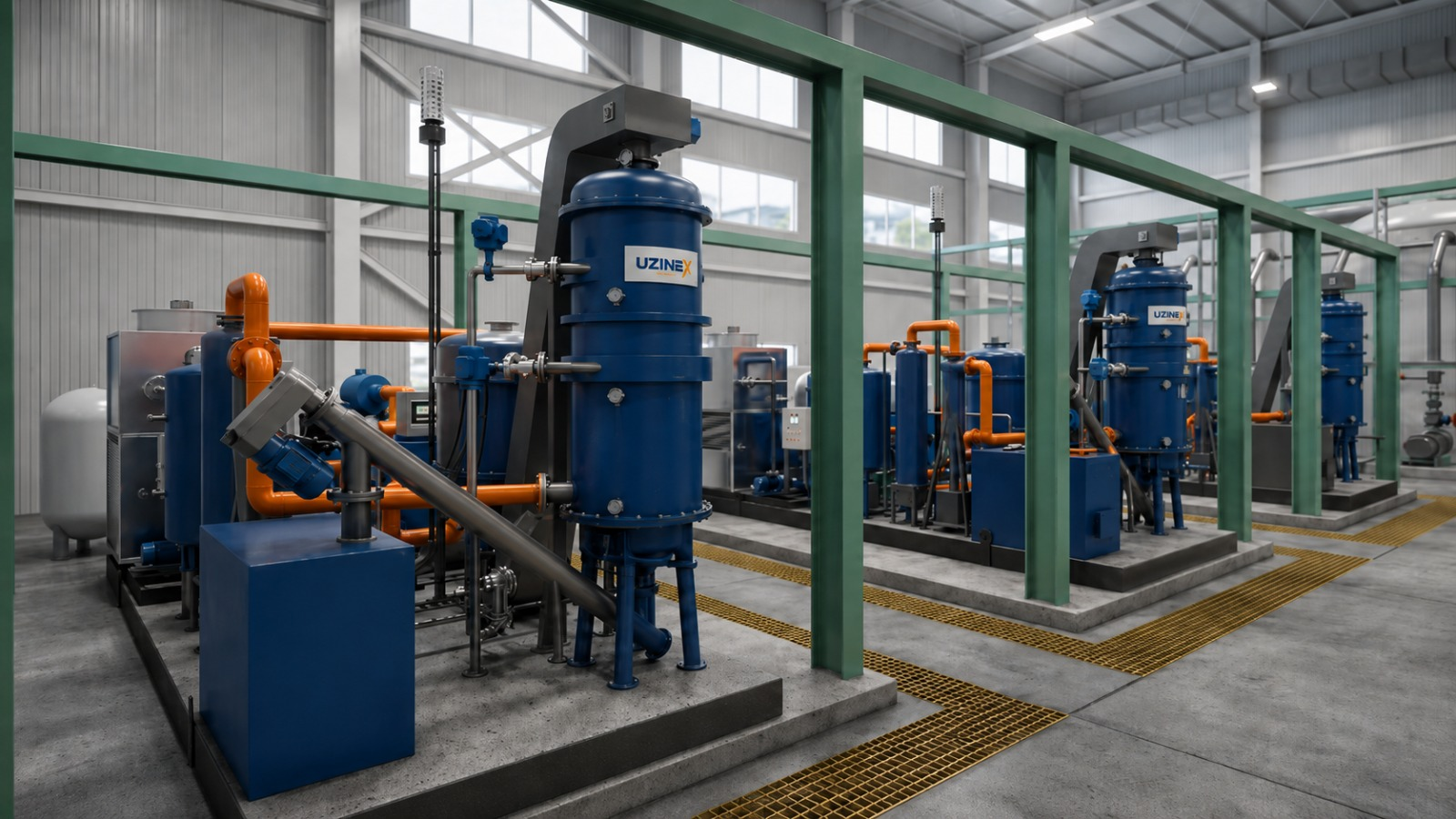
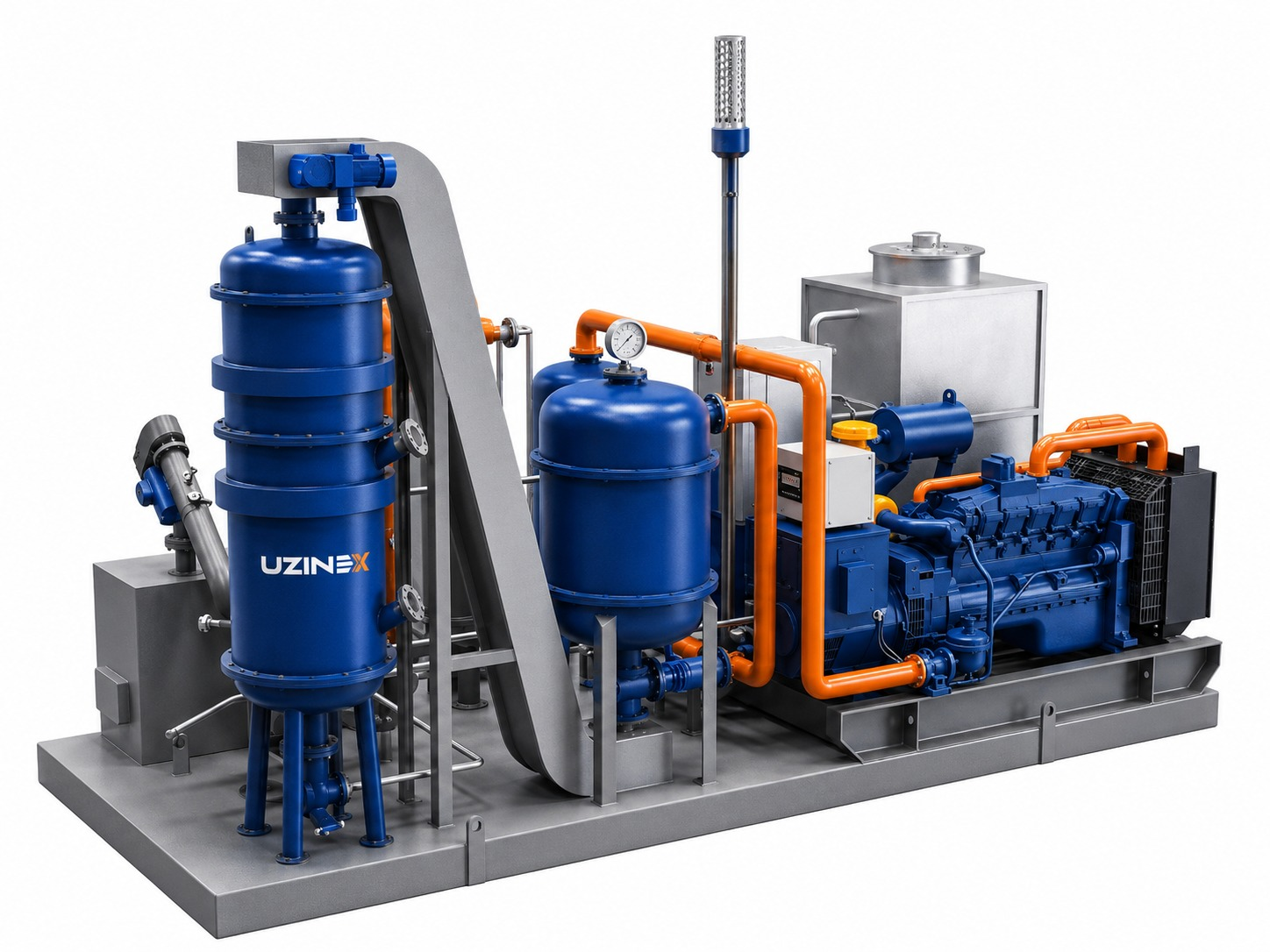
If you pay to dispose of agricultural or forestry waste and, at the same time, pay for grid electricity, a biomass gasification system from UZINEX (model GSP-50) removes both costs in a single investment. The 50 kW unit turns wood chips, pellets, nut shells and crop residues into continuous electrical power and heat, with a tar content below 20 mg/Nm³, safe for the gas engine.
Unlike direct combustion, this biomass gasification system produces clean syngas that feeds a gas generator set rather than a boiler. The whole unit ships 100% containerized and pre-assembled on a single steel skid, ready to run within hours. See where it fits across the UZINEX industrial equipment catalog, alongside our other energy lines.
Advantages of a Modular Biomass Power Plant
• Energy from waste, not disposal fees: the biomass gasification system converts 50–60 kg/h of wood and crop residues into a stable 50 kW of electrical power, turning a cost into a revenue stream.
• Tar below 20 mg/Nm³: two-stage purification with dynamic dry filters delivers clean gas that is safe for the engine, extends maintenance intervals and protects your investment.
• 100% containerized design: the full purification line, heat exchangers, the gas generator set and the PLC control cabinet are pre-integrated on one skid, ready to ship in standard containers.
• On-site assembly in ≤ 4 hours: bolt-on flange connections, no site welding; the gasifier body and flare pipe attach quickly, with no complex civil engineering.
• Flexible feedstock: runs on wood chips, pellets, nut and coconut shells or briquetted crop residues, so you use the cheapest, locally available fuel.
• Low operating cost: at roughly 1.2 kg/kWh, the low specific consumption and waste-derived fuel drive down the cost of every kilowatt produced.
• 24/7 operation: a daily demand of 1.2–1.4 tonnes of biomass sustains continuous generation, without frequent scheduled stops.
• Scalable in parallel. Add 50 kW modules to reach 200 kW, 500 kW or 1 MW, with built-in redundancy: if one unit goes into maintenance, the rest keep generating.
Technology: Two-Stage Gasification, Ultra-Low Tar
Large gasifiers often suffer from uneven temperature distribution and "cold spots" in the reaction chamber, the primary cause of high tar. The GSP-50 biomass gasification system optimizes the thermo-chemical reaction zone down to the millimeter: total uniformity means complete gasification and ultra-low tar levels that safeguard the gas engine.
The two-stage, down-draft, fixed-bed technology is inherited from proven 500 kW and 1 MW plants and enclosed in a standardized, factory-tested 50 kW block. Each unit operates at its peak thermodynamic efficiency, so stacking modules multiplies reliability rather than compromising it. The result is industrial-grade reliability with the precise control that only a compact system can achieve.
Technical Specifications: GSP-50 Biomass Gasification System
| Parameter | Value |
|---|---|
| Model | UZINEX GSP-50 |
| Rated electrical output | 50 kW (continuous, stable generation) |
| Electrical specifications | 400 V / 230 V, 3-phase 4-wire, 50 / 60 Hz |
| Gasification technology | Two-stage down-draft fixed-bed gasifier |
| Tar content after purification | 20 mg/Nm³ |
| Dust content after purification | 10 mg/Nm³ |
| Gas low heating value (LHV) | 4.5 – 5.5 MJ/Nm³ |
| Biomass consumption | 50 – 60 kg/h (approx. 1.2 kg/kWh) |
| Daily biomass demand | 1.2 – 1.4 t / 24 h (24H/7D operation) |
| Suitable feedstock | Wood chips, pellets, nut/coconut shells, briquetted crop residues |
| Optimum moisture content | 15% |
| Feedstock size range | 10 – 30 mm |
| On-site assembly time | ≤ 4 hours (bolt-on flange, no site welding) |
| Footprint (L × W × H) | approx. 6000 × 2000 × 2800 mm |
| Auxiliary power supply | 380 V / 50 Hz (or 460 V / 60 Hz), 3-phase |
| Construction | 100% containerized, pre-assembled on steel skid |
Applications for a Biomass Gasifier Power Plant
This biomass gasification system is the natural fit for rice mills, sawmills and farms that currently pay to dispose of husks, sawdust and crop residues. Instead of disposal costs, the same waste becomes on-site electricity and thermal energy. A single sawmill's offcuts can cover a meaningful share of its own electricity demand, while the recovered heat dries timber or product in the same workflow. To size the unit correctly for your load profile, the UZINEX team offers technological flow consulting before any quote.
For 200 kW, 500 kW or 1 MW requirements, instead of one massive, complex plant, several 50 kW modules are deployed in parallel and managed by a centralized control system. This biomass gasifier power plant configuration brings real redundancy: maintenance on one unit never stops the others. The solution aligns with the renewable-energy goals of Directive (EU) 2018/2001 (RED II).
In off-grid microgrids (resorts, islands, mining sites) the system replaces expensive, polluting diesel generators with a carbon-neutral alternative that integrates easily with solar PV and battery storage. The compact, skid-mounted design ships in standard containers, and as demand grows, additional modules are synchronized without any redesign.
The economics are straightforward: every tonne of residue fed into the biomass gasification system is a tonne you no longer pay to haul away, plus the diesel or grid power it displaces. For processing plants that expand, capacity scales without redesign: you simply slide in a second or third containerized unit as waste volume grows, with zero rework on the existing line.
Compatible Feedstock
A well-fed biomass gasification system depends on the right fuel. The unit accepts a wide range of woody and agricultural biomass, provided the size and moisture stay within the optimum range, exactly the window the anti-jamming feeding system is matched to. The values below are indicative and confirmed at quotation, based on the feedstock available locally.
| Feedstock | Recommendation |
|---|---|
| Wood chips | Yes, size 10 – 30 mm |
| Wood pellets | Yes |
| Nut / coconut shells | Yes |
| Crop residues | Yes, briquetted |
| Fuel moisture | ≤ 15% (optimum for gas quality) |
How a Biomass Gasification System Works
The flow, from raw material to electricity, is continuous and automated:
1. Biomass (10–30 mm, ~15% moisture) is loaded through the anti-jamming feeding system.
2. In the two-stage down-draft reactor, the material is dried, pyrolyzed, oxidized and reduced, producing low-tar syngas.
3. The gas passes through dynamic dry filters and heat exchangers, reaching below 20 mg/Nm³ tar and 10 mg/Nm³ dust.
4. The clean gas feeds the 50 kW generator set, delivering 400 / 230 V three-phase power at grid frequency.
5. Residual ash is collected in the ash pit for simple disposal.
6. When needed, several modules couple in parallel for 200 kW, 500 kW or 1 MW.
Because this biomass gasification system is standardized and factory-tested, a new operator quickly reaches consistent results, and restarting an operating regime requires no complicated adjustments.
Frequently Asked Questions
What fuel can a biomass gasification system use?
Wood chips, pellets, nut and coconut shells or briquetted crop residues, with a size of 10–30 mm and moisture up to 15%. In practice, you use the cheapest, locally available feedstock, which lowers the cost per kWh.
How much biomass does it consume per day?
For 50 kW in continuous operation, the demand is 1.2–1.4 tonnes of biomass per 24 hours, at a specific consumption of about 1.2 kg/kWh. The exact figure depends on the fuel type and moisture.
How long does installation and commissioning take?
Thanks to the containerized design, on-site assembly takes under 4 hours, using bolt-on flanges with no welding. At UZINEX, transport, assembly, commissioning and operator training are included and carried out by a team based in Romania.
Can I scale power above 50 kW?
Yes. The system is modular: you connect several 50 kW units in parallel to reach 200 kW, 500 kW or 1 MW. This biomass gas generator setup also adds redundancy, because maintenance on one unit does not stop the rest of the plant.
Does the system also produce thermal energy, not just electricity?
Yes. Beyond the 50 kW of electricity, the hot gas and exhaust can be recovered through the heat exchangers for hot water or drying processes, especially useful in rice mills and sawmills, where the heat dries the feedstock itself.
What maintenance does a biomass gasification system require?
Routine maintenance involves ash removal, checking the dry filters and servicing the generator set. Because the gas reaches the engine with tar below 20 mg/Nm³, engine service intervals are longer and unplanned downtime drops. A clean syngas stream also keeps the heat exchangers and filters efficient between service cycles.
Is the equipment eligible for EU-funded projects?
Yes. We provide complete technical documentation for programs such as PNRR and POR and support the SEAP/SICAP upload. On request, we supply the datasheet and certifications required for the investment file.
Why UZINEX?
• Experienced industrial integrator: over 30 years of combined experience and a technical base at Tehnopolis Iași, dedicated to industrial equipment and energy lines.
• 36-month warranty: extended coverage on equipment built for continuous, 24/7 industrial operation.
• Full installation included: transport, assembly, commissioning and operator training, delivered by a team based in Romania, with no hidden costs.
• Long-term support: spare parts in stock in Iași, national technical support within 24–48 hours and secure remote diagnostics.
• EU-funding ready: technical documentation for PNRR, POR and other active programs, plus SEAP/SICAP support.
• Technical consulting: we size the biomass gasification system to your load profile and available feedstock before quoting. See our technical support and service.
From agricultural waste to kilowatts delivered to the grid, the GSP-50 biomass gasification system turns a disposal cost into your own energy source: containerized, modular and ready to run within hours.