
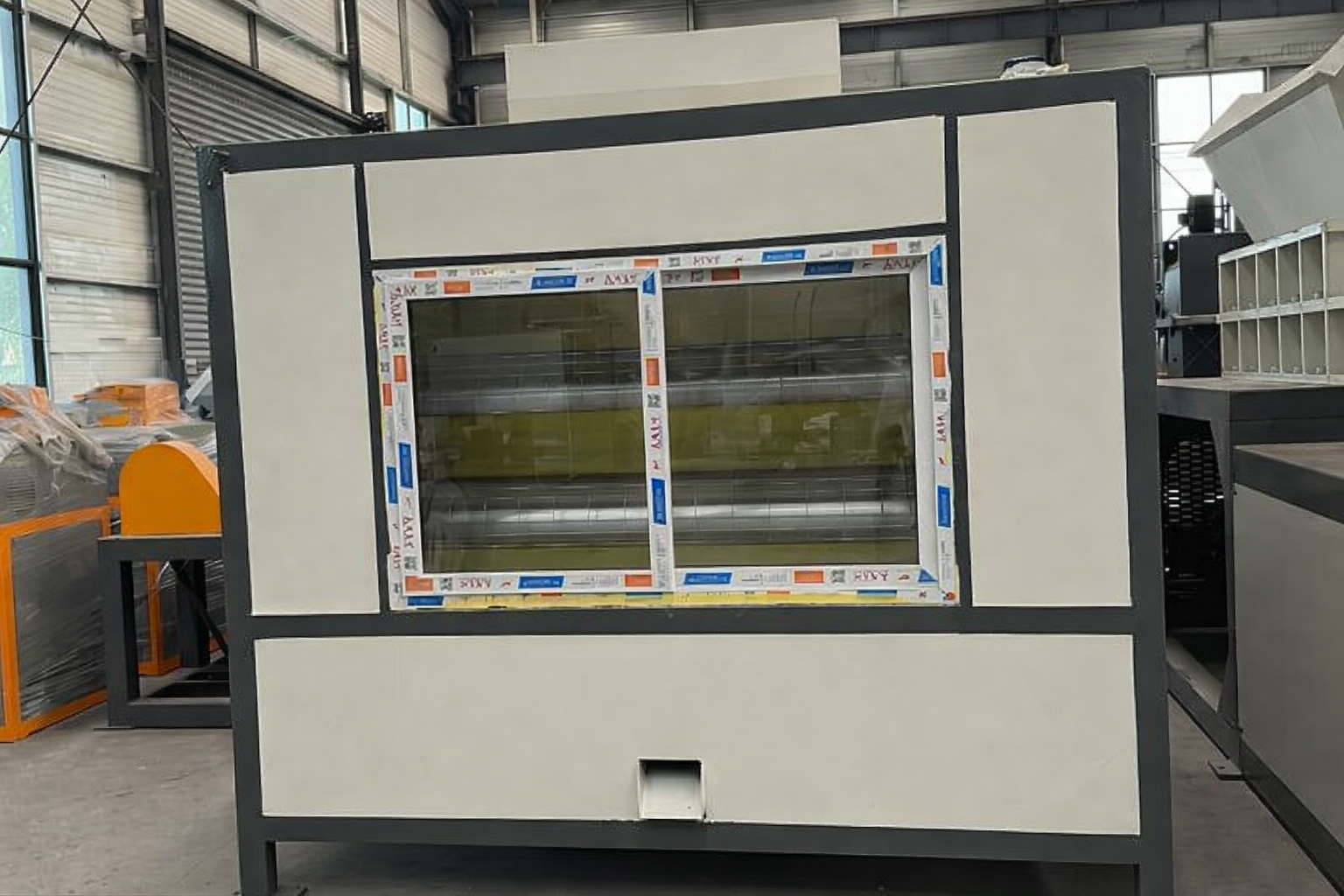
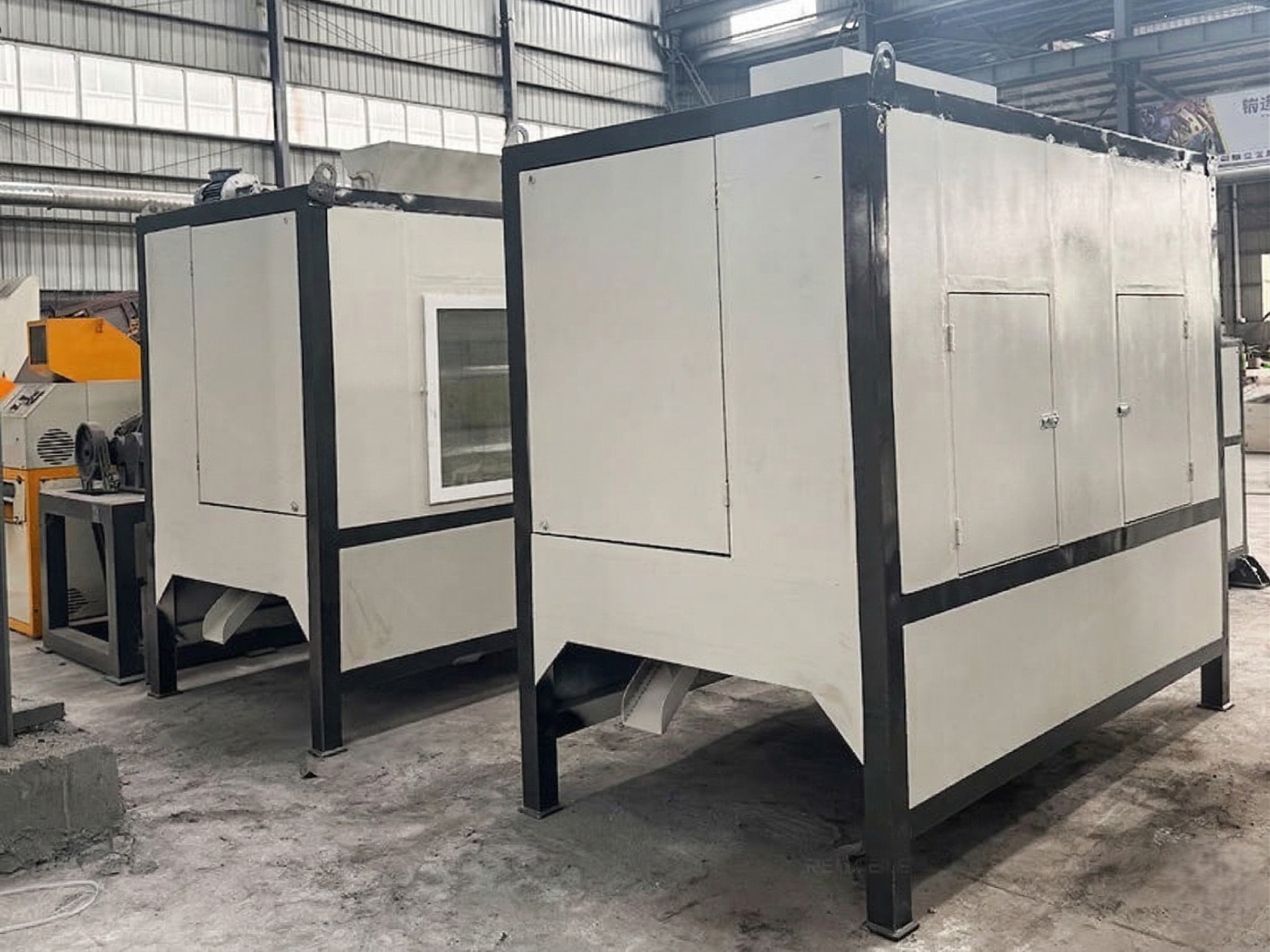
RELIABLE DF-series electrostatic recycling separator — high-voltage electric-field separation equipment for the precise sorting of metals and non-metals from fine mixtures of 0,04–1mm with a recovery rate of 99% and impurities under 1%. Available in four models — DF1500-I, DF1500-II, DF2000-I and DF2000-II — with two-stage (dual stage) separation for maximum purity, this electrostatic recycling separator separates, by differences in electrical conductivity, materials that cannot be separated by mechanical, magnetic or gravity means: aluminium from plastic, copper from PCBs, titanium from machining waste and metals from pharmaceutical composite foils.
The operating principle of this electrostatic recycling separator is purely physical — the high-voltage electric field charges particles differently according to their conductivity, producing distinct movement trajectories for conductive materials (metals) and non-conductive materials (plastics, rubber). No chemical reaction, no reagent, no water — dry separation keeps the chemical and physical properties of the recovered materials intact, producing metal and plastic fractions directly saleable without additional purification treatments. Key Advantages of the RELIABLE Electrostatic Recycling Separator
• Recovery rate 99% — impurities under 1%: RELIABLE's optimised design and extensive research have produced an electrostatic recycling separator with a recovery rate of 99% — the top standard for this technology. Impurities under 1% in the recovered metal fraction allow direct sale on the secondary metals market without additional sorting or purification. For materials with a valuable content of copper, gold or silver from PCBs, every extra percentage point of recovery translates directly into additional revenue per tonne processed.
• 2-stage (dual stage) separation — maximum purity impossible to achieve in a single stage: The DF series supports separation in two consecutive stages: the first stage roughly separates metal from plastic; the second stage reprocesses the intermediate fraction (materials that could not be clearly classified in the first stage) for additional purity. The -II variants (DF1500-II, DF2000-II) are explicitly configured for dual stage — 99% purity is not achievable in a single stage with other equipment.
• Dry separation — no water, no chemical reagents: The electrostatic process is completely dry — no drop of water, no acid, no base, no solvent. This eliminates the cost of wastewater treatment, reduces the environmental footprint of the recycling line and keeps the properties of the recovered materials identical to those of virgin materials — essential for copper and aluminium that must meet the purity standards of suppliers in the electronics and automotive industries.
• Particle range 0,04–1mm — ultra-fine separation impossible by mechanical means: The high-voltage electrostatic field operates efficiently on particles 0,04mm (40 micrometres) in size — below the limit of any mechanical or gravity separator. This allows the separation of copper dust from plastic dust in PCB granulate, aluminium powder from plastic powder in aluminium-plastic panels and metal particles from precision components that are impossible to separate otherwise.
• Applicable to 7 material categories — from PCB to titanium chips: The DF series processes an exceptionally varied range: aluminium powder, aluminium-plastic foils, aluminium-plastic panels, copper-plastic mixtures, electronic waste (WEEE), pharmaceutical trays (blister packs with aluminium and plastic) and titanium chips from aerospace machining. This material diversity makes the DF electrostatic recycling separator an investment that can be put to use across multiple waste streams simultaneously.
• Purely physical process — material properties remain intact: The high-voltage electric field does not alter the chemical structure, composition or physical properties of the separated materials. Copper recovered from PCBs has the same purity and conductivity as virgin copper; aluminium from aluminium-plastic panels is chemically identical to primary aluminium — saleable at the market prices of primary materials, not at the discount specific to recycled materials with residual impurities.
• Compatible with all RELIABLE crushers and shredders: The DF series receives the 0,04–1mm particles produced by RELIABLE crushing lines — the fine granules from the LCP vertical crusher, the metal dust from the WGD plastic crusher or the fine particles from copper granulators — integrating natively into the complete RELIABLE recycling lines distributed by UZINEX.
• 4 scalable models: DF1500-I/II and DF2000-II/II: The -I models are single-stage configurations for simpler separations or as a first stage; the -II models are dual-stage configurations for maximum-purity separation. The 1500mm and 2000mm widths of the separation roller determine the processing capacity — DF2000-II for high-volume industrial lines, DF1500-I as an entry point for small and medium operations.
Specifications — RELIABLE DF Electrostatic Recycling Separator
| Available models | DF1500-I / DF1500-II / DF2000-I / DF2000-II |
|---|---|
| Separation principle | High-voltage electric field — conductivity differences |
| Separation stages | Single stage (-I) or dual stage (-II) |
| Recovery rate | ≥99% |
| Output impurities | Under 1% |
| Particle range | 0,04–1 mm (40 micrometres – 1 millimetre) |
| Separation type | Dry separation — no water, no chemical reagents |
| Processable materials | Aluminium powder, aluminium-plastic foils, aluminium-plastic panels, copper-plastic mixtures, WEEE, pharmaceutical trays (blister), titanium chips, granulated PCBs |
| Prerequisite | Material pre-crushed to 0,04–1mm (does not accept material >1mm) |
| Customisation | Available on request |
The Physical Principle — How the Electrostatic Separator Works
Understanding the physical principle of this electrostatic recycling separator is essential for correctly configuring the line and for anticipating the separation results:
• Differential electrostatic charging: The mixture of fine particles (0,04–1mm) is fed uniformly onto the separator's rotating roller, which is connected to the high-voltage source. Conductive particles (metals — copper, aluminium, titanium) discharge rapidly and fall by gravity off the roller, following the trajectory determined by gravity and centrifugal force. Non-conductive particles (plastics, rubber, glass) retain the electric charge and are attracted to the oppositely polarised roller, adhering to its surface until detached by the cleaning brush.
• Separation in the transition zone: Particles with intermediate conductivity — semiconductive or with contaminated surfaces — follow intermediate trajectories between the metal fraction and the plastic fraction, collected in the middle zone of the separator. This is the fraction that feeds the second separation stage in the dual-stage (-II) configurations, for additional recovery of metal and plastic from the mixed fractions.
• The dual-stage effect: The first stage separates roughly; the second stage reprocesses the intermediate fraction from the first stage. The combination produces a total purity of 99% that is impossible to achieve with a single stage on materials with a wide conductivity distribution (such as PCBs with variable metal composition).
Applications — Where the DF Electrostatic Recycling Separator Is Used
A DF-series electrostatic recycling separator is the final high-precision separation stage in PCB and electrical cable recycling lines. The 0,04–1mm PCB granulate produced by fine crushers contains a mixture of copper dust, glass-fibre dust, epoxy-resin powder and particles of other metals (gold, silver, palladium) in varying proportions — a mixture impossible to separate by magnetic or gravity means. The DF's high-voltage electrostatic field separates the conductive metals from the non-conductive non-metals with 99% precision, producing metal dust that can be delivered directly to precious-metal refineries.
Pharmaceutical packaging manufacturers and blister recycling operators (the aluminium-plastic trays from medicine packaging) use this electrostatic recycling separator as the only viable method of recovering high-purity pharmaceutical aluminium from the aluminium-PVC mixture after the packaging has been crushed. Dry separation keeps the purity of the recovered aluminium at pharmaceutical-industry and food-packaging standards — standards impossible to meet with wet chemical separation. Explore the full range of Uzinex industrial equipment for integrated recycling and separation solutions.
The aerospace industry and titanium CNC machining workshops use DF-type electrostatic recycling separator systems to recover titanium chips and powder from machining waste — material with a market value of €15–30/kg that is impossible to recover by mechanical filtration or gravity sedimentation at sizes of 0,04–1mm. The dry electrostatic process does not contaminate the recovered titanium with water or reagents, keeping the purity required for reintroduction into the aerospace production process, in line with international standards for material recycling. The RELIABLE Separators — Complete Selection Guide
The RELIABLE range of separators available from Uzinex includes four types with completely different physical principles — the correct choice depends on the material and the particle size to be processed:
• DF electrostatic separator (electrical conductivity): Particles 0,04–1mm. For metals + non-metals: copper + plastic, aluminium + plastic, granulated PCB, titanium chips. 99% purity via dual stage. Does not separate metals from each other — it separates metals from non-metals.
• Eddy-current separator (variable magnetic field): For non-ferrous metals (aluminium, copper, zinc) from mixtures with non-magnetic materials or with plastic. Particles 5–100mm. Applications: the non-ferrous fraction from radiator crushing, aluminium from WEEE.
• Gravity separator (density): Separates materials of different density through a controlled air stream. Particles 0,1–10mm. Applications: separating rubber from steel wire in tyre granulate, separating materials of similar particle size but different density.
• Air separator (air classification): Separates light particles from heavy ones through an air stream. Applications: removing dust and light fractions from metal granulate, primary cleaning of mixtures.
Operating Mode — The Electrostatic Separation Process with the DF
• Preparing and feeding the pre-crushed material: The material must be pre-crushed to a particle size of 0,04–1mm before feeding — an essential condition for the electrostatic field to work. Material larger than 1mm is not processed efficiently. Feeding is done via a vibratory belt for uniform distribution across the full width of the separator roller (1500mm or 2000mm).
• Activating the high-voltage electric field: The high-voltage source activates the electric field on the rotating roller. The field intensity is adjusted according to the type of material and the conductivity difference between the components to be separated — finer adjustment is needed for materials of similar conductivity (e.g. aluminium alloys vs. some conductive polymers).
• Separation along differential trajectories: Through the action of this electrostatic recycling separator, the conductive particles (metals) discharge instantly onto the earthed roller and follow the trajectory determined by gravity and centrifugal force, falling into the metal collector. The non-conductive particles (plastics) retain their charge and adhere to the roller until mechanically detached by the brush, falling into the plastic collector.
• Collecting the intermediate fraction and the second stage: Particles with intermediate conductivity are collected separately and, in the dual-stage (-II) configurations, are fed into the second separation stage for maximum recovery from the mixed fraction. The combined result of the two stages reaches 99% purity.
• Adjusting parameters for maximum purity: The operator monitors the purity of the collected fractions and adjusts the electric-field intensity, the roller speed and the deflector angle for continuous optimisation. The control system allows the fine adjustments needed for materials with composition variations between batches.
Frequently Asked Questions about the RELIABLE DF Electrostatic Recycling Separator
How does it differ from the eddy-current separator for separating non-ferrous metals?
The eddy-current separator separates non-ferrous metals (aluminium, copper) from non-magnetic materials and works on particles of 5–100mm — suitable for crushed radiators or WEEE. This DF electrostatic recycling separator operates on ultra-fine particles of 0,04–1mm and separates metals from non-metals (not metals from each other), by electrical conductivity — suitable for PCB granulate, titanium chips or aluminium from pharmaceutical blisters that the eddy-current separator cannot process at this particle size. Must the material be dry before separation?
Yes — the material must be dry before feeding into the electrostatic separator. Surface moisture on the particles reduces the apparent conductivity of the metals and increases the apparent conductivity of the plastic, disrupting separation and reducing the purity of the fractions. Recycling lines that produce wet (washed) granulate include a thermal dryer or an air-drying stage before the electrostatic separator. Can the DF separate several metals from each other — aluminium from copper, for example?
Not directly — the electrostatic field separates conductors from non-conductors, not conductors from each other. Aluminium and copper are both good conductors and will fall into the same metal fraction. To separate non-ferrous metals from each other (aluminium from copper), a separate stage with the eddy-current separator or gravity (density) separation is needed, used in conjunction with the DF electrostatic separator in complete recycling lines. The 0,04–1mm particle range — how is this particle size achieved?
The 0,04–1mm particle size is obtained through successive fine crushing — the LCP vertical crusher or the WGD plastic crusher produce 1–10mm particles, and the mills or fine granulators produce the sub-1mm particle size required by the electrostatic separator. The UZINEX team can design the complete crushing and separation line with all the stages needed for your specific material, from the input size to the pure output fractions. What is the profitability of an electrostatic separator for PCB recycling?
PCBs contain precious metals — copper (15–30%), gold (50–350 g/tonne), silver (150–1000 g/tonne) and palladium. At current market prices (copper ~€8,000/t, gold ~€60,000/kg), every additional percentage point of recovery from 1 tonne of PCB is worth several hundred to thousands of euros. The 10–15% recovery difference brought by a dual-stage electrostatic recycling separator over equipment without this function translates directly into the return on the electrostatic-separator investment in the short term — a calculation available from the UZINEX team for your specific volumes. Why Buy the RELIABLE Electrostatic Recycling Separator from UZINEX?
• Free consultation for model selection and field configuration: The UZINEX team analyses the material to be separated, the particle size, the conductivities of the components and the required output purity, and recommends the DF model of this electrostatic recycling separator with the configuration (single or dual stage) that maximises recovery for your specific application.
• Delivery, commissioning and electric-field calibration included: Every DF electrostatic recycling separator delivered through UZINEX includes complete installation, calibration of the field intensity for the specific material and operator training for adjusting parameters across different material batches.
• Extended 60-month warranty and technical support under 36 hours: The 60-month warranty and the guaranteed response time under 36 hours ensure the continuity of the separation line — with priority delivery of wear components and remote technical support for optimising the electric field on new materials.
• Integrated into the complete RELIABLE ecosystem from UZINEX: The DF separator connects natively with the LCP vertical crushers and the copper granulators from the RELIABLE range distributed by UZINEX, allowing the design of the complete line from raw waste through to pure metal and plastic fractions, with single-source support for the entire investment.
• Quantifiable ROI through superior precious-metal recovery: For PCBs with gold and copper content, the additional recovery of a few percentage points through dual-stage DF translates into hundreds of thousands of euros per year at industrial volumes — a documentable financial argument to justify the investment to financiers or the board.
RELIABLE DF1500-I/II/2000-I/II electrostatic recycling separator — high-voltage electric field, dry separation without reagents, dual stage with 99% purity and impurities under 1%, for the ultra-fine particles of 0,04–1mm in PCB granulate, aluminium-plastic foils, copper-plastic mixtures, pharmaceutical trays and titanium chips, where no other separation method achieves this combination of purity and particle size.