
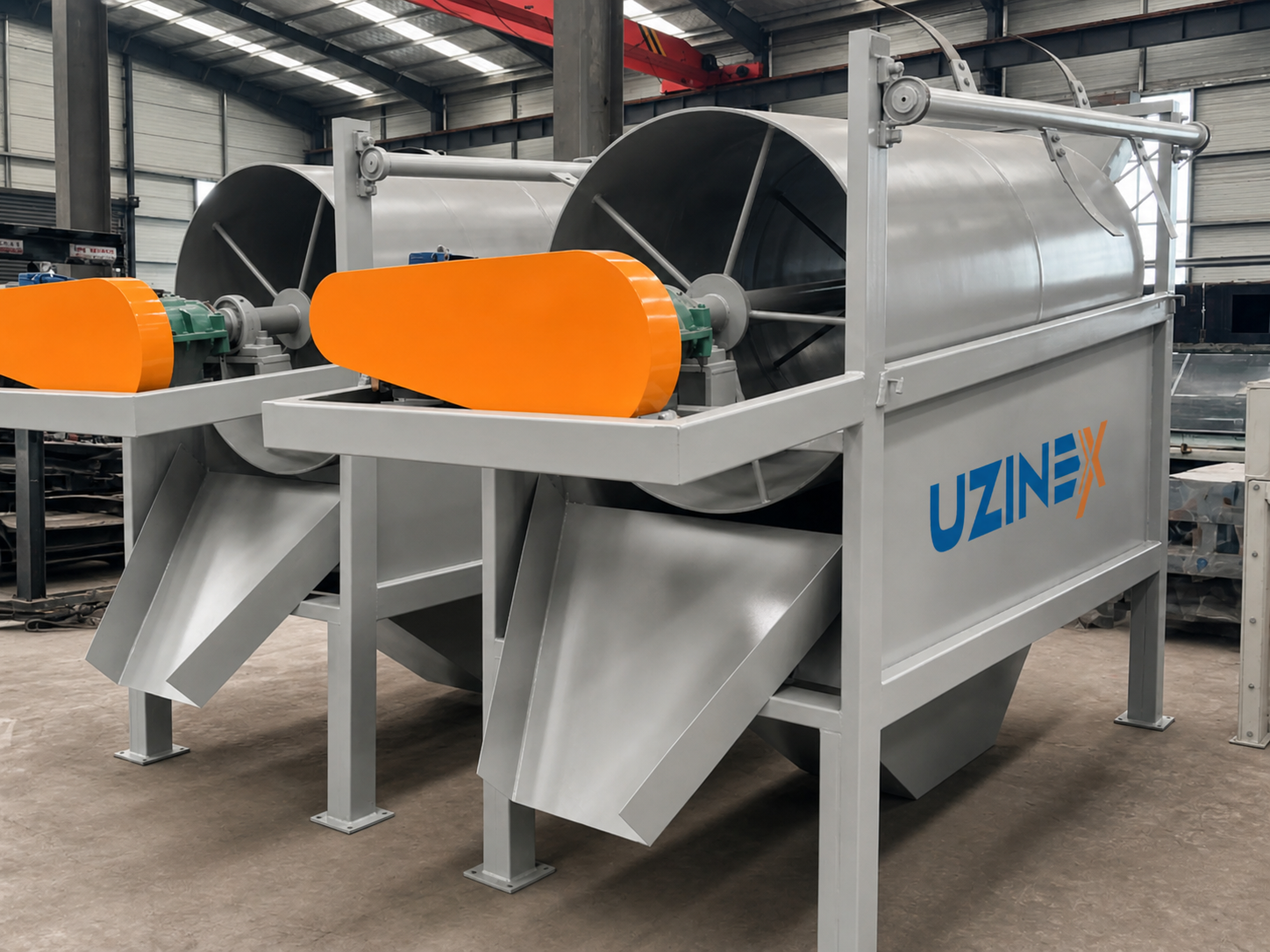
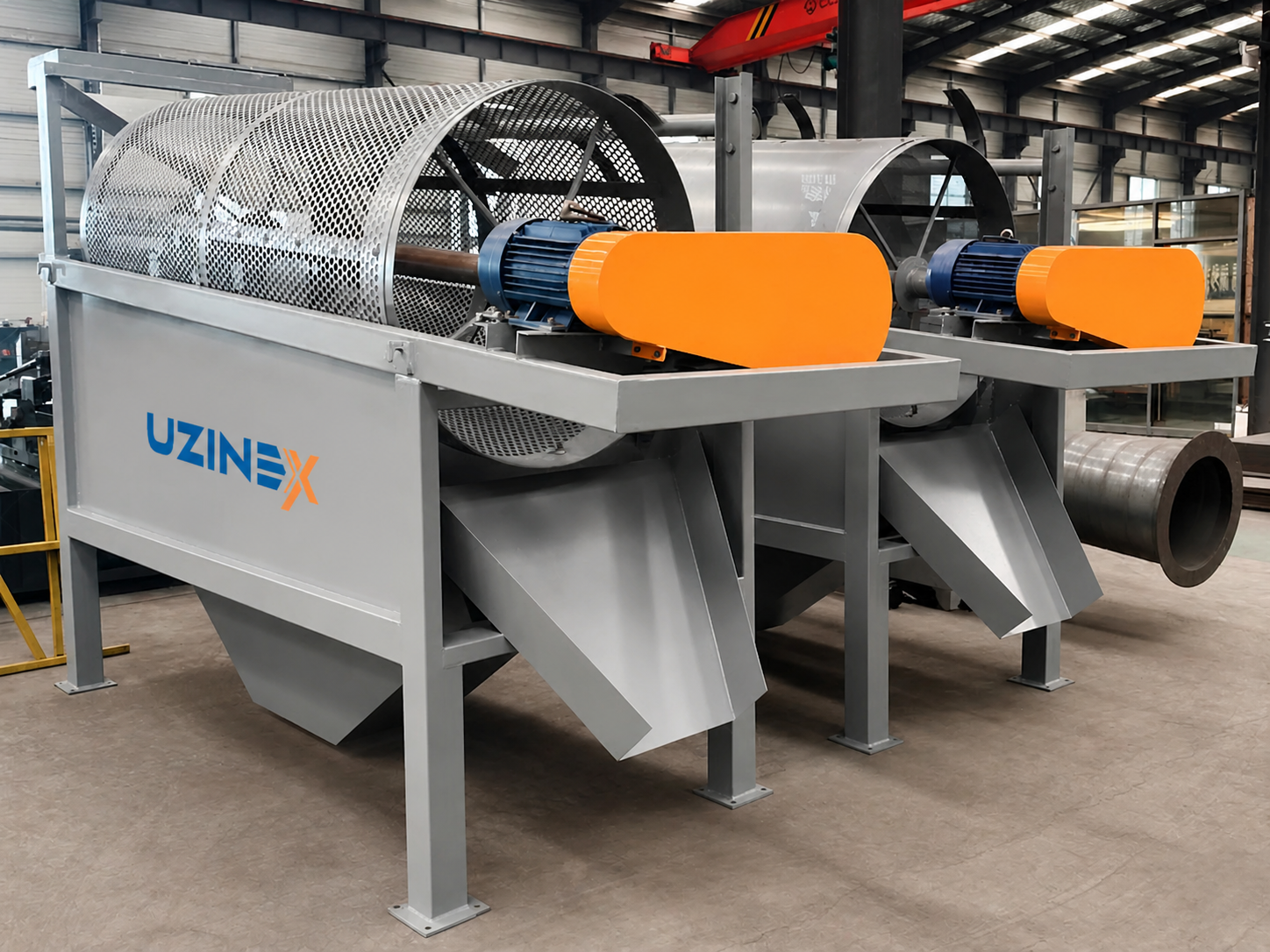
RELIABLE rotary trommel sorting screen — particle-size classification equipment using cylindrical rotation to sort materials according to particle size in the power-plant, coking-plant, metallurgy, chemical, construction-materials and mining industries. Unlike circular vibrating screens and linear screens, which clog on wet or sticky materials, this rotary trommel sorting screen permanently solves the problem of mesh clogging through the continuous rotation of the cylindrical drum, which self-cleans the screen surface on each rotation and ensures an uninterrupted flow of classified material throughout the shift without unclogging interventions.
The simple construction — electric motor, gearbox, perforated cylindrical drum assembly and frame — makes this rotary trommel sorting screen the equipment with the lowest number of moving components and the lowest maintenance complexity in the entire RELIABLE range. The specially designed screen has a long service life, is replaced quickly without special tools and locks precisely at the selected aperture — characteristics that minimise downtime and the cost of ownership over the entire service life of the equipment. Key Advantages of the RELIABLE Rotary Trommel Sorting Screen
• Zero clogging on wet materials — the defining advantage over vibrating screens: Circular vibrating screens and linear screens clog progressively when the material has high moisture or a clay content — wet particles adhere to the screen surface and block the mesh, reducing productivity and requiring periodic stoppages for cleaning. The continuous rotation of the drum of this rotary trommel sorting screen self-cleans the screen surface through the movement of the material against the mesh on each rotation, eliminating clogging as an operational problem even with materials of 20–30% moisture or with a significant content of sticky fine fractions.
• Simple 4-component structure — maximum reliability, minimal maintenance: The assembly of this rotary trommel sorting screen consists of: an electric motor, a gearbox, a perforated drum assembly and a support frame. No eccentric mechanism, no damping springs, no unbalancing shafts specific to vibrating screens — every component eliminated is a source of failure eliminated. The operational reliability of the rotary drum is significantly superior to that of vibrating screens, where the springs and eccentric shafts are the main causes of unplanned stoppages.
• Specially designed screen — long service life and precise aperture: The drum's perforated screen is manufactured from materials resistant to the abrasive wear specific to heavy industrial materials (coal, ore, aggregate, coke) and designed with optimised hole geometry for self-cleaning during rotation. The aperture is locked quickly without special tools, with constant dimensional precision across the entire drum surface — uniform particle-size classification at the outlet without variations linked to uneven screen wear.
• Fast screen replacement — minimal downtime: The drum design allows direct access to the screen surface and the replacement of the screen assembly without removing the gearbox or the motor. When the screen wears or the aperture is changed for a different particle-size fraction, the operator replaces the screen quickly, re-locks the aperture and restarts production — a significantly shorter interruption than replacing the screen on vibrating equipment with a suspended mechanism.
• Sorting by particle size — precise particle-size classification: The operating principle of the rotary drum ensures that each particle in the processed material is exposed to the screen holes multiple times during its passage through the drum — far more than on a vibrating screen with a single pass. This produces a more complete and more precise particle-size classification, with a smaller fraction of large particles "escaping" through the holes or of small particles remaining in the coarse fraction.
• High efficiency at low cost — superior value-for-money: This rotary trommel sorting screen combines high sorting efficiency with the low acquisition and operating cost of the simple structure. The absence of complex vibration mechanisms, damping springs and dynamic balancing systems reduces both the acquisition price and the cost of spare parts compared with vibrating screens of equivalent capacity.
• Applicable in 6 heavy industries: The power-plant industry (classifying coal and slag), coking plants (sorting coke), the construction-materials industry (sand, gravel, aggregate), metallurgy (ores, metallurgical slags), the chemical industry (chemical granules, salts) and mining (sorting raw ore) use the rotary drum as the standard particle-size classification solution for the large volumes and the materials of variable moisture specific to these industries.
• Low noise level compared with vibrating screens: The slow, uniform rotation of the drum generates a significantly lower noise level than the high-frequency vibrations of vibrating screens — a direct advantage for compliance with workplace noise standards in industrial halls and for integration into production lines with permanent personnel near the equipment.
Specifications — RELIABLE Rotary Trommel Sorting Screen
| Operating principle | Rotating cylindrical drum — particle-size classification through continuous rotation |
|---|---|
| Main components | Electric motor + gearbox + perforated drum assembly + support frame |
| Screen | Specially designed — wear-resistant, long service life |
| Screen aperture | Fast locking, configurable to the required particle-size fraction |
| Screen replacement | Fast — no special tools, no removal of motor or gearbox |
| Advantage over vibrating screens | Zero clogging on wet materials, low noise, simpler structure |
| Processable materials | Coal, coke, ore, sand, gravel, aggregate, metallurgical slags, chemical granules, construction material |
| Applicable industries | Power plants, coking plants, metallurgy, chemicals, construction materials, mining |
| Noise level | Low compared with vibrating screens — slow uniform rotation |
| Customisation | Available — drum dimensions and screen aperture on request |
Rotary Screen vs. Vibrating Screen — Direct Comparison for the Correct Selection
The choice between the rotary trommel screen and the vibrating screen depends on the material characteristics and the specific operational requirements of the sorting line:
• Wet material or material with a clay content: The vibrating screen clogs progressively — the rotary trommel screen does not clog. This is the conclusion that makes this rotary trommel sorting screen the choice documented by RELIABLE and confirmed by operators where moisture is variable or high (mines, quarries, wet household-waste sorting stations).
• Dry and uniform material: The vibrating screen has a higher sorting efficiency per square metre of surface than the drum — for completely dry and uniform materials, the vibrating screen may be more suitable if space is limited and the material presents no clogging risk.
• Reliability and maintenance: The rotary drum wins decisively — the 4-component structure without damping springs or unbalancing mechanisms has a significantly lower unplanned-failure rate than vibrating screens with complex mechanisms.
• Operational noise: The rotary drum wins — a low noise level compared with high-frequency vibrations, compatible with industrial noise standards without additional shielding in most installations.
• Space occupied: The rotary drum requires more length than a vibrating screen of the same capacity — a relevant consideration for halls with limited space.
Applications — The Industries That Use the Rotary Trommel Sorting Screen
A RELIABLE rotary trommel sorting screen is the particle-size classification equipment in installations where wet, abrasive or variable materials periodically block vibrating screens and stop production lines. Power plants use the rotary drum to classify raw coal into the particle-size fractions required by the combustion boilers — mine coal has variable moisture (8–25%) that systematically blocks vibrating screens and causes frequent stoppages of the boiler feed line. The rotary drum, thanks to continuous self-cleaning, maintains the uninterrupted flow of classified coal throughout the shift without unclogging interventions.
The construction-materials industry — stone crushers, aggregate and sand sorting stations, concrete plants — uses this rotary trommel sorting screen to classify wet aggregate granules from quarries. Quarry aggregates have a moisture of 5–15% and a content of fine clay fractions that clogs the mesh of vibrating screens. This rotary trommel sorting screen classifies the wet aggregates directly from the crusher. The rotary drum classifies the wet aggregates directly from the crusher, without an additional drying stage. Explore the full range of Uzinex industrial equipment for integrated solutions for sorting and processing industrial materials.
Household and industrial waste sorting stations use rotary trommel sorting screen systems as the first particle-size classification stage — separating the fine fractions (under 40mm, rich in decomposed organic material) from the coarse fractions (plastic, metal, wood, paper) before the material-specific sorting lines. Household waste has a moisture of 30–60% — percentages that completely block any vibrating screen, but which the rotary drum handles continuously, in line with international standards for processing and sorting waste. The Operating Principle — Particle-Size Classification through Rotation
• Feeding the material into the rotary drum: The raw material — coal, aggregate, ore, waste — is gravity-fed through the inlet end of the rotating cylindrical drum. The drum is slightly inclined relative to the horizontal (3–7°) to facilitate the advance of the material from the feed end towards the discharge end under the action of gravity and rotation.
• Continuous rotation and self-cleaning of the screen: The electric motor drives the drum through the gearbox at a slow, constant rotation speed. On each rotation, the perforated screen surface passes through the material inside the drum and, on its return, self-cleans through the relative movement against the material. Wet or fine particles that would temporarily adhere to the screen surface detach through rotation before they block the holes — the fundamental mechanism that eliminates clogging.
• Particle-size classification through the screen holes: During its passage through this rotary trommel sorting screen, particles smaller than the hole aperture fall through the screen into the fine-fraction collector beneath the drum. Particles larger than the aperture continue to roll towards the drum's discharge end and fall into the coarse-fraction collector. The classification is repeated on each rotation for each particle — sorting efficiency superior to single-pass screens.
• Discharging the classified fractions: The fine fraction (below the aperture size) is collected in the bunker or conveyor belt beneath the drum. The coarse fraction (above the aperture size) is discharged at the drum end into the corresponding bunker or conveyor belt. Both fractions are available continuously, without stoppages or accumulation.
• Preventive maintenance — screen inspection and replacement: At regular intervals, the operator inspects the screen surface to detect wear or local damage. The replacement of the worn screen is done quickly, with direct access to the drum surface, without removing the motor or the gearbox — minimal downtime compared with replacing the screen on vibrating equipment with suspended mechanisms.
Frequently Asked Questions about the RELIABLE Rotary Trommel Sorting Screen
Why does the rotary drum not clog on wet materials, unlike the vibrating screen?
On the vibrating screen, the wet material adheres to the horizontal or slightly inclined screen surface under the action of capillary adhesion force — surface water sticks the fine particles to the holes, progressively blocking the passage of material. In this rotary trommel sorting screen, the screen surface rotates continuously and the material rolls inside the drum — the relative movement between the screen and the material on each rotation detaches the adhering particles before capillary adhesion blocks the holes. The self-cleaning is continuous and requires no additional mechanism. Can the rotary screen process materials with a high clay content?
Yes — this is one of the applications for which the rotary drum is specifically recommended over vibrating screens. Wet clay is the most aggressive clogging agent for vibrating screens. On the rotary drum, the rolling of the material during rotation breaks up and partially disintegrates the soft clay fragments and detaches the clay particles adhering to the screen surface, keeping the holes functional in this rotary trommel sorting screen. For materials with a very high clay content (>15%), a light water wash or a controlled pre-wetting can further improve the classification. What is the standard aperture size and how is it configured for a different fraction?
The screen aperture is configured at the equipment order according to the particle-size fractions required by the specific application (e.g. 10mm for separating the fine fraction from coal, 40mm for separating the fine organic fraction from household waste, 80mm for the pre-sorting of raw quarry aggregate). The configuration is locked quickly and precisely. When the required fraction changes, the screen is replaced with one of the corresponding aperture — a fast operation, without special tools. How is the rotary drum integrated into the recycling line ahead of the separators?
The rotary drum is usually the first particle-size classification stage in the sorting or recycling line — it pre-sorts the raw material into particle-size fractions that go to different equipment in the following stages. The fine fraction (below the drum aperture) goes to the magnetic or gravity separators; the coarse fraction goes to the shredders or crushers in the secondary stage. This particle-size pre-sorting improves the efficiency of all downstream equipment, which operates on pre-classified material instead of the total mixture. Does it require a special foundation or can it be installed directly on the floor?
The support frame of the rotary drum distributes the loads statically and dynamically over the floor surface without the need for special reinforced-concrete foundations — unlike high-capacity vibrating screens, which require anti-vibration foundations. Installation on a standard industrial floor is sufficient for medium-capacity models. The UZINEX team checks the floor load during the design visit and recommends the necessary site preparation. Why Buy the RELIABLE Rotary Trommel Sorting Screen from UZINEX?
• Free consultation for aperture selection and capacity sizing: The UZINEX team analyses the type of material, the moisture, the input particle size and the required output particle-size fractions and recommends the screen aperture and the drum model with the optimal capacity and classification efficiency for your specific application.
• Delivery, commissioning and operator training included: Every rotary trommel sorting screen delivered through UZINEX includes complete installation, configuration of the aperture to the specific particle-size fractions and operator training for preventive maintenance and fast screen replacement.
• Extended 60-month warranty and technical support under 36 hours: The 60-month warranty and the guaranteed response time under 36 hours ensure the continuity of the particle-size classification line — with priority delivery of replacement screens and gearbox components from UZINEX's own stock.
• The simplest equipment in the RELIABLE range — the lowest total cost of ownership: The structure with 4 main components and the absence of complex vibration mechanisms produces the lowest cumulative cost of maintenance, spare parts and unplanned stoppages in the entire RELIABLE range of recycling equipment distributed by UZINEX — a financial argument documentable over 5 years of operation.
• A solution for the specific problem of vibrating screens on wet materials: If your current installation has recurring problems of vibrating-screen clogging on materials of variable moisture or with a clay content, the RELIABLE rotary drum permanently solves this operational problem — eliminating the cost of cleaning stoppages, personnel intervention and the loss of productivity associated with clogging.
RELIABLE rotary trommel sorting screen — simple motor+gearbox+drum structure, continuous self-cleaning that eliminates clogging on wet materials, a specially designed screen with a long service life and fast replacement, for the particle-size classification of coal, ore, aggregates, slag, industrial and household waste in power plants, quarries, sorting stations and all the industries where wet materials block vibrating screens and stop production lines.