
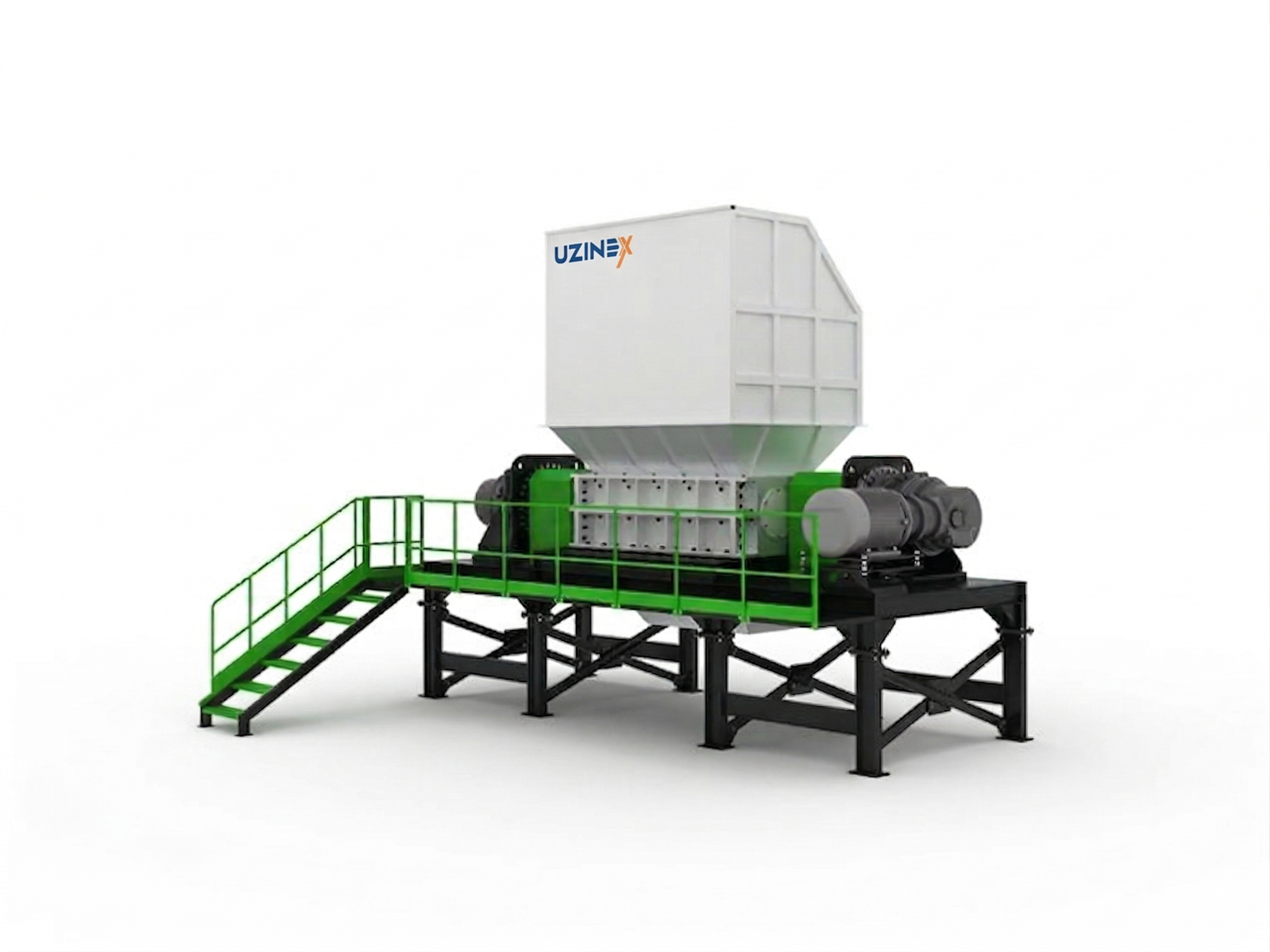
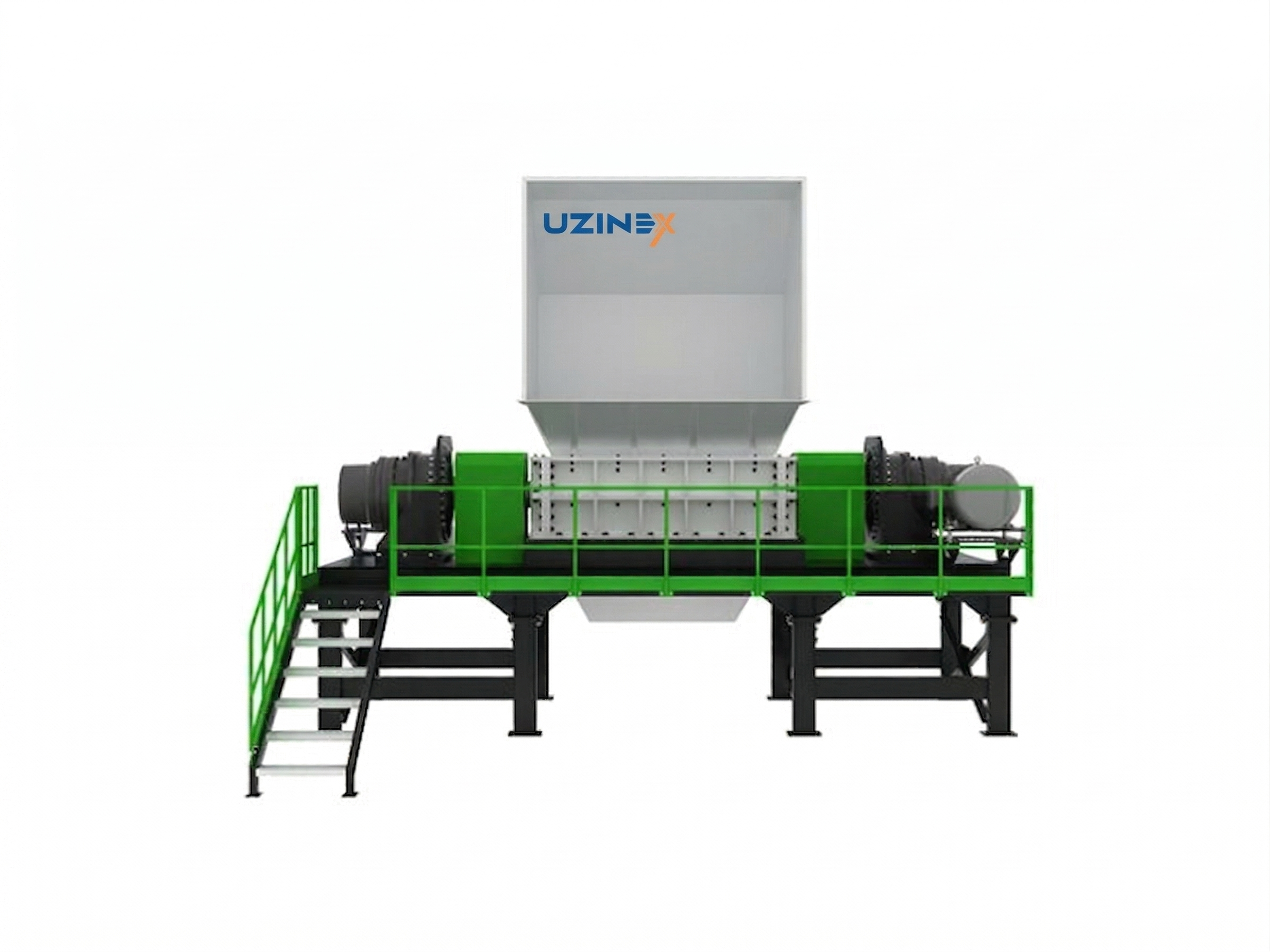
RELIABLE D-series tyre recycling shredder — the specialized equipment for fragmenting used tyres of all categories (car, motorcycle, bicycle, agricultural, OTR) into 50mm rubber chips ready to feed physical recycling, pyrolysis or TDF lines. Available in eight models D600–D2200 with automatic adaptation to the tyre type without re-adjusting the parameters.
Performance is documented by real users: a European customer increased capacity from 2 tonnes/h to 3.5 tonnes/h on truck tyres, and a customer in India confirms stable operation at 45°C — performance that makes this tyre recycling shredder the choice proven on three continents.
The specific challenge of shredding tyres compared to plastic or metal is their three-component composition: elastic vulcanized rubber that deforms instead of cutting, embedded steel wire that rapidly wears the knives, and reinforcement textiles that wrap around the shafts. This tyre recycling shredder solves all three challenges simultaneously through knife geometry adapted to the traction of elastic rubber, rotation speed calibrated for breaking the steel wire and an anti-wrapping guard system for the cord textiles — without manually re-adjusting the parameters when changing the tyre type. Key Advantages of the RELIABLE Tyre Recycling Shredder
• Automatic adaptation to all tyre types — no parameter re-adjustment: The RELIABLE Tire Shredder automatically detects and adapts the cutting force and rotation speed to the type of tyre fed — from thin bicycle tyres to OTR tyres of mining machinery with a diameter of 2–4 metres. The operator feeds the tyres without stopping the line or changing the settings — maximum productivity on mixed flows of used tyres collected at recycling stations with a wide variety of sources.
• 50mm rubber chips — the standard size for all recovery flows: The 50mm chips produced by this tyre recycling shredder are the input size accepted by secondary rubber granulators, by pyrolysis plants and by TDF production systems. A single primary shredder produces the correct output for any of the three recovery flows, without changing the grate or adjusting the output size for each destination.
• Confirmed performance: truck tyres 2 t/h → 3.5 t/h (+40%): The European customer cited by the manufacturer replaced their previous equipment with RELIABLE and increased processing from 2 tonnes/h to 3.5 tonnes/h on truck tyres — a 75% increase in volume in the same production space, with a simultaneous reduction in maintenance costs. This is real performance measured in the field, not a catalogue specification.
• Stable operation at 45°C — designed for extreme conditions: The special protection design of the cooling systems and bearings allows continuous operation of this tyre recycling shredder at ambient temperatures of 45°C and in environments with abrasive dust — conditions typical in recycling facilities in hot climates and in industrial halls without air conditioning. The Indian customer ordered 2 additional units after confirming performance under real production conditions.
• Processes OTR tyres — including giant mining machinery tyres: OTR (Off-The-Road) tyres from construction machinery, mining excavators and large agricultural tractors have diameters of 1.5–4 metres and weights of 500–5000 kg — impossible to process with standard shredders. The D series with models up to D2200 is dimensioned to accept and fragment whole OTR tyres, opening up the recycling market for the most difficult flow of used tyres.
• 4 knife types configurable per tyre composition: Equipment knife for tyres with thick steel wire (trucks, OTR); SW-type for tyres with textile reinforcement without wire; VZ for thin and light tyres (bicycles, motorcycles); Pineapple knife for fragmenting recycled rubber to dimensions under 10mm in the secondary stage. The correct knife configuration maximizes blade service life and minimizes the energy consumed per tonne processed.
• 3 recovery flows from the same output — 50mm chips: The 50mm chips produced by any RELIABLE tyre recycling shredder are the standard input for: (1) the physical recycling line into rubber powder for synthetic turf and flooring; (2) the pyrolysis plant for producing fuel oil, carbon black and steel wire; (3) the TDF (Tire Derived Fuel) production system for use as a coal substitute in cement kilns and power plants. The same shredder feeds any combination of the three flows.
• Models D600–D2200 — scalable from collectors to large industrial capacities: The wide range of eight models covers all sizes of tyre recycling operations — from local collection stations with the D600 to high-capacity industrial lines with the D2000 and D2200. All models share the same operating principle, facilitating operator training on any model in the series.
The 3 Recovery Flows for Shredded Used Tyres
A RELIABLE-type tyre recycling shredder is the mandatory first stage for any of the three recovery flows for used rubber — the choice of flow depends on the available investment, the local markets and the applicable regulations:
• Physical recycling → rubber powder: The 50mm chips pass through secondary crushers and cryogenic or ambient-temperature mills, producing rubber powder of 20–80 mesh. The powder is used in: synthetic turf for sports fields, rubber flooring for playgrounds and fitness rooms, flooring tiles, waterproof renders, bitumen modifiers and reclaimed rubber products. The market for recycled rubber powder is in continuous growth. Explore the complete range of Uzinex industrial equipment for integrated recycling solutions.
• Pyrolysis → fuel oil + carbon black + steel wire: The 50mm rubber chips are introduced into the pyrolysis plant where they are heated in the absence of oxygen at 300–600°C, producing: pyrolysis oil (equivalent to diesel, usable in thermal power plants or refined as fuel), technical carbon black (usable in the production of paints, rubber and pigments) and clean steel wire (directly recyclable as scrap iron). Typical yield: 40–45% oil, 30–35% carbon black, 15–20% wire, 5–10% combustible gases.
• TDF (Tire Derived Fuel) → granular fuel for industry: The 50mm rubber chips, after extracting the steel wire with a magnetic separator, are used directly as TDF (tyre-derived fuel) in cement kilns, power plants and industrial installations with high-temperature combustion. The calorific value of TDF is 30–34 MJ/kg — higher than energy coal (25–28 MJ/kg) — with significantly lower supply costs compared to conventional fossil fuels.
Tyre Types Processed
| Car (passenger) tyres | R13–R22, including run-flat; outer diameter 560–750mm |
|---|---|
| Truck / HGV tyres | R17,5–R22,5; outer diameter 780–1060mm; high steel wire |
| Motorcycle tyres | Standard motorcycle/scooter sizes; textile reinforcement |
| Bicycle tyres | 24"–29" and other formats; thin rubber without wire |
| Agricultural tyres | R30–R54, tractor tyres; wide profile, solid rubber |
| Engineering tyres (OTR) | Excavators, bulldozers, mining machinery; diameter 1,5–4m; weight up to 5000 kg |
| Special tyres | Aircraft, military equipment, special industrial machinery |
| Standard output particle size | 50mm (configurable) |
| Automatic adaptation | Yes — no parameter re-adjustment when changing type |
| Available models | D600 / D800 / D1000 / D1200 / D1400 / D1600 / D2000 / D2200 |
Case Studies — Performance Confirmed in the Field
The performance of a tyre recycling shredder is validated in real production, not in catalogue specifications. RELIABLE documents the results obtained at installations in Europe, India and France:
• European customer — truck tyres, +40% capacity: The processing of truck tyres increased from 2 tonnes/h to 3.5 tonnes/h after replacing the previous equipment with RELIABLE. Maintenance costs were reduced simultaneously. The 75% increase in capacity in the same production space allowed the customer to take on additional volumes without investing in infrastructure.
• India customer — stable operation at 45°C in harsh conditions: Standard equipment frequently fails in the air-conditioning-free industrial halls of India — ambient temperatures of 40–48°C and abrasive dust from shredded rubber rapidly degrade cooling systems and bearings. The RELIABLE Tire Shredder operated stably under these conditions, prompting the customer to place an additional order for 2 units, after confirming performance on real production.
• France customer — leader in used rubber recycling: The French company specialized in recycling rubber products uses RELIABLE as the main equipment for its tyre processing lines — a reference for compliance with European recycling standards and for the conformity documentation required by EU regulations on the management of used tyres.
How It Works — The Tyre Shredding Process
• Feeding the tyres — whole, without prior preparation: On this tyre recycling shredder, used tyres are fed whole into the shredding chamber through the feed hopper — there is no need to pre-cut or de-rim (extract the bead wire) before feeding. The D1000 and larger models accept whole truck tyres; the D2000–D2200 models accept large OTR tyres.
• Automatic adaptation and start of shredding: The control system detects the type and size of the tyre fed and automatically adjusts the rotation speed and cutting force for optimal efficiency. No operator intervention is needed when changing the tyre type in the feed line.
• Three-stage fragmentation — rubber, wire, textile: The knives of this tyre recycling shredder simultaneously fragment the three components of the tyre: the vulcanized rubber (by shearing and traction), the steel wire (by fatigue rupture from repeated bending) and the cord textiles (by sectioning). The special knife geometry prevents the textiles from wrapping around the shafts.
• Separation of the steel wire (optional): At the shredder outlet, the magnetic separator can extract the steel wire from the rubber chips — clean wire, directly usable as scrap iron. Magnetic separation is included as standard in the configurations for pyrolysis and TDF where the presence of wire reduces the quality of the final products.
• Discharge of the 50mm chips to the secondary stage: The 50mm rubber chips are discharged on the conveyor belt towards the secondary granulator (for rubber powder), towards the pyrolysis plant or towards the TDF storage and delivery system — depending on the chosen recovery flow.
Frequently Asked Questions about the RELIABLE Tyre Recycling Shredder
Can the shredder process OTR excavator tyres without pre-cutting?
Yes — the D1600, D2000 and D2200 models are dimensioned to accept whole OTR tyres from excavators and bulldozers, with outer diameters of 1.5–3 metres. Larger OTR tyres (diameter over 3m, weight over 2000 kg) require pre-cutting into 2–4 quarters with a hydraulic saw before being fed into the shredder, a standard operation in OTR recycling stations. The UZINEX team can recommend the pre-cutting equipment suited to your specific tyre dimensions. Which recovery flow is more profitable — powder, pyrolysis or TDF?
Profitability depends on local prices for secondary raw materials and on the investment in the secondary-stage equipment. Pyrolysis produces the highest value per tonne of rubber (oil, carbon black and wire, all recoverable separately), but requires the largest investment in the pyrolysis plant. Rubber powder has a stable market and growing demand for synthetic turf and flooring, with medium-cost secondary equipment. TDF has the shortest recovery chain — the chips are delivered directly to the user industries — but the price depends on fossil fuel quotations. The UZINEX team can analyze the options according to your local market. How often are knife changes needed for tyres with steel wire?
Tyres with steel wire (trucks, HGVs) wear the knives faster than tyres without wire (bicycles, motorcycles). The change frequency depends on the dominant type of tyre processed, the feeding method and the configured knife type. The Equipment knife for wire-reinforced tyres and the special steel knives available on request maximize service life on this type of material. The UZINEX team provides a change-frequency recommendation based on the volume and type of tyres in your specific operation. Does the RELIABLE Tire Shredder comply with European tyre recycling regulations?
Yes — the product is installed and operational in recycling facilities in France and other European countries, confirming compatibility with the technical and environmental requirements applicable in the EU. European Directive 2000/53/EC and Romanian legislation require recycling through authorized operators with appropriate equipment — this tyre recycling shredder is documented in compliant European installations. The UZINEX team can assist with the technical documentation needed for authorizing the installation in Romania. How does the tyre shredder differ from the dual-shaft shredder for metals?
Although both are dual-shaft shredders as a construction principle, the operating parameters are fundamentally different. Vulcanized rubber requires higher cutting speeds than heavy metals — the rotor of the tyre shredder operates faster and with knife geometry adapted to the traction and shearing of elastic rubber. The D-series shredder for metals has higher torque and lower speed, suited to fragmenting rigid metal bodies. Using the metal shredder on tyres — or vice versa — produces low throughput and accelerated knife wear. Why Buy the RELIABLE Tyre Recycling Shredder from UZINEX?
• Free consultancy for model and recovery flow selection: The UZINEX team analyzes the available tyre volume, the composition (car/truck/OTR), the target recovery flow and the local market for secondary raw materials, and recommends the right D model and the optimal knife configuration for your application.
• Delivery, commissioning and operator training included: Every RELIABLE tyre recycling shredder delivered through UZINEX includes complete installation, start-up and testing with real tyres and training of the operating team for correct feeding, knife wear monitoring and preventive maintenance.
• Extended 60-month warranty and technical support under 36 hours: The 60-month warranty and the guaranteed response time under 36 hours ensure the continuity of the recycling line — with priority delivery of knives and wear parts from UZINEX's own stock, minimizing unplanned downtime during the peak season of used tyre collection.
• Confirmed references from Europe and international markets: Functional installations in France, Europe, India and other countries — performance documentation available on request to justify the investment to financiers or partners. The manufacturer documents real cases with capacity data — concretely, every RELIABLE tyre recycling shredder installed comes with verifiable references from real production.
• Integrated into the complete RELIABLE tyre recycling line: RELIABLE supplies not only the primary shredder, but also the secondary equipment — rubber granulators, magnetic separators and pyrolysis plants. UZINEX can design and deliver the complete tyre recycling line from the primary shredder to the final product, with single-source support for the entire investment.
RELIABLE tyre recycling shredder D600–D2200 — automatic adaptation to all tyre types without re-adjustment, 50mm rubber chips for physical recycling, pyrolysis or TDF, confirmed operation at +40% capacity versus European customers' previous equipment and proven resistance at 45°C in extreme industrial conditions, for any operator that needs a tyre recycling shredder that profitably recovers used tyres from local or regional collections.