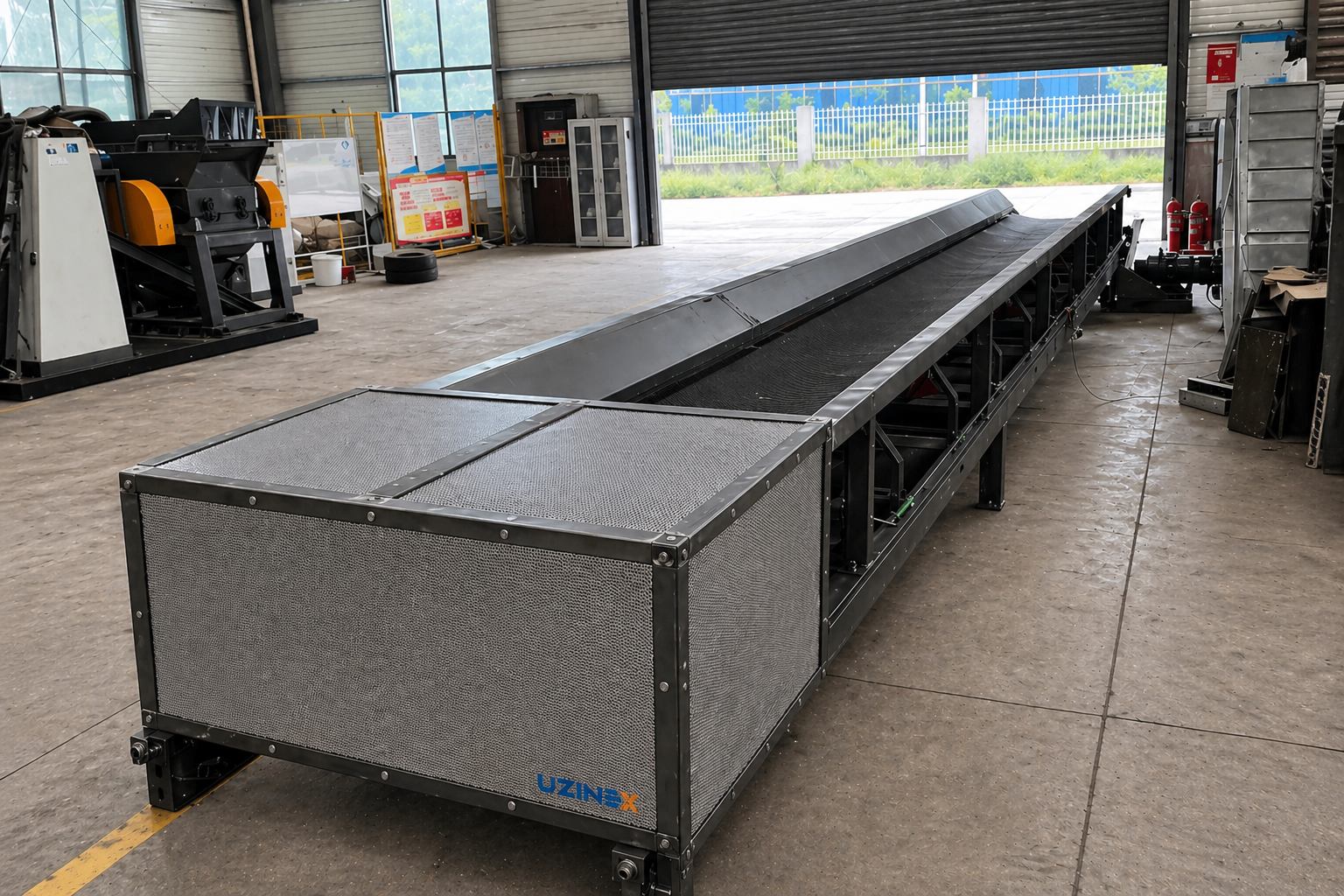
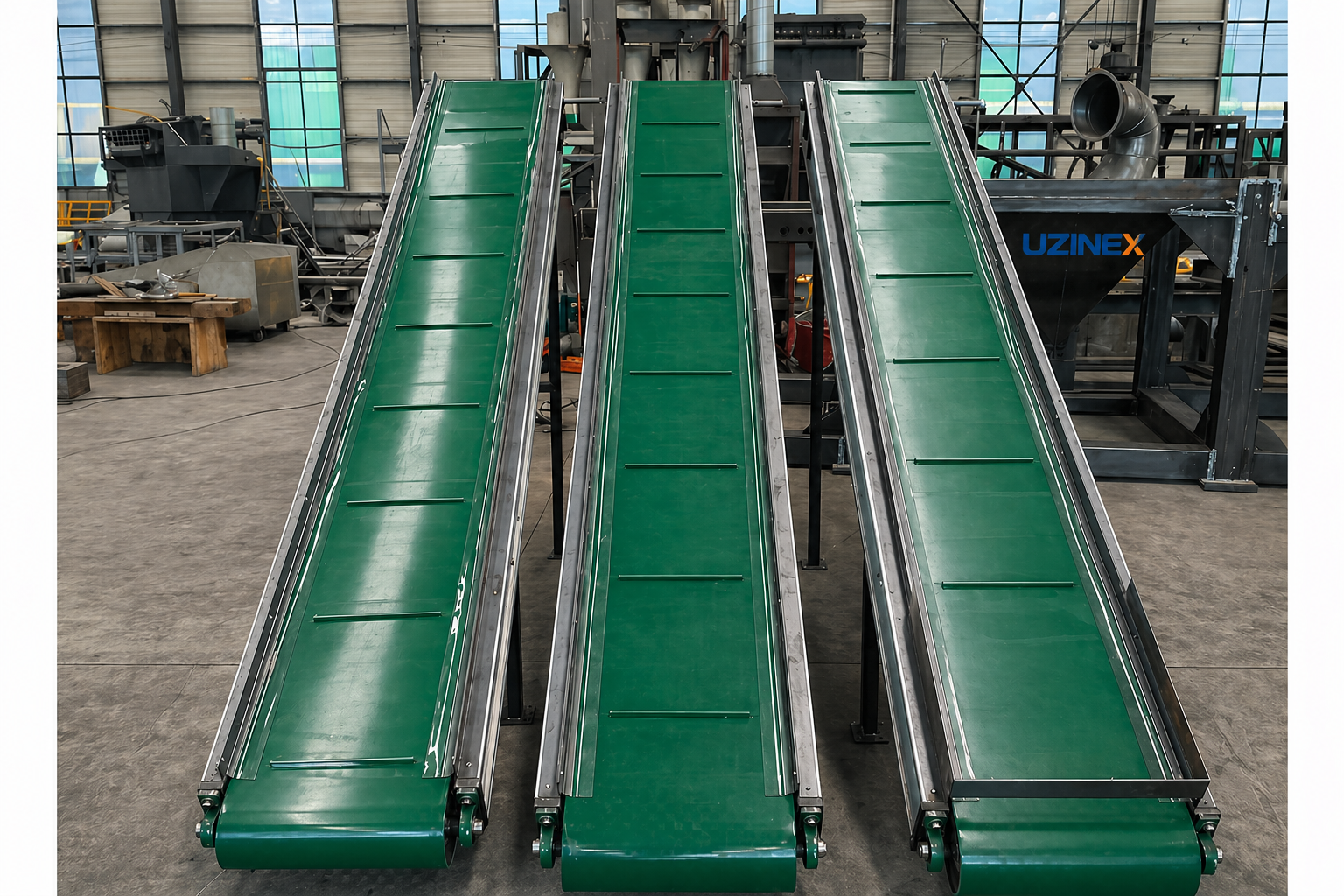
RELIABLE industrial recycling conveyor belt — the auxiliary continuous-transport equipment that physically connects all the equipment in the recycling line, ensuring an uninterrupted material flow from feeding through shredders, crushers and separators to the final bunkers. Available with wear-resistant rubber, PVC and metal plates, with a heavy-duty steel frame and a modular structure.
This industrial recycling conveyor belt is the only piece of infrastructure whose correct selection determines whether the rest of the equipment in the line operates at nominal capacity or is limited by blockages and stoppages at the material transfer between stages.
The choice of belt material, surface and load-bearing capacity is not standardizable — each application requires an assessment of the shape of the transported material (large pieces vs. fine granules), its physical properties (hardness, moisture, corrosiveness, temperature) and the recycling scenario (pre-shredding feed, post-crushing transport, distribution to separators). An incorrectly sized industrial recycling conveyor belt produces frequent blockages, rapid belt deterioration and stoppages of the entire line — a correctly configured belt operates uninterrupted throughout the service life of the equipment it connects. Key Advantages of the RELIABLE Industrial Recycling Conveyor Belt
• Heavy-Duty steel frame — stability and resistance to heavy loads: The structural steel frame of this industrial recycling conveyor belt is designed for the impact and weight loads specific to industrial recycling lines — metal pieces, shredded car bodies, crushed appliances and heavy construction waste are materials with irregular density and shapes that produce uneven impacts on the belt surface. The robust frame absorbs these impacts without deforming the support structure and without losing roller alignment throughout the equipment's service life.
• Wear-resistant rubber belt — long life on abrasive materials: The wear-resistant rubber of the standard belt is the optimal material for transporting the abrasive materials specific to industrial recycling — crushed metal, rubber granulate with wire, mineral aggregate, slag and construction waste. The abrasive wear resistance of the RELIABLE rubber belt is significantly superior to standard PVC or textile belts, reducing the replacement frequency and the maintenance cost per year of operation.
• 3 belt materials — rubber, PVC, metal plates: Each transport material has specific belt requirements. Rubber covers the wide range of dry and semi-wet abrasive materials in recycling. PVC is optimal for fine, light and clean materials from plastic and packaging sorting lines — a smoother surface that does not retain fine particles. Metal Chain Plates transport materials at high temperatures, extremely abrasive materials, or materials with irregular sharp shapes that would rapidly damage textile or rubber belts.
• Fully customizable length and width — adaptable to any hall layout: Industrial recycling halls have varied layouts — the equipment is arranged at different distances and heights, with support columns and other obstacles between them. This industrial recycling conveyor belt is designed to the exact length and width required by the distance between the connected equipment, the working width of the receiving equipment and the necessary hourly material throughput — no post-installation adaptation or capacity compromise.
• Multiple surfaces — smooth, anti-slip, patterned, with side walls: The belt surface is selected according to the transport angle and the transported material. The smooth surface for fine materials on horizontal belts; anti-slip and patterned (with relief profiles) for transport at a high angle without the material sliding; side walls for keeping fine or bulk materials on the belt at transport angles of 30–90°, eliminating lateral material loss during vertical transfer.
• Modular structure — quick belt replacement without prolonged line stoppage: The modular design of the frame and the belt tensioning system allow a worn belt to be replaced quickly, without dismantling the rollers or the motor and without special tools. The line downtime during a belt change is minimal compared to conveyor belts with monolithic structures, where a belt change requires partial frame dismantling.
• Adjustable speed — synchronization with the throughput of the connected equipment: The variable-speed motor of this industrial recycling conveyor belt allows the belt speed to be adjusted to synchronize the material throughput with the nominal capacity of the receiving equipment — the shredder, crusher or separator in the following stage. Overfeeding a piece of equipment produces blockages; underfeeding reduces productivity. Adjustable speed maintains the optimal throughput continuously.
• Compatible with all equipment in the RELIABLE Uzinex range: This industrial recycling conveyor belt is designed as a native interface element with all the RELIABLE equipment distributed by UZINEX — the feed inlets and discharge points of the shredders, crushers and separators in the range have dimensions compatible with the standard belt widths, ensuring direct mechanical integration without adapters or structural modifications.
Selection Guide — The Belt Type Suited to the Application
Choosing the correct belt type for an industrial recycling conveyor belt determines the durability, maintenance frequency and operational continuity throughout the line's service life:
• Wear-resistant rubber belt: The universal application for industrial recycling — crushed metal (iron, aluminium, copper), rubber granulate, construction waste, ore, coal. High resistance to abrasion, impact and cutting from the sharp edges of metal fragments. Operating temperature: -20°C to +70°C. Standard widths: 400–2000mm. The first choice for 80% of recycling applications.
• PVC belt: Optimal for light, fine materials without sharp edges — plastic granulate, sorted films, packaging waste, the fine fractions from WEEE sorting lines. The smoother surface compared to rubber does not retain the fine particles that would contaminate the sorted fractions. Resistant to oils and grease. Operating temperature: 0°C to +60°C. The suitable choice for fine sorting stages and distribution to electrostatic or gravity separators.
• Metal Chain Plates: The solution for extreme applications — materials at high temperatures (foundry slag, hot post-crushing waste), materials with sharp metal content that would perforate the rubber or PVC belt, and extremely heavy materials with violent impacts at feeding. Exceptional durability against mechanical wear and resistance to temperatures above 200°C on special variants. Higher purchase cost, but a service life 3–5× that of rubber belts in extreme applications.
• Anti-slip or patterned surface: Required at transport angles above 15–20° — the surface profiles or ribs prevent the material from sliding back down the belt at high angles, maintaining a constant throughput towards equipment mounted at height (platform-mounted shredders, feed silos, raised bunkers).
• Belt with side walls: Essential for transporting fine or granular materials on belts inclined at angles of 30–90°, where the material would fall off the sides without retaining walls. It eliminates material losses during vertical transfers and allows vertical elevation with a single belt instead of a cascading system of horizontal + vertical belts.
Specifications — RELIABLE Industrial Recycling Conveyor Belt
| Available belt materials | Wear-resistant rubber / PVC / Metal Chain Plates |
|---|---|
| Belt surfaces | Smooth / Anti-slip / Patterned / With side walls |
| Frame | Heavy-duty structural steel — resistance to impact and heavy loads |
| Length | Customizable on request — from 1m to tens of metres |
| Belt width | Customizable — standard 400mm, 500mm, 600mm, 800mm, 1000mm, 1200mm, 1400mm, 1600mm, 2000mm and others |
| Belt speed | Adjustable via variable-speed drive — synchronization with the throughput of the connected equipment |
| Transport angle | Horizontal up to 45° (rubber/PVC) or up to 90° (belt with side walls) |
| Transported materials | Plastic, crushed metal, rubber granulate, WEEE, ore, household waste, construction waste |
| Maintenance | Modular structure — quick belt replacement without frame dismantling |
| Customization | Complete — belt material, surface, length, width, angle, speed, tensioning system |
Applications — The Position of the Conveyor Belt in the RELIABLE Recycling Line
A RELIABLE industrial recycling conveyor belt connects every pair of consecutive equipment in the processing line, ensuring a continuous material flow at the optimal throughput. At the entry to the line, the feed belt transports the raw material — shredded car bodies, appliances, waste bags — from the storage area to the feed inlet of the primary Double Shaft or Single Shaft shredder. This first belt requires a rubber belt with an anti-slip profile at the feed angle and sizing to the maximum throughput of the primary shredder to prevent underfeeding that reduces productivity.
Between the primary shredder and the secondary crusher, this industrial recycling conveyor belt transports the 50–150mm fragments produced by the shredders towards the feed inlet of the vertical LCP crusher or the WCD metal crusher. Metal fragments from recycling have sharp edges and variable weights — the wear-resistant rubber belt or the metal plates are the only durable options on this high-impact stage. Explore the full range of Uzinex industrial equipment for complete recycling solutions with conveyor belts configured for each stage.
When transferring material from the separators in the final stages to the bunkers that collect the pure fractions, narrower conveyor belts with a PVC belt or a smooth surface transport the granules of copper, aluminium or sorted plastic without contaminating the pure fractions with impurities from the rough surface of rubber belts or from residual abrasive material, in line with international standards for processing and sorting recycled materials . How It Works — Continuous Transport with the RELIABLE Belt
• Sizing and configuration at installation: Before installation, the UZINEX team determines the exact length between the connected equipment, the width needed for the hourly material throughput, the transport angle and the type of transported material. Based on this assessment, the belt material, surface and tensioning system are selected — a correct configuration at installation eliminates premature belt replacements and post-installation adjustments.
• Progressive start-up and speed synchronization: At line start-up, the belt starts up progressively via the variable-speed drive, reaching operating speed before the feeding equipment starts. The speed is set for the optimal throughput of the receiving equipment — if the shredder has a capacity of 5 t/h, the belt is adjusted to feed 5 t/h continuously, without throughput peaks that would cause blockages and without gaps that would reduce productivity.
• Continuous transport and monitoring: The monitoring system of this industrial recycling conveyor belt detects belt slippage (via the speed sensor on the head pulley) and lateral belt drift (via drift sensors), generating alerts before minor problems escalate into unplanned stoppages. Detecting lateral drift is especially critical on long belts where uncorrected drift rapidly damages the belt edges.
• Transfer to the receiving equipment: At the discharge end, the material falls by gravity onto the feed inlet of the next equipment. The discharge guide chute ensures the material is centered on the feed inlet of the receiving equipment, preventing material dispersion outside the feed inlet and material losses during transfer.
• Preventive maintenance and belt replacement: At regular intervals, the operator inspects the belt condition (wear, edge cracks, local damage) and the system tensioning. When the wear limit is reached, the belt is replaced quickly thanks to the modular design — release tension, remove the old belt, insert the new belt, re-tension, check alignment — without dismantling the motor or the frame.
Frequently Asked Questions about the RELIABLE Industrial Recycling Conveyor Belt
How do you choose between a rubber belt and metal plates for auto fragments?
Auto fragments (auto shred) of 50–150mm have sharp edges from sheet metal and metal components, variable weights and sometimes liquid residue. The rubber belt of any industrial recycling conveyor belt with a thickness of 10–15mm handles 90% of auto shred applications at a significantly lower purchase and replacement cost than metal plates. Metal plates become necessary only when the fragments contain components at high temperatures (immediately post-crushing of hot materials) or when the fragment shape causes systematic perforation of the rubber belt — a rare case with pre-cooled auto shred. At what transport angle is a belt with side walls required versus anti-slip?
An anti-slip belt (with profiles or ribs) allows transport at angles up to 30–35° for large granules and 25–30° for fine granules. At higher angles, the material slides back down the belt regardless of the surface profile. A belt with side walls allows transport at angles of 45°–90° (vertical) for any fine or granular material — the only solution for vertical transfers or for high angles in limited spaces. The UZINEX team checks the required transport angles when designing the line layout. Can the RELIABLE conveyor belt operate outdoors or in high-humidity environments?
Yes — the wear-resistant rubber belt and the metal plates are both suitable for outdoor operation and high-humidity environments. The structural steel frame is anti-corrosion treated for operation in humid industrial environments. For environments with high chemical corrosiveness (acids, bases), the UZINEX team recommends stainless steel frames or frames with protective epoxy coating, available on request. What belt width is suitable for the connection between the Double Shaft shredder and the metal crusher?
The connection between the RELIABLE Double Shaft shredder (output 50–150mm, capacity 700–1200 kg/h on D800–D1200 models) and the WCD metal crusher requires a belt with a width of at least 600–800mm to handle the maximum throughput without accumulation at the transfer point. The exact width depends on the specific shredder and crusher model and on the belt fill rate. The UZINEX team calculates the optimal width based on the nominal capacity of the connected equipment. Is the conveyor belt delivered with the motor and drive included or separately?
Each RELIABLE industrial recycling conveyor belt is delivered as a complete assembly — motor, gearbox, variable-speed drive, frame, belt and tensioning system — ready for installation and connection to the electrical panel of the recycling line. The motor parameters (power, speed) are sized to order based on the belt length, width and estimated material load. Why Buy the RELIABLE Industrial Recycling Conveyor Belt from UZINEX?
• Free configuration for each stage of the recycling line: The UZINEX team designs each industrial recycling conveyor belt in the line — belt material, surface, length, width, angle, speed — based on the capacity of the connected equipment and the characteristics of the transported material, ensuring mechanical compatibility and optimal throughput at each transfer.
• Delivered as a complete assembly ready for installation: Motor, gearbox, variable-speed drive, heavy-duty frame, belt, tensioning system and discharge chute — delivered together, configured to the line specifications, with no additional component purchases or post-installation adaptations.
• Extended 60-month warranty and technical support within 36 hours: The 60-month warranty and the guaranteed response time of under 36 hours ensure the continuity of the material flow — with priority delivery of spare belts, rollers and tensioning components from UZINEX's own stock, minimizing the unplanned stoppages that block the entire line.
• Native compatibility with all RELIABLE equipment from UZINEX: The discharge dimensions of the D-series shredders, the WCD/WGD/LCP crushers and the separators in the RELIABLE range are documented by UZINEX, allowing each conveyor belt to be configured with the exact interface dimensions for direct mechanical integration without adapters.
• Single supplier for the entire recycling line: UZINEX designs, delivers and commissions the complete line — shredders, crushers, separators and the conveyor belts that connect them — with a single source of technical support for the entire processing infrastructure, eliminating uncertainty regarding compatibility between equipment from different suppliers.
RELIABLE industrial recycling conveyor belt — wear-resistant rubber, PVC or metal plates, heavy-duty steel frame, fully customizable length and width, anti-slip surfaces and side walls for any transport angle, modular structure for quick replacement, — RELIABLE industrial recycling conveyor belt for the uninterrupted connection of all equipment — from the primary shredders through crushers and separators to the bunkers that collect the final valorizable fractions.