
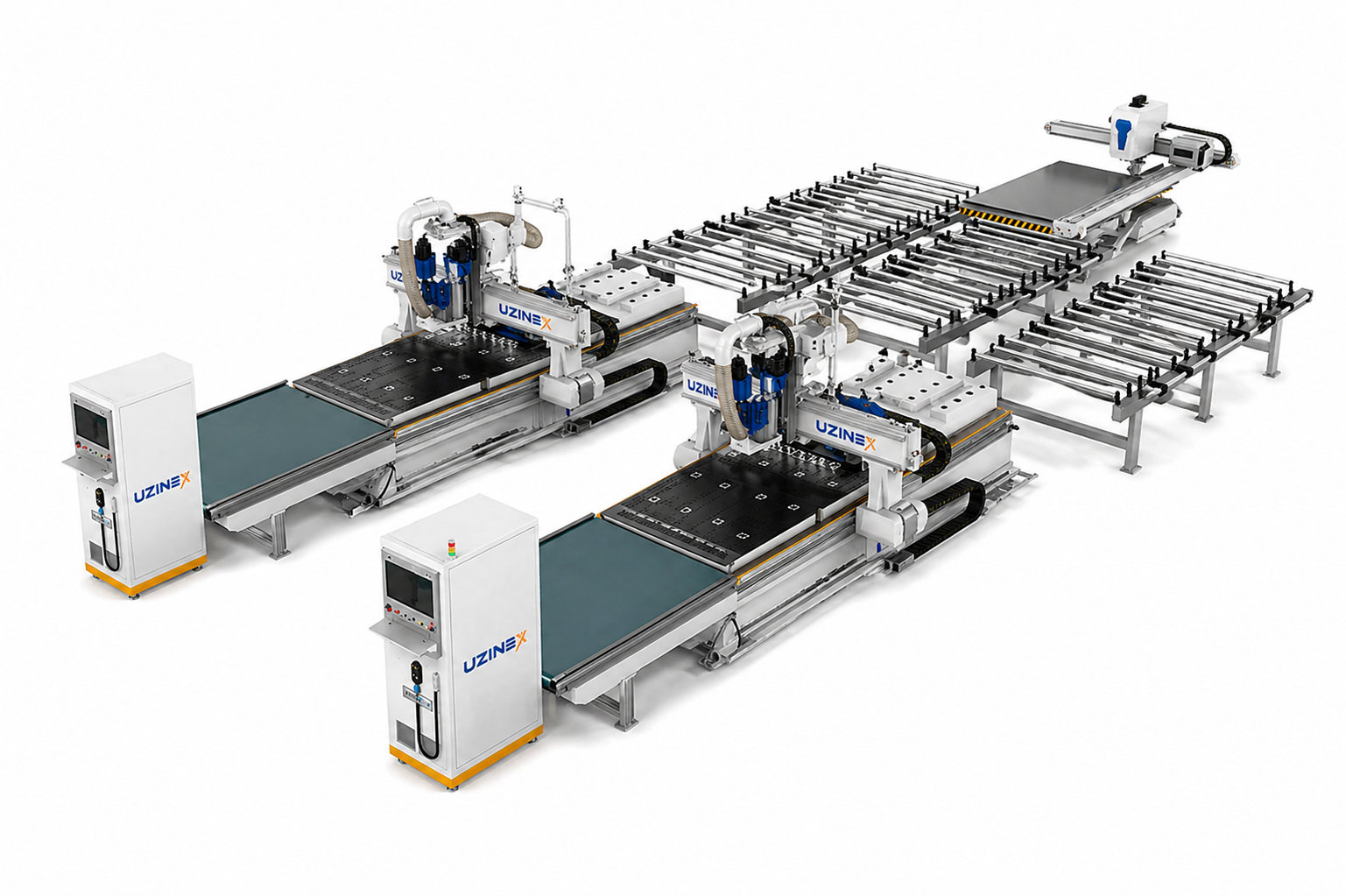
The CNC nesting cell for furniture is the integrated production line for furniture factories moving to industrial-scale automation — it combines two CNC ATC routers, a high-speed labelling system, nesting software and a central control system in a cell that processes up to 240 panels per 8-hour shift.
Unlike an individual CNC router, the CNC nesting cell for furniture is a complete line solution: it receives the orders, calculates the nesting optimisation, cuts the panels, labels them per panel and prepares them for finishing and packaging — without manual transfer between stations.
The CNC nesting cell for furniture is designed for continuous operation across multiple shifts, with minimal operator intervention — a single operator can supervise the entire cell thanks to the central control system that manages production sequencing, real-time monitoring and intervention alerts. The optional robotic system for palletising, offcut handling and waste removal turns the CNC nesting cell for furniture into a fully automated line, from the raw board to the finished labelled panels, ready for the edge banding machine.
Components of the CNC nesting cell for furniture
| Component | Specification |
|---|---|
| CNC ATC routers | 2 units with automatic tool changer (ATC) |
| Labelling system | High-speed automatic labelling, per panel |
| Nesting software | Integrated central nesting optimisation system |
| Control system | Centralised control, real-time monitoring |
| Production capacity | 240 panels / 8-hour shift (~30 panels/hour) |
| Operating mode | Continuous, multi-shift, minimal operator intervention |
| Robotic system | Optional — palletising, offcut handling, waste removal |
| Operating level | Operable without advanced technical personnel |
| Monitoring | Real time, centralised system |
| Compatible materials | Chipboard, MDF, wooden panels for the furniture industry |
The CNC nesting cell for furniture is sized and configured at the quotation stage according to the production volume, the order typology and the workshop infrastructure. Free technical consultancy for assessing feasibility and ROI for your factory.
Advantages of the CNC nesting cell for furniture
• 240 panels per 8-hour shift — industrial capacity with reduced personnel — the CNC nesting cell for furniture produces up to 240 panels per shift with a single supervising operator, instead of the teams of 4–6 people required on conventional lines with individual routers and loading-unloading operators. At a rate of 30 panels per hour in continuous flow, the CNC nesting cell for furniture covers the production of dozens of complete furniture carcasses per day, with all panels cut, drilled and labelled.
• 2 CNC ATC routers in parallel — redundancy and double capacity — the CNC nesting cell for furniture operates with two independent CNC ATC routers that work simultaneously on different boards from the same order. This dual configuration provides both double the capacity of an individual router and operational redundancy — if one router goes into maintenance or has a technical intervention, the other continues production, eliminating a complete line stoppage.
• Integrated nesting system — minimal material loss on every board — the CNC nesting cell for furniture has nesting optimisation software integrated into the central control system that automatically calculates the most efficient arrangement of pieces on each chipboard or MDF board, minimising the waste area. Nesting optimisation is the parameter with the greatest direct financial impact in a furniture factory — a 3–5% reduction in material loss across a production of 100 boards per day means dozens of boards saved each month.
• High-speed automatic labelling — complete traceability, error-free sorting — the CNC nesting cell for furniture automatically labels each panel immediately after cutting with the order information, the panel type, the position in the furniture carcass and the assembly instructions. The labels are automatically generated by the central system based on the active production order — without manual labelling, without sorting confusion, without assembly errors at the end customer. Per-panel traceability is the standard requirement for furniture suppliers to high-volume retailers.
• Centralised control — a single operator for the entire cell — the CNC nesting cell for furniture is managed through a central control system that coordinates the sequencing of the two routers, the nesting optimisation, the labelling and (optionally) the palletising robot. The operator enters the production orders, the system automatically plans the machining order, allocates the panels to the routers and monitors execution in real time. The operating level does not require advanced technical personnel — the operator supervises the flow, rather than programming the CNC manually.
• Real-time monitoring — full production transparency — the CNC nesting cell for furniture offers complete real-time visibility into the production status: panels processed, panels pending, intervention alerts, material consumption and progress per order. This transparency allows the production manager to re-plan priorities in real time and to respond promptly to urgent orders without stopping the line.
• Optional robotic system — complete automation up to the pallet — the CNC nesting cell for furniture can be extended with a robotic system that picks up the cut panels from the routers, sorts them by order, palletises the panel sets per furniture carcass and handles offcuts and waste. Integrating the robot turns the CNC nesting cell for furniture from a cutting and labelling line into a fully automated production centre, with direct output onto pallets ready for delivery.
• Multi-shift operation without interruption — the CNC nesting cell for furniture is designed for continuous operation over two or three shifts, with planned maintenance intervals carried out without a complete line stoppage. Production capacity multiplies in proportion to the number of shifts: two shifts mean up to 480 panels per day, three shifts mean up to 720 panels per day.
• 60-month UZINEX warranty — a team of engineers dedicated to integration, national technical support within 24–48 hours, transport, installation and commissioning included.
The CNC nesting cell for furniture vs. individual CNC routers
A furniture factory producing with two separate individual CNC routers has two loading-unloading operators, two separate production programmes, manual labelling per panel and nesting calculated manually or with non-integrated external software. The CNC nesting cell for furniture replaces this fragmented configuration with an integrated solution in which the nesting software, the routers and the labelling operate as a single unified system coordinated by a single controller.
The difference in productivity does not come only from the speed of the routers — it comes from eliminating the dead times between operations, from the automatic nesting optimisation on every board, from eliminating manual labelling and from reducing sorting errors. The CNC nesting cell for furniture produces more panels with fewer people and fewer chipboard sheets per completed order.
Applications — CNC nesting cell for furniture
Furniture factories with serial production that deliver flat-pack furniture orders to retailers, furniture stores or customers with direct delivery are the main users of the CNC nesting cell for furniture. The minimum production volume that economically justifies the CNC nesting cell for furniture is approximately 100–150 panels per day, the level at which nesting optimisation and the elimination of manual labelling produce measurable monthly savings.
Manufacturers exporting flat-pack furniture to the Western European market find in the CNC nesting cell for furniture the solution that allows them to meet the traceability and labelling standards required by international retailers — each panel is automatically labelled, packaging errors are eliminated and sorting by order is done without manual intervention.
Factories with mixed production — serial orders and made-to-order orders with varied dimensions — benefit most from the integrated nesting system of the CNC nesting cell for furniture. Automatic nesting optimisation on every board is critical precisely when orders are varied and panel dimensions differ from one order to another — exactly the situation in which manual nesting calculation generates the greatest material losses.
Workflow — CNC nesting cell for furniture
• Production orders are entered into the central system of the CNC nesting cell for furniture — manually or by import from the factory's management software (ERP, furniture CAD).
• The nesting software automatically calculates the optimal arrangement of pieces on each chipboard/MDF board, minimising material losses.
• The central system allocates the cutting programmes to the two CNC ATC routers and sequences the production for continuous flow.
• The two CNC ATC routers simultaneously cut the panels according to the optimised nesting plan, in parallel and independently.
• The high-speed automatic labelling system applies the identification label to each panel immediately after cutting.
• The labelled panels are removed and sorted — manually by an operator, or automatically by the optional robot — onto pallets per order, ready for the edge banding machine line and finishing.
Frequently asked questions about the CNC nesting cell for furniture
What minimum production volume justifies the investment in the CNC nesting cell for furniture?
The CNC nesting cell for furniture becomes economically viable from approximately 100–150 panels per day, the level at which the material savings from nesting optimisation, the elimination of manual labelling personnel and the increase in production speed exceed the amortisation cost of the investment. UZINEX calculates the estimated ROI for the specific volume of your factory at the quotation stage.
Can the CNC nesting cell for furniture be integrated with the factory's ERP software?
Yes. The central system of the CNC nesting cell for furniture can receive production orders from the factory's ERP or CAD software via file import or communication interfaces. The integration details are established at the quotation stage according to the management software used. UZINEX handles the integration setup as part of commissioning.
How much personnel is required to operate the CNC nesting cell for furniture?
The CNC nesting cell for furniture requires a single supervising operator who enters the production orders, monitors execution and intervenes on alerts. The operation of loading the boards onto the routers can be manual (1 additional operator) or automated by extension with a robotic system. Without the robot, the CNC nesting cell for furniture operates with 2 people at full capacity.
Is the CNC nesting cell for furniture eligible for European funding?
Yes. UZINEX is a member of the Enterprise Europe Network and supplies equipment for EU-funded projects — PNRR digitalisation and automation, the Regional Programme, the Just Transition Programme. The CNC nesting cell for furniture, as an industrial production automation investment, falls within the eligible expenditure categories of these programmes. Direct addition in SEAP/SICAP available. Leasing and credit options on the UZINEX credit and leasing page.
Why UZINEX for the CNC nesting cell for furniture
The CNC nesting cell for furniture is the most complex investment in furniture production automation — it requires flow design, nesting software configuration, integration with the factory's ERP and personnel training. UZINEX handles this entire process, not just the equipment delivery.
• Flow design included — at the quotation stage, UZINEX analyses the optimal configuration of the CNC nesting cell for furniture for the volume, the order typology and the infrastructure of your workshop.
• Nesting software configuration included — the optimisation system is configured for the board types and panel dimensions in your production before delivery.
• ERP integration on request — the CNC nesting cell for furniture connects to the factory's management software as part of the implementation project.
• Transport, installation and commissioning included — the UZINEX team of engineers installs and calibrates the CNC nesting cell for furniture at your location.
• Personnel training included — operators learn to manage the CNC nesting cell for furniture at maximum capacity from the very first week of production.
• 60-month warranty — extended coverage for the entire cell in continuous industrial production across multiple shifts.
• National technical support within 24–48 hours — guaranteed response time, technicians with nationwide coverage.
• Eligible for European funding — complete technical documentation for PNRR and POR files, direct addition in SEAP/SICAP.
CNC nesting cell for furniture UZINEX — 2 CNC ATC routers in parallel, integrated nesting software, high-speed automatic labelling per panel, centralised control with real-time monitoring, 240 panels / 8 hours, multi-shift operation, optional robotic system, 60-month warranty, transport, installation and commissioning included throughout Romania.