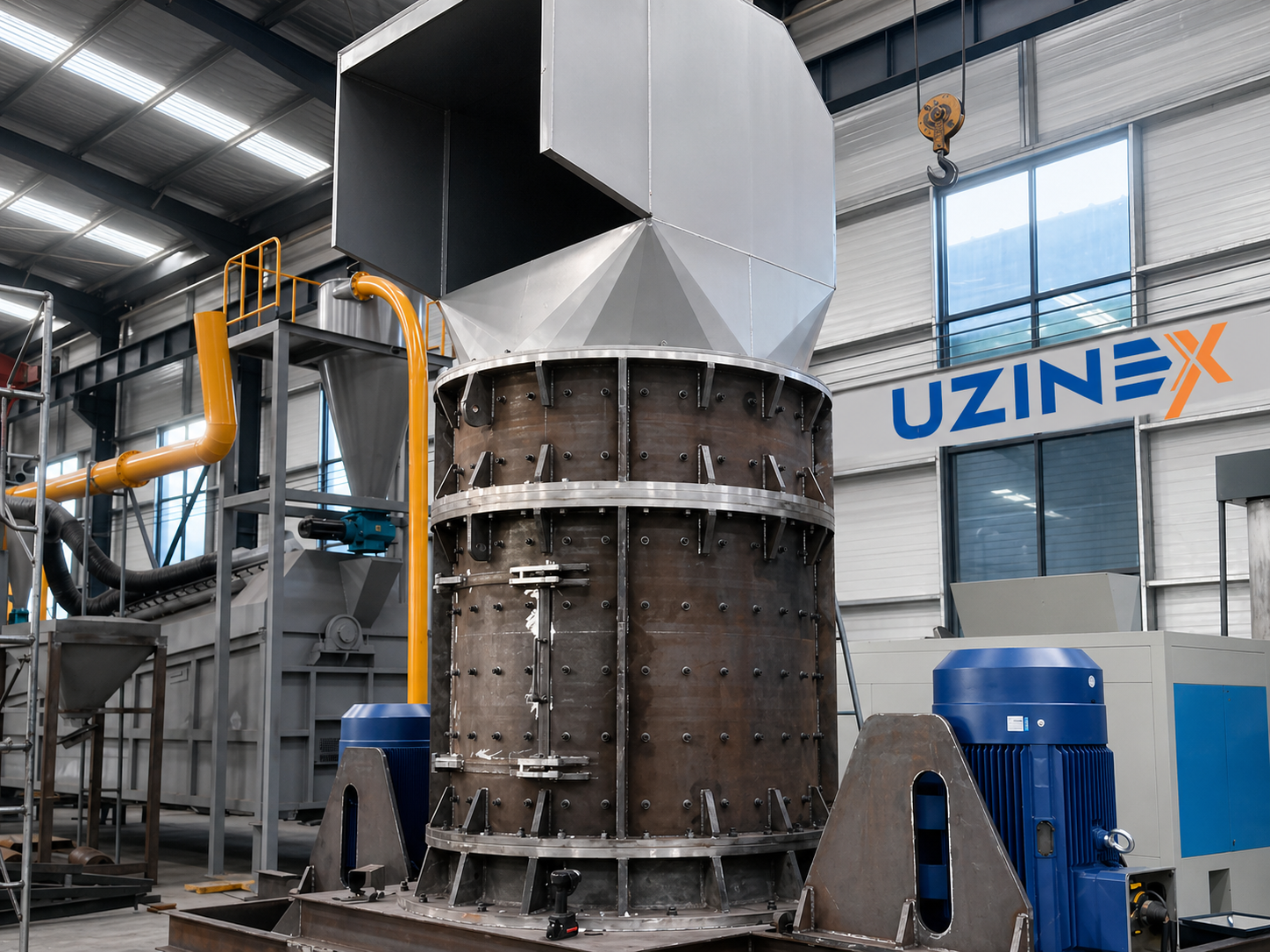
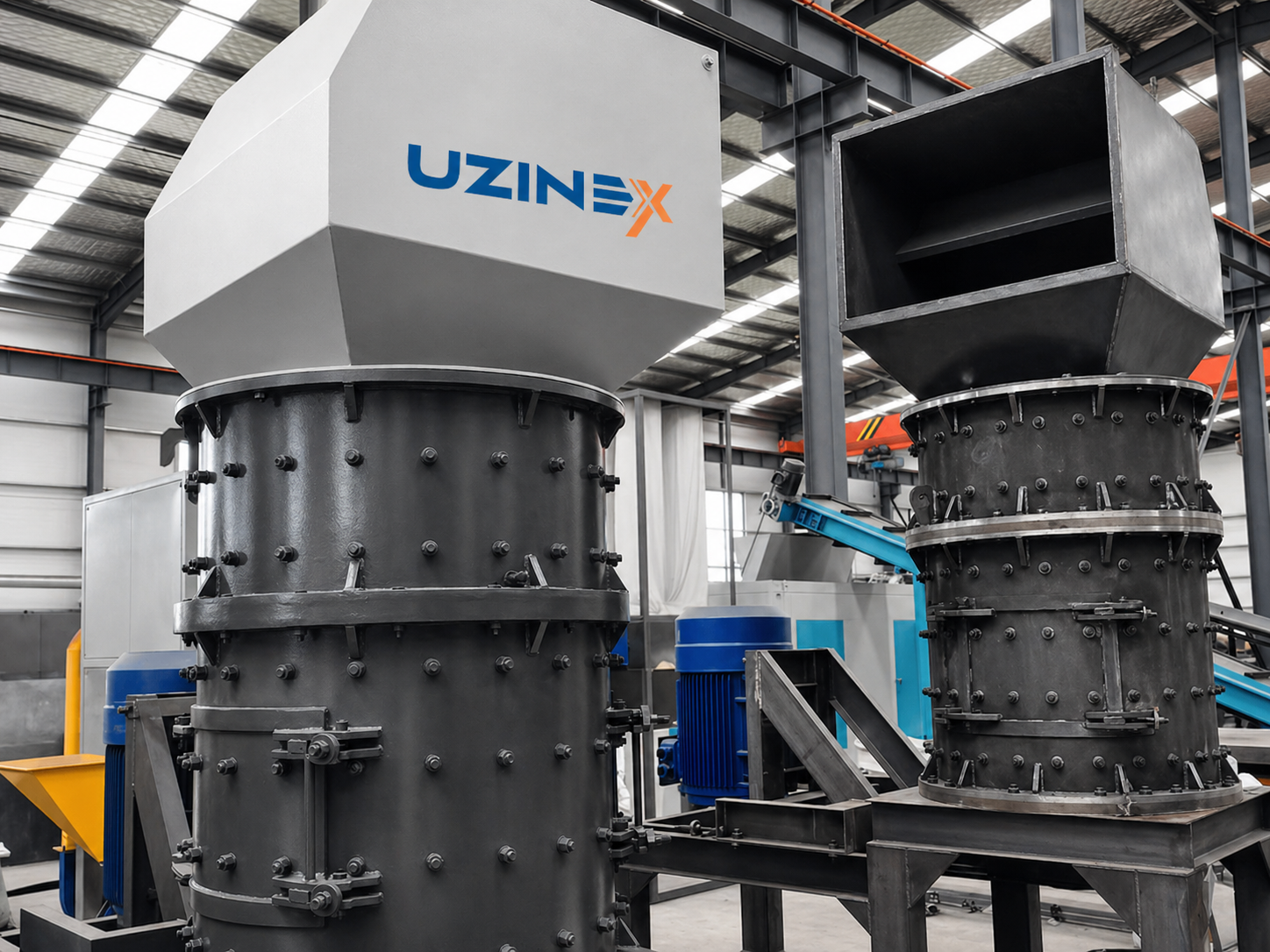
RELIABLE LCP-series vertical metal recycling crusher — a compound machine with a vertical shaft and three configurable methods (blades, hammers, chains) for radiators, scrap aluminium, PCBs, cables, motors and solar panels. Available as LCP-1000/1300/1600/1800, with a maximum feed of 500mm and high-chromium alloy hammers.
This vertical metal recycling crusher delivers a recovery rate 10–15% higher than traditional equipment — a directly quantifiable advantage in the revenue generated from recovered non-ferrous metals.
The vertical-shaft construction structurally differentiates this vertical metal recycling crusher from horizontal hammer crushers: the vertical rotor allows direct gravity feeding of materials up to 500mm in size without primary size-reduction equipment, eliminates the need for a primary shredder for medium-sized materials, and produces particles with uniform morphology optimised for maximum efficiency of the magnetic and eddy-current separators in the secondary stage. Key Advantages of the RELIABLE LCP Vertical Metal Recycling Crusher
• 3 crushing methods in the same body — blades, hammers, chains: The LCP series integrates three configurable crushing principles within the same vertical chamber: blade type for materials of medium mechanical strength, hammer type for high-energy impact on hard metals, and chain type for flexible and ductile materials. The operator selects or combines the methods suited to the dominant material type being processed, without changing the machine or the crushing chamber.
• 500mm maximum feed — no primary shredder for medium materials: The feed opening of the vertical chamber accepts material up to a maximum size of 500mm — whole radiators, medium engine blocks, appliance sub-assemblies and photovoltaic panel sections can be fed directly without pre-shredding. This eliminates the investment and operating cost of a primary shredder for applications with materials under 500mm in size.
• Metal recovery +10-15% over traditional equipment: The uniform particles produced by the LCP's vertical shaft facilitate magnetic separation and air classification with an efficiency 10–15% higher than traditional horizontal crushing equipment. Particles of regular shape and size behave predictably in the magnetic field and the air flow of the separators, reducing mixed fractions and increasing the purity of the recovered metal — directly saleable at higher prices on the secondary raw-materials market.
• Hammers and liner in high-chromium alloy and multi-element steel: The wear parts of the LCP series — hammers and liner plates — are manufactured from high-chromium alloy and wear-resistant multi-element steel, materials superior to the standard alloy steel of horizontal metal crushers. The optimised rotor speed and hammer angle minimise replacement frequency, reducing maintenance cost per tonne of material processed.
• Output size adjustable via speed and number of blades/hammers: Output particle size is adjusted by changing the rotor rotation speed and the number or configuration of installed blades/hammers — without changing the screen grate as on classic crushers. This provides greater flexibility and a shorter setting time when modifying the particle-size specifications required by a change in material or in the secondary-stage separator.
• Uniform particles for magnetic separation and air classification: The vertical design of the crushing chamber produces particles of more uniform shape and size than horizontal crushers — uniformity that maximises the efficiency of magnetic separators (for iron extraction) and eddy-current separators (for aluminium and copper extraction). The purity of the separated metal fractions increases directly with the uniformity of the incoming particles.
• 4 LCP-1000–1800 models scalable by capacity: The range of four models covers processing capacities from small and medium installations (LCP-1000, LCP-1300) to high-volume industrial recycling centres (LCP-1600, LCP-1800). All models share the same vertical-shaft operating principle and the same 3 configurable crushing methods.
• Dual role — primary or secondary crushing: The ability to accept a 500mm feed allows the LCP to be used as a primary crusher for medium-sized materials, eliminating the D-series shredder. For materials larger than 500mm, the LCP operates as a secondary stage after the primary shredder, producing directly the optimal particle size for the third-stage separators.
Specifications and Models — RELIABLE LCP Vertical Metal Recycling Crusher
| Available models | LCP-1000 / LCP-1300 / LCP-1600 / LCP-1800 |
|---|---|
| Construction type | Vertical compound crusher — vertical shaft |
| Crushing methods | 3 configurable: blade type / hammer type / chain type |
| Maximum feed size | 500 mm (no pre-shredding for material under 500mm) |
| Output size adjustment | Via rotor speed and number of blades/hammers (no screen change) |
| Hammers and liner | High-chromium alloy + wear-resistant multi-element steel |
| Metal recovery | +10-15% over traditional equipment |
| Particle output | Uniform — optimised for magnetic separation and air classification |
| Main materials | A/C radiators, automotive radiators, scrap aluminium, PCB circuit boards, cables, motors, lithium batteries, refrigerators, solar panels, scrap iron, tyres |
| Role in the line | Primary (feed ≤500mm) or secondary (after D-series shredder) |
| Customisation | Available on request |
Applications — What the LCP Vertical Metal Recycling Crusher Processes
An LCP-series vertical metal recycling crusher is the central machine of radiator recycling lines. A/C and automotive radiators (aluminium + copper, 60–80% of weight) are fed directly without pre-shredding, producing uniform particles delivered to the eddy-current separator at >99% purity.
This is the most widespread HVAC recycling line globally — the LCP is its heart and the difference between an 85% and a 98% recovery of the non-ferrous metals from every processed radiator.
PCB circuit board and electrical cable recyclers use this vertical metal recycling crusher to fragment PCBs and cables into uniform 5–20mm particles ready for the electrostatic separators that extract copper, gold and valuable components. The regular particles produced by the vertical shaft facilitate electrostatic separation — the irregular particles with sharp edges produced by horizontal crushers disrupt the electrostatic field and reduce separation efficiency. Explore the full range of Uzinex industrial equipment for complete solutions for recycling non-ferrous metals, WEEE and composite materials.
End-of-life photovoltaic panel recycling lines use LCP-type vertical metal recycling crusher systems as the central fragmentation stage — panels contain aluminium (frame), glass, silicon photovoltaic cells and EVA films, each fraction recoverable separately through the combination of vertical crushing + density separation + electrostatic separation, in line with international standards for the recycling of electrical and electronic waste. The 3 Crushing Methods — Configuration Selection Guide
Selecting the correct crushing method for a vertical metal recycling crusher determines energy efficiency, particle morphology and the service life of the wear parts:
• Blade type: Controlled shearing for materials of medium mechanical strength — radiators, aluminium-plastic panels, insulated cables. Produces particles with regular edges, optimal for electrostatic and density separation. Blade wear is faster than hammer wear on abrasive materials.
• Hammer type: High-energy impact for hard metals — motors, cast-aluminium engine blocks, compact scrap iron. Produces cubic particles through impact fracturing, similar to the WCD but with more uniform particles thanks to the vertical shaft. High-chromium alloy hammers with extended service life compared with carbon-steel hammers.
• Chain type: Flexibility for ductile materials and those with low fracture resistance — aluminium foils, thin cables, lithium batteries. The chains yield elastically on impact with unexpected hard materials (massive metal pieces), preventing jamming and rotor damage — an intrinsic protection mechanism against unsuitable material fed in by accident.
Operating Mode — The Crushing Process with the LCP
• Gravity feeding into the vertical chamber: The material (radiator, solar panel, motor, PCB) is gravity-fed through the upper feed inlet of the vertical chamber — directly for materials under 500mm, or from the discharge conveyor of the primary shredder for larger materials. Vertical feeding ensures uniform distribution of the material over the blade/hammer/chain rotor.
• Crushing by the configured method — blades, hammers or chains: The rotor of this vertical metal recycling crusher, with the configured method, fragments the material through centrifugal force and impact with the walls or liner plates of the chamber. The rotor speed and the number of crushing elements determine the fragmentation energy and the particle size produced.
• Particle-size adjustment via speed and configuration: The operator adjusts the rotor speed and, if necessary, the number of blades or hammers to achieve the optimal particle size required by the secondary-stage separators — without stopping for a screen change, through commands from the control panel.
• Discharge of uniform particles to the separators: Uniform particles of the configured size fall by gravity from the vertical chamber onto the discharge conveyor and are directed straight to the magnetic separator (iron), the eddy-current separator (aluminium, copper) or the electrostatic separator (PCBs, cables).
• Wear monitoring and preventive maintenance: The control system monitors rotor vibration and motor current for early detection of hammer or blade wear. On a wear signal, the operator replaces the worn elements by accessing the vertical chamber — without removing the complete rotor.
Frequently Asked Questions about the RELIABLE LCP Vertical Metal Recycling Crusher
Why does the vertical shaft produce more uniform particles than the horizontal shaft?
In horizontal-shaft crushers, centrifugal force throws the material radially and the impact is asymmetric — larger pieces remain in the chamber longer than small ones, producing a wide size distribution at the outlet. In a vertical-shaft vertical metal recycling crusher, the gravity-fed material is uniformly distributed over the rotor and each particle follows a similar path, producing the narrower size distribution and more uniform morphology required by the separators. Can the LCP completely replace the D-series primary shredder for all materials?
The LCP can replace the D-series shredder for materials under 500mm in size — radiators, solar panels, cables, PCBs and medium appliances. For materials larger than 500mm — complete car bodies, whole refrigerators, massive metal drums — the D-series shredder remains necessary as the primary stage. The D-series → LCP combination covers any input material size with the optimal output for the third-stage separators. What is the difference between the LCP and the WCD for radiator recycling?
The LCP is the optimal choice for radiators and materials with a non-ferrous metal content (aluminium + copper): the uniform particles of the vertical shaft maximise non-ferrous metal recovery through the eddy-current separators. The WCD is optimised for ferrous metals (iron, steel) destined for smelters, where cubic particles maximise bulk density for transport and melting. The choice depends on the dominant material and the destination of the recovered metals. Is the chain type method recommended for lithium batteries?
Yes — chain type is the recommended method for lithium batteries, because the chains yield elastically on impact with the metallic battery cells, preventing jamming and rotor damage. Processing lithium batteries requires additional precautions — ventilation, fire suppression and specific procedures for short-circuit risk — regardless of the type of crusher used. The UZINEX team can assist with the complete configuration of a lithium-battery processing line with the necessary safety measures. How does the +10-15% recovery over traditional equipment compare in an economic calculation?
At an aluminium market price of €1,800–2,200/tonne, an additional recovery of 10-15% on a line processing 1 tonne/h means 180–330 kg of additional aluminium recovered per operating hour. On a schedule of 16 hours/day, 250 days/year through any well-configured vertical metal recycling crusher, this represents 720–1320 additional tonnes of aluminium per year — a revenue difference of €1.3–2.9 million annually compared with traditional equipment, solely from the higher recovery efficiency of this vertical metal recycling crusher. Why Buy the RELIABLE Vertical Metal Recycling Crusher from UZINEX?
• Free consultation for model and crushing-method selection: The UZINEX team analyses the type of materials processed (radiators, PCBs, cables, solar panels), the daily volume and the secondary-stage separators, and recommends the LCP model and the crushing-method configuration (blades/hammers/chains) with maximum metal recovery for your specific application.
• Delivery, setup and commissioning included: Every LCP vertical metal recycling crusher delivered through UZINEX includes complete installation, configuration of the crushing method and rotor speed for optimal particle size, and operator training for the adjustment system and maintenance of the high-chromium alloy wear parts.
• Extended 60-month warranty and technical support under 36 hours: The 60-month warranty and the guaranteed response time under 36 hours ensure the continuity of the recycling line — with priority delivery of high-chromium alloy hammers, blades, chains and liner plates from UZINEX's own stock.
• Integrated into the complete RELIABLE ecosystem from UZINEX: The LCP connects natively with the D-series shredders and with the magnetic, eddy-current, electrostatic and density separators from the RELIABLE range distributed by UZINEX — designing and delivering the complete non-ferrous metal recovery line with single-source support for the entire investment.
• ROI documented through superior metal recovery: The 10–15% increase in metal recovery rate over traditional equipment is documented by the manufacturer and translates directly into additional revenue per tonne processed — a quantifiable financial argument to justify the investment to financiers or business partners.
RELIABLE LCP-1000–1800 vertical metal recycling crusher — vertical shaft with 3 configurable crushing methods, 500mm maximum feed without pre-shredding, high-chromium alloy hammers, uniform particles for magnetic and eddy-current separators and metal recovery 10–15% higher than traditional equipment, for any recycling line that needs a vertical metal recycling crusher that maximises the value recovered from every tonne of waste processed.