
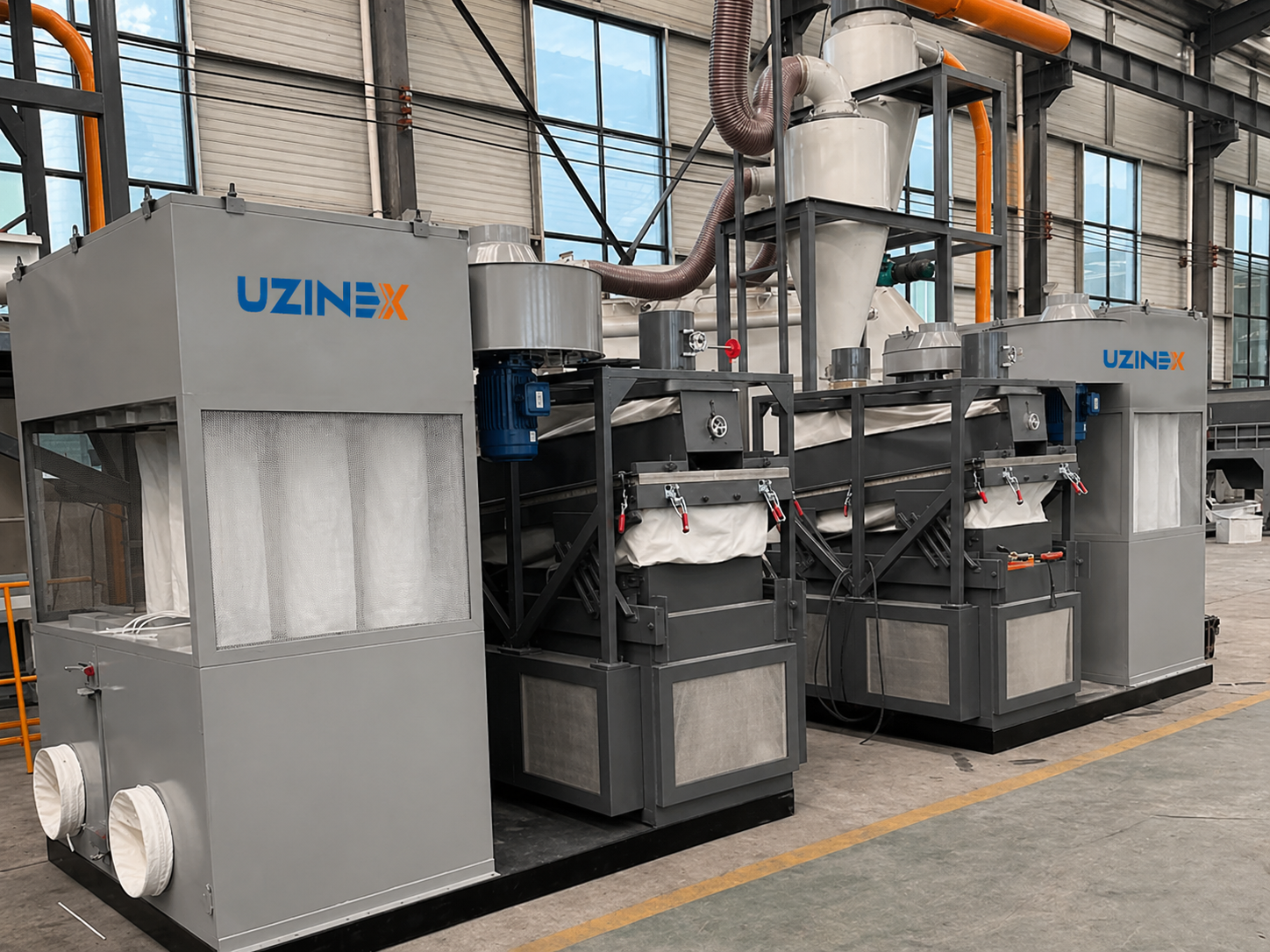
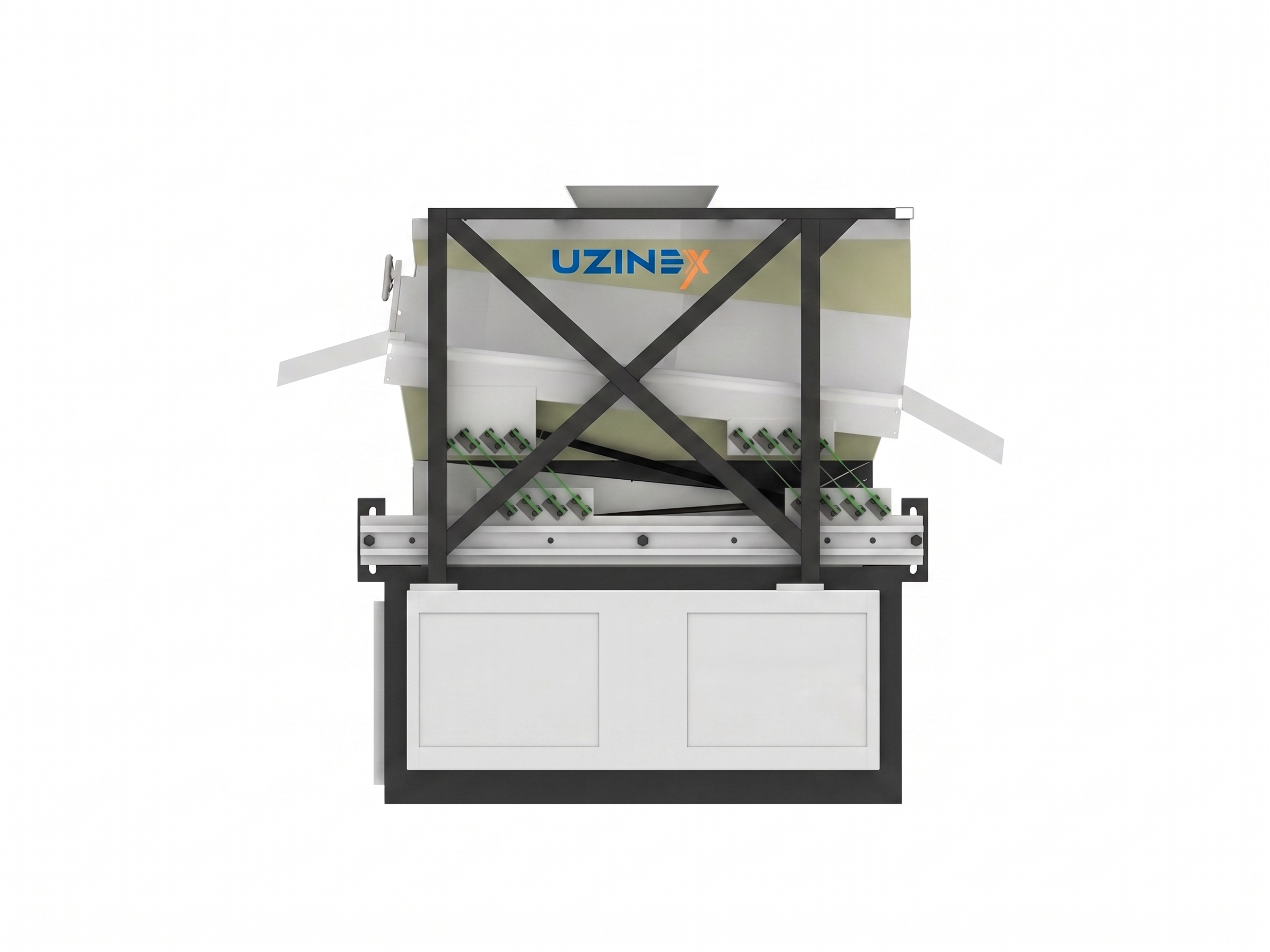
RELIABLE gravity density recycling separator — sorting equipment using air-stream suspension to separate materials of different density: copper from plastic, aluminium from plastic, ore granules, medical powders and grains. Range 50mm–200 mesh, efficiency of 10× over manual sorting, automatic air recirculation and a pulse system for dust removal.
This gravity density recycling separator separates on the basis of material density, not size — the only dry physical method capable of separating copper granules from plastic granules of the same size, which are impossible to separate by mechanical screening or by a horizontal air stream.
Unlike the FX air separator, which separates light from heavy materials through a horizontal air stream, a gravity density recycling separator uses suspension in an upward air stream and the vibration of a perforated plate for the density-based stratification of a mixture of granules of different density but similar size — separation impossible by simple mechanical means or by a horizontal air stream. This makes the gravity separator the indispensable tool for separating copper from plastic in cable granulate, copper from aluminium in radiator granulate and active substances from impurities in the food and pharmaceutical industries. Key Advantages of the RELIABLE Gravity Density Recycling Separator
• Sorting range 50mm–200 mesh — the widest in the RELIABLE separator range: The ability to sort materials from 50mm (coarse granulate fragments) down to 200 mesh (75 micrometres — fine powder) makes this gravity density recycling separator the equipment with the widest operating range in the RELIABLE range. The same density-based separation principle applies across the entire range of particle sizes, without changing the equipment or the sorting chamber — only adjusting the air-stream and vibration parameters.
• 10 times more efficient than manual sorting — documented by the manufacturer: The productivity of manually sorting copper granules from plastic or contaminated grains is limited by human speed and accuracy. The RELIABLE gravity separator processes the same volume of material 10 times faster with greater and more constant accuracy throughout the shift, without the fatigue that degrades manual-sorting quality towards the end of the schedule.
• Automatic air recirculation — integrated classification and collection: The integrated automatic air-recirculation system eliminates the need for a separate external fan and additional air ducts. The air used for material suspension is recovered internally, cleaned by the pulse removal system and recirculated in a closed circuit — reducing energy consumption compared with systems using continuous fresh air and eliminating the loss of fine material through the air exhaust.
• Pulse dust-removal system — zero leakage into the workshop: The pulse removal system, with bag filters and periodically cleaned compressed-air pulses, ensures that the dust generated in the sorting process does not escape into the workshop atmosphere. This protects operator health, complies with workplace air-quality standards and prevents the contamination of other areas of the recycling line with fine copper, aluminium or plastic dust from the sorting chamber.
• Zero waste gases, zero water, zero secondary solid waste: The separation process by air suspension is completely dry and generates no secondary waste — no washing wastewater, no chemical residues, no sludge and no combustion gases. This makes the gravity density recycling separator the cleanest separation method in terms of environmental compliance — ISO 14001 certifiable without special secondary-waste management procedures.
• Precise density separation — works on materials of similar particle size: The main value of the gravity separator over all other separators in the range is its ability to separate materials of similar particle size but different density — a situation impossible for mechanical screens (which separate only by particle size) and difficult for eddy-current or air separators (reduced efficiency when particles have the same size but different density). Copper (8,9 g/cm³) and plastic (0,9–1,4 g/cm³) of the same granule size are separated efficiently by density in the upward air stream of the gravity separator.
• Applicable in 6 distinct fields — from recycling to the food industry: The versatility of the density principle allows the use of this gravity density recycling separator in completely different industries: electrical cable recycling (copper + plastic), radiator recycling (copper + aluminium), ore processing (dense minerals vs. tailings), lithium battery recycling, the purification of pharmaceutical raw materials and grain grading — fields impossible to cover with a single machine based on magnetic or electrostatic principles.
• Purely physical separation — material properties remain intact: Air suspension and gravity stratification do not chemically or thermally alter any processed material. Copper recovered from cable granulate, aluminium from radiators and active substances from pharmaceutical powders have physical and chemical properties identical to virgin materials — saleable at the prices of quality raw materials, not at the discount of contaminated or degraded materials.
Specifications — RELIABLE Gravity Density Recycling Separator
| Separation principle | Suspension in an upward air stream + density stratification |
|---|---|
| Particle-size range | 50 mm → 200 mesh (75 micrometres) — the widest range in the line |
| Efficiency vs. manual | >10× more efficient than manual sorting |
| Air recirculation | Automatic — closed circuit integrated in the equipment |
| Dust removal | Pulse system with bag filters — zero leakage into the workshop |
| Secondary emissions | Zero — no waste gases, no wastewater, no secondary solid waste |
| Separation type | Purely physical — no reagents, no mechanical contact with the sorting parts |
| Processable materials | Copper+plastic, copper+aluminium, aluminium+plastic granules (cables, radiators), ore, lithium battery granules, pharmaceutical substances, grains and seeds |
| Applicable fields | Metal recycling, ore processing, metallurgy, pharmaceutical industry, food industry, battery recycling |
| Customisation | Available on request |
The Physical Principle — How Gravity Suspension Separation Works
The mechanism of the gravity separator is based on a fundamental property of fluid physics — in an upward air stream, materials of different density balance at different heights relative to the vibrating perforated surface:
• The dense layer (heavy materials): Particles of high density (copper 8,9 g/cm³, aluminium 2,7 g/cm³) are hard to suspend in the upward air stream and stratify in the lower layer, in contact with the vibrating perforated plate. The vibration of the plate "transports" the dense layer towards the heavy-material discharge end.
• The light layer (low-density materials): Particles of low density (plastic 0,9–1,4 g/cm³, fibres, organic materials) are easily suspended by the upward air stream and stratify in the upper layer, above the dense layer. The air stream and the geometry of the sorting chamber direct the light layer towards the opposite discharge end, physically separating the two fractions.
• Stratification precision through dual adjustment: The air-stream velocity and the frequency/amplitude of the perforated-plate vibration are adjusted independently to optimise stratification for the specific densities and particle sizes of the processed material. The combination of the two parameters produces a precise separation zone adaptable to any binary mixture of materials of different density.
Applications — Where the Gravity Density Recycling Separator Is Used
A RELIABLE gravity density recycling separator is the key density-separation stage in electrical cable recycling lines. The copper and plastic granules produced by the cable granulator after fine crushing have similar sizes (0,5–5mm) — the identical sizes make separation by mechanical screening impossible. Copper (8,9 g/cm³) and PVC or PE plastic (0,9–1,4 g/cm³) have densities 6–9 times different — a density difference sufficient for precise separation in the upward air stream of the gravity separator, producing a copper fraction with >99% purity directly saleable to copper refineries.
Radiator and automotive aluminium component recycling lines use this gravity density recycling separator as a complementary stage after the eddy-current separator — for the final separation of aluminium granules (2,7 g/cm³) from plastic granules (0,9–1,4 g/cm³) that could not be separated efficiently by eddy currents at fine particle size. Manufacturers of medicines and food supplements use the gravity separator for grading and purifying active powders of impurities of different density, the process complying with pharmaceutical regulations for physical separation without reagents. Explore the full range of Uzinex industrial equipment for integrated recycling and density-separation solutions.
The mining industry, grain processing and seed sorting use gravity density recycling separator systems for the classification and purification of powdered and granular materials — separating dense minerals from tailings in ore concentrates, removing broken or dried seeds (lower density) from grain batches and grading industrial powders into fractions of homogeneous density, in line with international standards for material processing. The Gravity Separator versus the Other RELIABLE Separators — When to Choose Each
Four separators, four distinct physical principles — the correct choice depends on the differentiating property of the materials to be separated and the available particle size:
• Gravity separator (density — upward air stream + vibration): Materials of different density and similar particle size — copper+plastic, aluminium+plastic, ore+tailings, grains. Range 50mm–200 mesh. The unique solution for granules of the same size with different density.
• FX air separator (aerodynamic resistance — horizontal air stream): Light vs. heavy materials of different shape and aerodynamic resistance — plastic films, fibres vs. metal, compact granules. Optimal for separating materials with very different surface/mass ratios, regardless of size.
• Eddy-current separator (alternating magnetic field): Non-ferrous metals (aluminium, copper) from non-magnetic mixtures. Particles 3–100mm. Radiators, auto shred, WEEE. Does not separate metals from plastic at fine particle size.
• DF electrostatic separator (electrical conductivity): Metal vs. non-metal at ultra-fine particles 0,04–1mm. Granulated PCB, aluminium-plastic foils, titanium chips. Does not separate metals of the same conductivity.
Operating Mode — Gravity Suspension Separation
• Feeding the granular mixture onto the perforated plate: The mixed granules (e.g. copper + plastic from the cable recycling line) are fed uniformly onto the surface of the vibrating perforated plate. The thickness of the feed layer is adjusted to ensure correct stratification — too thick a layer inhibits separation by limiting the air stream's access to the lower particles.
• Activating the upward air stream: The fan of this gravity density recycling separator supplies the calibrated upward air stream through the openings of the perforated plate. The air-stream velocity is adjusted for the optimal balancing of the layers of different density — the velocity at which the plastic remains suspended above the plate, but the copper stays in contact with the vibrating plate.
• Density stratification through vibration: The vibration of the perforated plate fluidises the mixture, facilitating the rearrangement of the particles into density layers. The dense layer (copper) forms in contact with the plate; the light layer (plastic) rises above it. The plate's slope and the vibration frequency determine the transport speed of each layer towards the corresponding discharge end.
• Discharging the separated fractions: The copper (the dense layer) is discharged at the end of the inclined plate into separate bunkers; the plastic (the light layer) is discharged at the opposite end or through side deflectors. The separator's adjustable deflector allows the fine adjustment of the separation zone to optimise the purity of the collected fractions.
• Air recirculation and dust removal: The air used for suspension is collected internally, passed through the bag-filter system and cleaned by the compressed-air pulses of the pulse system. The cleaned air is recirculated to the fan in a closed circuit — zero dust emissions into the workshop, constant energy consumption and the collection of the fine dust as a separate saleable fraction.
Frequently Asked Questions about the RELIABLE Gravity Density Recycling Separator
Why can the gravity separator separate copper from plastic when the mechanical screen cannot?
The mechanical screen separates on the basis of size — it passes only what fits through the mesh and retains what does not. If the copper and plastic have the same granule size (e.g. both at 1–3mm from the cable granulation line), the screen can make no separation. This gravity density recycling separator separates on the basis of density, not size — copper (8,9 g/cm³) and plastic (0,9–1,4 g/cm³) have densities 6–9 times different, a difference sufficient for complete separation by any well-calibrated gravity density recycling separator, regardless of whether the granules are the same size. How does the gravity separator differ from the FX air separator — both use air?
The FX uses a horizontal or oblique air stream to entrain light materials with high aerodynamic resistance (films, fibres) versus heavy compact materials — separation based on the surface/mass ratio. The RELIABLE gravity separator uses an upward air stream and the vibration of a perforated plate for the density stratification of granules of similar size — separation based solely on density. They are complementary machines: the FX removes films and fibres from the cable granulate before the gravity separator, which precisely separates copper from plastic at fine particle size. Can the gravity separator process wet materials, or must they be dried?
The materials must be dry before feeding — surface moisture reduces the cohesion between the particles and the air stream, disrupting stratification and reducing the precision of the density separation. Recycling lines that produce wet granulate (washed cables) include a dryer or an air-drying stage before the gravity separator. The UZINEX team checks the material's moisture during the design visit and recommends the appropriate drying stage if needed. Can it also work for pharmaceutical or food materials?
Yes — the manufacturer explicitly lists medical substances and grains/seeds among the equipment's applications. The density-based separation principle and the absence of any chemical agent, lubricant or metal part in direct contact with the processed material comply with the hygiene requirements of food and pharmaceutical processing. The contact materials can be specified in food-grade stainless steel for applications with strict hygiene requirements. The 50mm–200 mesh range is very wide — how is it set for my material's specific particle size?
The 50mm–200 mesh range indicates the total range covered by the equipment, not that all particle sizes are processed simultaneously. For a specific material (e.g. cable granulate at 0,5–3mm), the air-stream and vibration parameters are set to the optimal values for that particle size. The UZINEX team calibrates these parameters at commissioning on the line's real material and trains the operator for the fine adjustments to batch variations. Why Buy the RELIABLE Gravity Density Recycling Separator from UZINEX?
• Free consultation for the optimal configuration: The UZINEX team analyses the densities of the fractions to be separated, the available particle size and the required output purity and configures the air-stream, vibration and deflector parameters for maximum efficiency on your specific material.
• Delivery, commissioning and calibration on real material included: Every gravity density recycling separator delivered through UZINEX includes complete installation, calibration on the line's real material and operator training for adjusting the air-stream and vibration parameters and for maintaining the pulse dust-removal system.
• Extended 60-month warranty and technical support under 36 hours: The 60-month warranty and the guaranteed response time under 36 hours ensure the continuity of the density-separation line — with priority delivery of bag filters and pulse-system components from UZINEX's own stock.
• Documented environmental compliance — zero secondary emissions: The environmental characteristics of this gravity density recycling separator — zero waste gases, zero wastewater, zero secondary solid waste — are documentable for environmental-compliance reports and for ISO 14001 certification — direct arguments for environmental audits and for institutional customers who require proof of the recycling line's ecological compliance.
• Integrated into the complete RELIABLE ecosystem from UZINEX: The gravity separator completes the 3 RELIABLE separators (eddy-current, electrostatic, air) for complete coverage of all physical separation principles, with single-source UZINEX support for the entire recycling and separation line designed, delivered and commissioned.
RELIABLE gravity density recycling separator — air suspension for density stratification, range 50mm–200 mesh, 10 times more efficient than manual sorting, automatic air recirculation, a pulse system without dust emissions and zero secondary waste, for the recycling lines for cables, radiators and batteries and for the pharmaceutical, food and mining industries that need the precise separation of materials of different density at any particle size.