
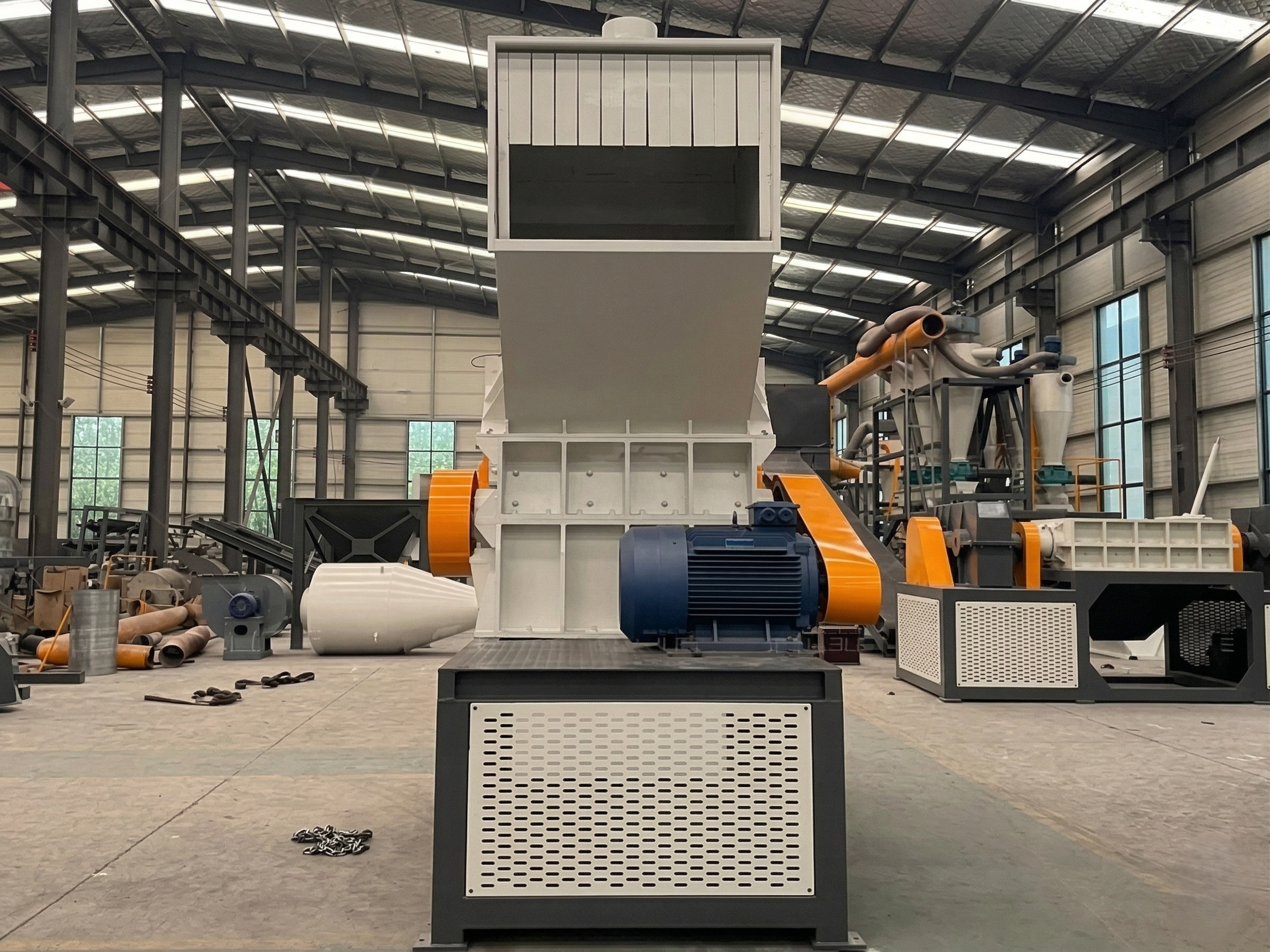
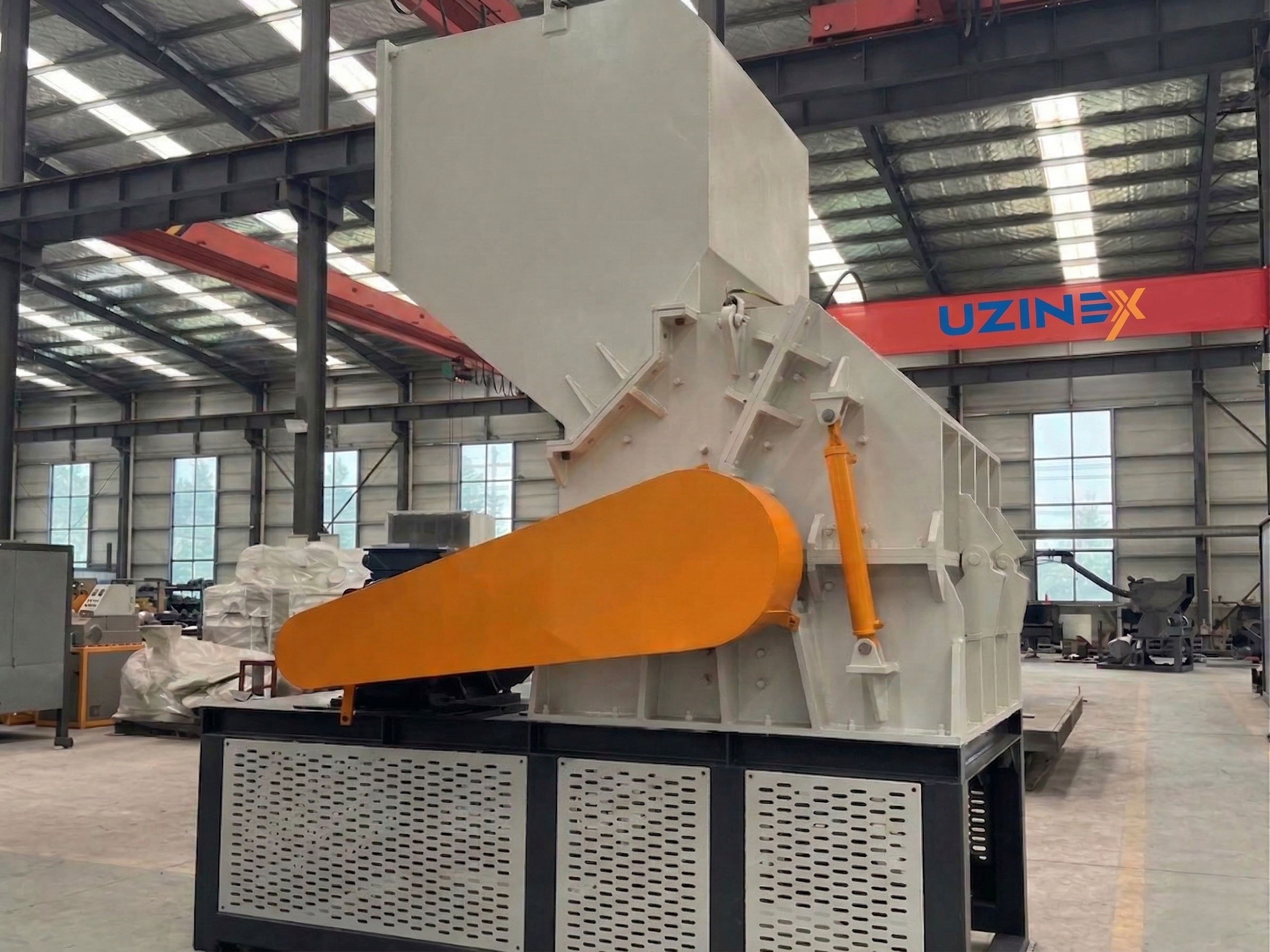
RELIABLE WCD-series metal recycling crusher — the equipment with high-speed, high-torque hammers for fragmenting scrap iron, car bodies, household appliances, motors, metal drums and steel sheet into cubic particles adjustable for smelters. Available in seven models WCD-800–2200, with side maintenance doors and full remote operation.
This metal recycling crusher reduces the volume of metal waste and increases the bulk density of the material by 3–5 times compared to loose metal, reducing transport costs and accelerating the melting speed in metallurgical furnaces.
Unlike dual-shaft shredders that shear metal into 50–150mm pieces, a WCD-series metal recycling crusher with hammers fragments through high-energy impact — the rotor hammers repeatedly strike the metal material until it reaches the size specified by the gap between the hammers and the liner plates of the crushing chamber. The resulting particle is cubic, not flattened or needle-shaped — the morphology required by smelters that feed their furnaces with bulk materials for uniform and efficient melting. Key Advantages of the RELIABLE WCD Metal Recycling Crusher
• Cubic particles with reduced needle and flake content — optimal morphology for smelters: The hammers' impact mechanism produces particles with a regular cubic shape and reduced content of elongated (needle) or flat (flake) particles. Cubic particles pack more densely in the container and in the furnace than the flakes and flat sheet pieces produced by shredders, reducing the transported volume at equal bulk density and distributing uniformly in the melt for a higher melting speed.
• Particle size adjustable to the smelter's specifications: The output particle size is adjusted by modifying the gap between the hammers and the liner plates of the crushing chamber — a setting made quickly without major dismantling. Smelters and furnaces have different specifications for the size of the input material; this metal recycling crusher is configured precisely for the requirements of the end customer for the processed scrap iron.
• Quick-opening side doors — direct access to hammers and liner without dismantling: The side-door design allows direct access to the rotor with hammers and to the liner plates of the crushing chamber without dismantling the main housing or lifting the rotor. The replacement of worn hammers or damaged liners is done with the doors open, significantly reducing downtime compared to crushers with access from the rotor end.
• High-speed, high-torque motor — maximum impact energy on metal material: The main motor of the WCD rotor delivers high torque at high rotation speeds — a combination that maximizes the kinetic energy of the hammers on impact with the metal material. This energy is the most important parameter of a metal recycling crusher with hammers: the greater the impact energy, the more efficiently the harder materials (structural steel, thick body sheet, rims) are fragmented without clogging the crushing chamber.
• Full automation with remote operation — control from a distance: The fully automated control system of the WCD series allows operation from a distance via the remote-operation panel — monitoring the rotor speed, motor current, bearing temperature and the status of the maintenance doors, with start, stop and parameter-adjustment commands without the physical presence of the operator at the machine. This reduces personnel exposure to the noise and dust in the crushing zone.
• Applicable to 8 categories of metal materials: The WCD series processes a wide range of industrial and post-consumer metal waste: generic scrap iron, metal drums and containers, complete vehicle bodies, household appliances (refrigerators, washing machines), galvanized or painted steel sheet (color steel tile), PCB circuit boards, electric motors, lithium batteries and used photovoltaic panels. This eliminates the need for strict sorting by material type before crushing.
• Reduced transport costs — increased bulk density: Unprocessed scrap iron (sheet metal, car bodies, whole appliances) has a bulk density of 50–150 kg/m³. Fragmenting it into cubic particles of the specified size increases the bulk density to 300–600 kg/m³ — 3–5 times more material per the same transport tonnage, directly reducing the transport cost per tonne of metal delivered to the smelter.
• 7 models WCD-800–2200 — scalable from local stations to industrial capacities: The wide range of models covers all sizes of scrap iron processing operations — from local collectors and processors with the WCD-800 to industrial metal recycling centres with the WCD-2000 and WCD-2200. All models share the same maintenance principle through side doors, facilitating operator training.
Specifications and Models — RELIABLE WCD Metal Recycling Crusher
| Available models | WCD-800 / WCD-1000 / WCD-1300 / WCD-1600 / WCD-1800 / WCD-2000 / WCD-2200 |
|---|---|
| Operating principle | Hammer crusher — high-torque rotating hammers + liner plates |
| Processable materials | Scrap iron, metal drums, car bodies, household appliances, galvanized/painted steel sheet, PCB circuit boards, motors, lithium batteries, solar panels, refrigerators |
| Output particle shape | Cubic — reduced needle and flake content |
| Particle size | Adjustable — to the customer / smelter specifications |
| Maintenance | Quick-opening side doors — direct access to hammers and liner |
| Control | Full automation with remote operation (control from a distance) |
| Operating benefits | Reduced transport costs, increased bulk density, accelerated melting speed |
| Customization | Specific dimensions on request |
| Use in the line | Primary or secondary after the D-series shredder |
Applications — What the WCD Metal Recycling Crusher Processes
A WCD-series metal recycling crusher is the central equipment of scrap iron processing stations that deliver the material directly to smelters and furnaces. Metal waste collectors who purchase scrapped cars, used appliances and demolished metal structures use the WCD to transform bulk, voluminous material with low bulk density into dense cubic particles recoverable at the market price of processed iron — significantly higher than that of unprocessed loose iron. Car bodies, motors and metal drums are introduced directly into the crushing chamber without pre-cutting or pre-preparation.
WEEE (waste electrical and electronic equipment) recyclers use this metal recycling crusher as the first fragmentation stage for refrigerators, washing machines, televisions and IT equipment — reducing large bodies to particles of the specified size for the magnetic, eddy-current or electrostatic separators in the secondary stage. Galvanized or painted steel sheet from construction (metal roof tiles, sandwich panels) and used photovoltaic panels are other high-volume applications growing in Romania. Explore the complete range of Uzinex industrial equipment for integrated solutions in recycling metals, WEEE and composite materials.
Manufacturers and metalworking workshops use WCD-type metal recycling crusher systems for the internal recovery of metal scrap, scrapped parts and production waste — reducing the cost of managing metal waste and recovering the raw material value through direct delivery to the smelter, in accordance with international standards for processing and recovering metal waste. Position in the Recycling Line — Metal Crusher vs. Shredder vs. Plastic Crusher
Each piece of equipment in the RELIABLE range from Uzinex has a specific role in the processing chain — the right choice depends on the material processed and the required output:
• D-series shredder (Double Shaft) → 50–150mm pieces: The first stage for voluminous metal materials (whole refrigerators, seized motors). Produces 50–150mm pieces that enter the metal crusher for final fragmentation or go directly to the smelter if the size is accepted.
• WCD crusher (Metal Crusher) → cubic particles at the specified size: Primary or secondary stage for metals — produces cubic particles to the smelter's specifications. It can process metal materials of moderate size directly without the primary shredder; for massive materials, the D shredder precedes the WCD.
• WGD crusher (Plastic Crusher) → ~1cm granules: The equipment for plastic — not suitable for metal. The WGD produces fine granules of 8–15mm through blade shearing, optimized for polymers, not for metals of high mechanical strength.
• Combined use WCD + magnetic separator: The particles from the WCD crusher contain mixed ferrous and non-ferrous metal. The magnetic separator extracts the iron; the eddy-current separator extracts the aluminium and copper — a complete metallurgical separation line in three steps starting from crushing.
How It Works — The Crushing Process with the WCD
• Feeding the metal material into the crushing chamber: The metal material — car body, appliance, construction sheet — is fed manually with a crane or electromagnet or by conveyor belt into the crusher's feed opening. The WCD-1600–2200 models accept larger materials directly; for massive pieces (seized engine block, thick metal structures), the primary D-series shredder reduces the size beforehand.
• Fragmentation through high-speed impact: The rotor with hammers — driven by the high-speed, high-torque motor — repeatedly strikes the metal material, generating the impact energy needed to fracture the metal. The material ricochets between the hammers and the liner plates until it reaches the size specified by the adjusted gap of the crushing chamber.
• Size control through the hammer-liner gap: The final particle size is determined by the gap between the edge of the rotating hammers and the surface of the liner plates fixed on the housing. The operator adjusts this gap (usually 10–150mm depending on the model) to reach the size specified by the smelter or the magnetic separation stage.
• Discharge of the particles and transport to the secondary stage: The cubic particles of this metal recycling crusher fall by gravity through the discharge grate of the crushing chamber into the discharge conveyor and are directed towards the delivery container for the smelter or towards the magnetic separator in the secondary stage.
• Maintenance through side doors — hammer and liner replacement: When the hammers or liner plates wear, the operator opens the side doors of the housing, directly accesses the rotor and liners without dismantling, replaces the worn components and restarts production. Remote operation allows wear to be monitored in real time through the motor current and the early signaling of the need for replacement.
Frequently Asked Questions about the RELIABLE WCD Metal Recycling Crusher
Why are cubic particles more valuable than flat sheet pieces for smelters?
Smelters receive the material at a price correlated with bulk density — denser material = more efficient melting. Flat pieces and flakes occupy a lot of volume at low density and produce uneven melting zones.
The cubic particles of this metal recycling crusher pack at a bulk density 3–5 times higher, melt uniformly and reduce energy consumption per tonne — direct advantages that make any WCD metal recycling crusher a tool for increasing revenue from the recovery of scrap iron. Can the WCD process lithium batteries safely?
Lithium batteries are listed in the applications of the WCD series, but their processing requires additional precautions — adequate ventilation, a fire suppression system and specific operating procedures for managing the risk of short circuit and ignition when fragmenting lithium cells. The UZINEX team can assist with the configuration of the lithium battery processing line with the necessary safety measures, including complementary fire suppression equipment and gas collection systems. What is the difference between the WCD (hammer crusher) and the D-series shredder for metal?
The D-series dual-shaft shredder shears the metal into 50–150mm pieces through the action of two rows of knives rotating in opposite directions — a slower and more controlled mechanism, suited to the first stage of size reduction. The WCD crusher with hammers fragments through high-energy impact at higher speeds, producing finer cubic particles with the morphology required by smelters. On pure metal flows, the WCD can operate directly without the primary shredder for moderately sized pieces; on massive or compact materials, the combination D-series → WCD produces the optimal result. How is the output particle size adjusted?
The output size is adjusted by changing the gap between the hammers and the liner plates of the crushing chamber. This adjustment is made with the machine stopped, via the integrated adjustment system of the WCD models, without replacing parts or making construction modifications. The typical size is 20–80mm for feeding smelters, but it can be configured to the exact specifications of the beneficiary at delivery and commissioning by the UZINEX team. Which WCD model is suitable for processing whole car bodies?
Complete car bodies require WCD-1600 models or larger — WCD-1800, WCD-2000 or WCD-2200 depending on the type and number of bodies processed per hour. The bodies are pre-depolluted (removal of fluids, the catalytic converter and hazardous components) before crushing. The UZINEX team analyzes the daily volume of car bodies, the maximum dimensions and the output particle size specifications and recommends the WCD model with the optimal capacity for your operation. Why Buy the RELIABLE Metal Recycling Crusher from UZINEX?
• Free consultancy for model selection and particle size configuration: The UZINEX team analyzes the type of metal materials processed, the daily volume and the specifications of the beneficiary smelter and configures this metal recycling crusher with the WCD model and the adjustment size suited to your specific application.
• Delivery, commissioning and automation system configuration included: Every WCD metal recycling crusher delivered through UZINEX includes complete installation, adjustment of the particle size to the beneficiary smelter's specifications and operator training for the remote operation system, wear monitoring and hammer replacement through the side doors.
• Extended 60-month warranty and technical support under 36 hours: The 60-month warranty and the guaranteed response time under 36 hours ensure the continuity of scrap iron processing — with priority delivery of hammers, liner plates and wear components from UZINEX's own stock, minimizing unplanned downtime during periods of intensive collection.
• Integrated into the complete RELIABLE ecosystem from UZINEX: The WCD integrates natively with the D-series shredders and with the magnetic, eddy-current and electrostatic separators in the RELIABLE range distributed by UZINEX, allowing the design and delivery of the complete metal processing line — from raw metal waste to the pure iron, aluminium and copper fractions ready for recovery.
• A globally proven solution — active installations in Thailand, Vietnam and France: The RELIABLE series is installed and operational in recycling facilities on three continents, including the installation in Thailand where RELIABLE equipment processes household appliance waste in a complex. References are available on request for evaluating performance before the purchase decision.
RELIABLE metal recycling crusher WCD-800–2200 — high-speed, high-torque hammers, cubic particles adjustable to the smelter's specifications, side doors for rapid maintenance and full remote operation, for processing stations handling scrap iron, car bodies, household appliances and WEEE that deliver dense and uniform material to smelters and furnaces with reduced transport costs and maximized melting speed.