
01
Spur gears
The most common gears. Pinions and wheels for reducers, gearboxes and drives, hobbed in a single set-up.
A farmer from Pechea, in Galați County, Romania, who still works his land, opened a second line of business through his company, Miatec S.R.L.: a gear cutting workshop. With funding from AFIR, the Romanian agency that channels EU rural investment money, UZINEX delivered a CNC gear hobbing machine with 7 axes controlled by a Siemens Sinumerik 828D. It cuts spur and helical gears, gearbox pinions, gear pump gears, worm wheels and spline shafts, for his own farm machinery and for customers in the area.
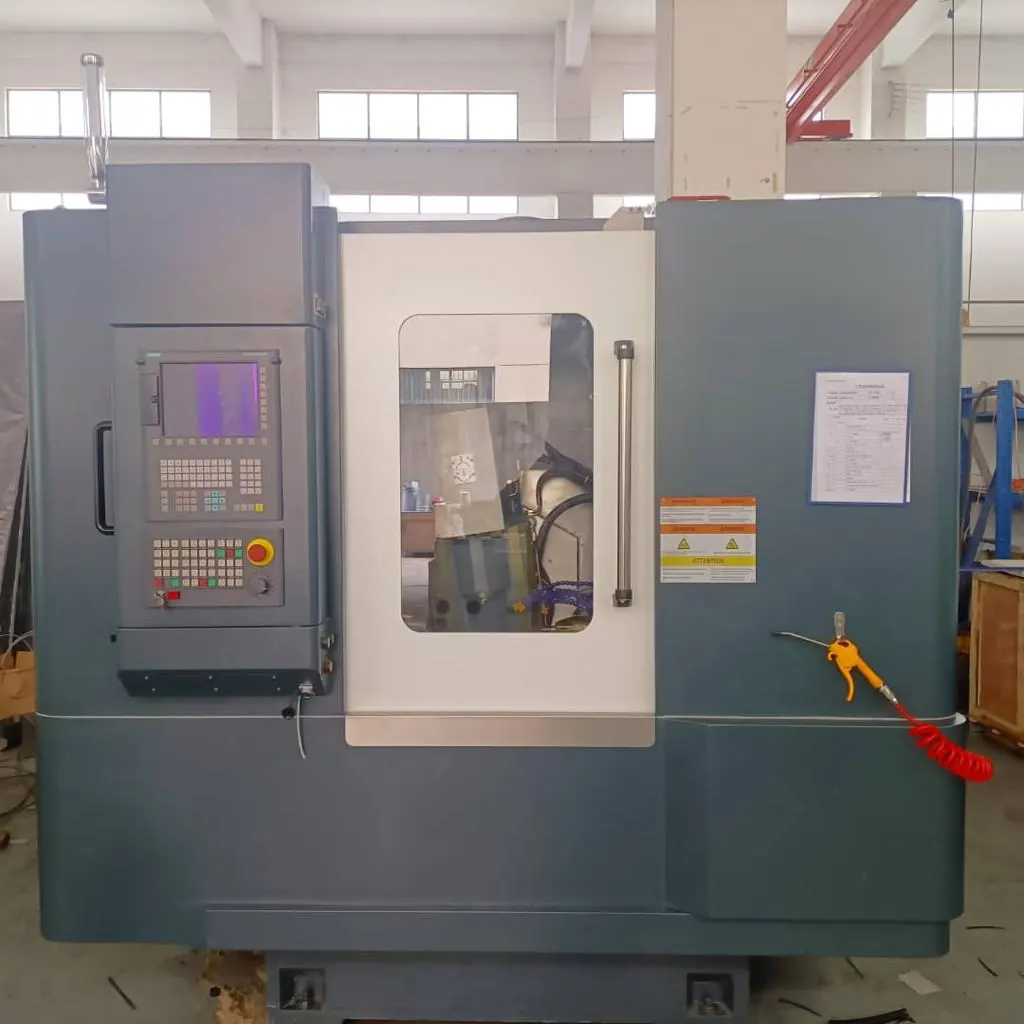
Anyone who runs farm machinery knows what the season looks like: a gearbox fails, then a seed drill reducer, then a hydraulic pump on a tractor. Most of the time the missing part is a gear or a pinion. The original spare part is slow to arrive, and for machines that are out of production it may never arrive at all.
The owner of Miatec farms in Pechea and keeps farming. He noticed that his neighbours, the machine shops in Galați County and the farm machinery repair services all had the same problem. That became his second line of business: a workshop that makes gears to order, from a sample or from a drawing, in small and medium batches.
The investment was backed by AFIR funding for diversifying farm income. His requirements were clear: a machine a new operator learns quickly, one that holds accuracy from the first part to the last in a batch, and one that covers the parts the area actually needs, meaning gearbox pinions, gear pump gears, worm wheels and spline shafts. Our answer was a CNC gear hobbing machine with a Siemens Sinumerik 828D control.
Gear hobbing is how most of the world's cylindrical gears are made. On a CNC hobbing machine, the same workshop moves from a one-off replacement gear to a batch of several hundred by changing only the program and the hob.
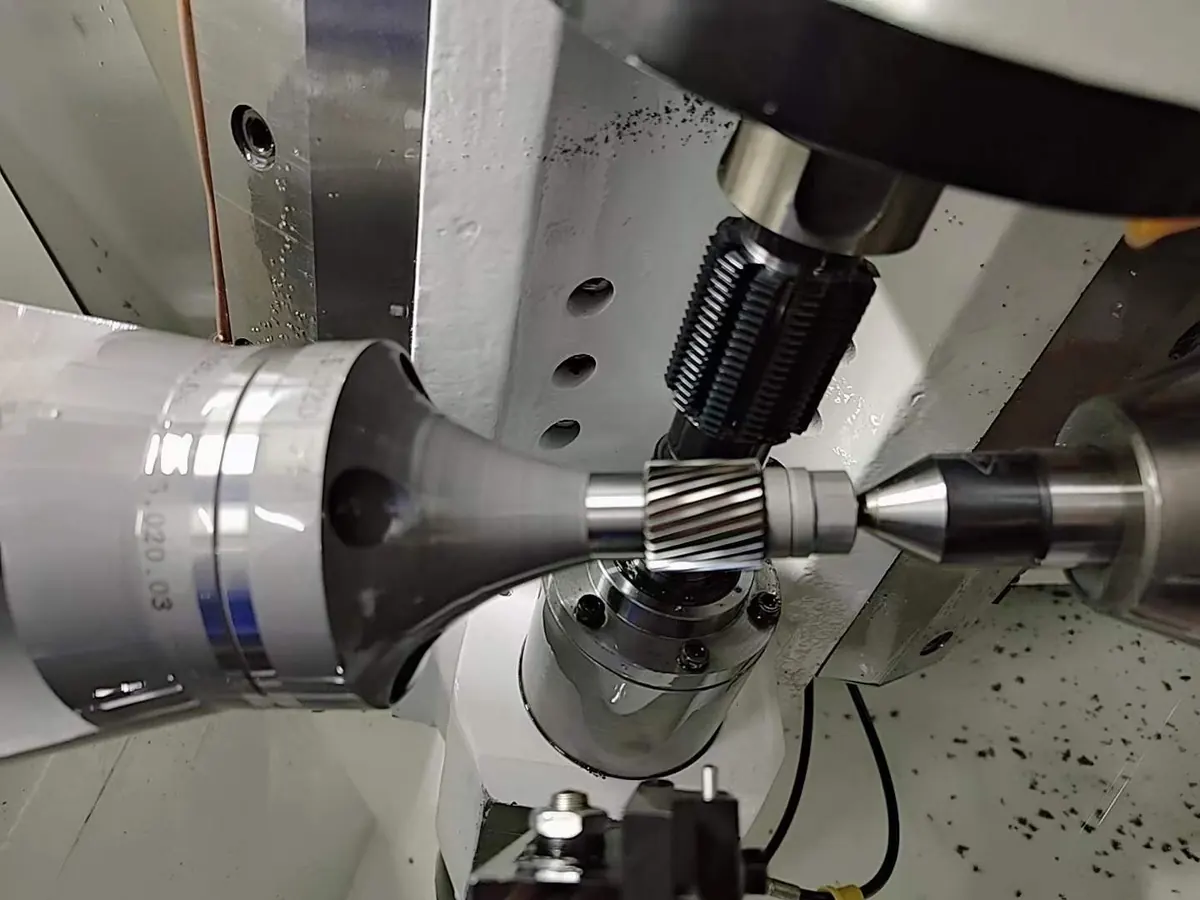
A hob cutter looks like a screw with grooves cut across its thread. Each groove creates a cutting edge, and the edges together form the profile of a rack. When the hob and the gear blank rotate locked to a fixed ratio, the edges cut the tooth spaces one after another and the flanks come out with an involute profile. The tooth shape is generated by the motion itself, which is why hobbing is called a generating process.
The ratio is simple: with a single-start hob, the workpiece advances exactly one tooth for every turn of the hob. A 20-tooth gear makes one full turn for 20 turns of the hob. Older hobbing machines got that ratio from change gears. On a CNC gear hobbing machine the control holds it electronically, between the hob axis and the table axis. A new gear means a new program on the same machine.
The hob spindle, with a BT30 taper and automatic hydraulic tool clamping, turns at up to 5,000 rpm.
The rotary table turns the workpiece in sync with the hob, up to 270 rpm, with a precision motor for exact indexing.
The hob travels across the face width along the workpiece axis. Z-axis travel is 300 mm.
The distance between hob and workpiece sets the tooth depth, programmed in one or several passes.
The hob head swivels up to ±45° to match the hob lead angle and the helix angle of the gear. That is how helical gears are cut.
The hob moves along its own axis between parts, so wear spreads over its whole length and the tool lasts longer.
Single-start hob: the workpiece advances 1 tooth per hob turn (z = 20)
These are the values of the machine delivered, in its Siemens-controlled configuration. For larger parts or coarser modules, we size the gear hobbing machine in the quotation.
| Gear types | spur and helical cylindrical gears, worm wheels, spline shafts |
|---|---|
| Module | 0.1–3 mm |
| Maximum workpiece diameter | 120 mm |
| Minimum number of teeth | 3 |
| Accuracy | grade 7, ISO 1328 scale |
| CNC axes | 7 |
| CNC control | Siemens Sinumerik 828D, Siemens direct-drive axes |
| Maximum hob (diameter × length) | 80 × 90 mm |
| Hob clamping | BT30 taper, automatic hydraulic clamping and release |
| Maximum hob speed | 5,000 rpm |
| Hob head swivel | ±45° |
| Z-axis travel | 300 mm |
| Hob axis to workpiece axis distance | 15–95 mm |
| Rotary table diameter | 150 mm |
| Maximum table speed | 270 rpm |
| Installed power | 13 kW |
| Power supply | 380 V, three-phase, 50 Hz |
| Weight | 5,900 kg |
| Interface | keyboard and screen in English |
A CNC control widely used in European machine shops. All the main control units are Siemens, and the axes are direct-drive.
The hob spindle has a BT30 taper with automatic hydraulic clamping and release, so tool changes and set-up are quick.
High rigidity, accuracy that holds over time, and easy maintenance.
Exact table indexing and enough cutting force for hobbing.
Precise hob shifting, longer tool life, and full cutting rigidity.
A precision linear guide moved by a hydraulic cylinder, with a live centre that protects the workpiece centre hole.
Stainless steel inner guarding fully separates the cutting zone and makes chip removal easier.
Hydraulic unit, lubrication, coolant and chip separator, all fitted to the machine at delivery.
The machine covers the small and medium parts most often needed for repairs and short runs: up to 120 mm in diameter and module 3. In practice, gears for reducers, pumps, farm machinery gearboxes and drive mechanisms.
The most common gears. Pinions and wheels for reducers, gearboxes and drives, hobbed in a single set-up.
The hob head swivels to the helix angle. Helical gears run quieter and carry more load than spur gears, which is why reducers and gearboxes use them.
The wheel of a worm drive, with teeth curved around the worm. It is hobbed with a hob that has the same profile as the mating worm.
Involute splines are hobbed exactly like a gear, with a spline hob. PTO shafts and drive hubs are typical parts.
The machine works from 3 teeth up, so small pinions cut integral with the shaft are possible for pumps and reducers.
Gear pairs in hydraulic pumps need an accurate profile and tight clearance to hold pressure. Grade 7 straight from hobbing covers many of them; tighter requirements are met by grinding afterwards.
The material follows the load, the speed and the working environment. The table shows the combinations used most often for the parts made in this workshop.
| Material | Typical use | Heat treatment |
|---|---|---|
| 42CrMo4 (≈ AISI 4140, quenched and tempered alloy steel) | loaded reducer pinions and gears, spline shafts | quenched and tempered before hobbing, optional induction hardening after |
| 16MnCr5 and 20MnCr5 (≈ AISI 5115/5120, case-hardening steels) | gearbox and reducer gears with high flank wear | carburized and hardened after hobbing, then ground when high accuracy is required |
| C45 (≈ AISI 1045, carbon steel) | gears and pinions under moderate load, common spare parts | normalized or quenched and tempered, optional induction hardening |
| CuSn12 (tin bronze) | worm wheels | none; runs against a hardened steel worm |
| Grey or ductile iron (EN-GJL, EN-GJS) | large, slow gears and geared housings | none or stress relief |
| Stainless steel (e.g. X20Cr13, ≈ AISI 420) | food-grade and corrosive-media pumps | hardened and tempered, depending on grade |
| Engineering plastics (POM, PA6) | quiet gears, light loads, running without lubrication | none |
There are several ways to make a gear. The table shows where each process fits, and why a gear workshop usually starts with a CNC gear hobbing machine.
| Process | How it works | Typical parts | Typical accuracy (ISO 1328) | When to choose it |
|---|---|---|---|---|
| Gear hobbing | hob and workpiece rotate in sync while the hob feeds across the face width | spur and helical gears, worm wheels, splines, pinions | grades 7–9 | batches and repairs; the most productive process for external gears |
| Gear shaping | a pinion-type cutter reciprocates and rolls with the workpiece | internal gears, gears next to a shoulder, cluster gears | grades 7–9 | when a hob has no run-out room or the gear is internal |
| Form milling with a module cutter | a disc cutter machines one tooth space at a time on a dividing head | one-offs, repairs, coarse modules | grades 9–11 | a single part when needed, on a universal milling machine |
| Gear grinding | an abrasive wheel finishes the flanks after heat treatment | hardened high-precision gears | grades 3–6 | after hobbing and hardening, when noise and accuracy matter |
Accuracy grades are indicative. Real results depend on the tool, the material, the workholding and the set-up.
Installation and commissioning were carried out by Sorin Baciu of UZINEX, together with an external partner. Operator training was part of the delivery. Click any image to enlarge it.
The price included transport to the client's site, installation, commissioning and operator training. The engineer who commissioned the machine remains the client's contact after delivery.
Enter your own figures: how many gears you buy each month, at what price, what the material and an hour of machine time cost. The calculator shows your cost per gear, the monthly saving, how loaded the machine is and how many months it takes to pay back the investment. The starting values are only an example.
Cost per gear = material + cycle time × machine-hour cost. Payback = your investment ÷ monthly saving.
A machine tool that cuts gear teeth by hobbing. The hob, which looks like a grooved screw, and the gear blank rotate in sync, and the teeth are generated with an involute profile. Hobbing is the most widely used process for external cylindrical gears.
Spur and helical cylindrical gears, pinions from 3 teeth up, worm wheels and involute spline shafts. In practice: reducer pinions and gears, gear pump gears, farm machinery gearbox gears and spare parts copied from a sample.
Module 0.1 to 3 mm and parts up to 120 mm in diameter, from 3 teeth up. The Z-axis travel, which sets how far the hob can feed along the part, is 300 mm.
Grade 7 on the ISO 1328 scale, the usual level for quality gear hobbing. Real accuracy depends on the hob, the material and the workholding. For grades 5 or 6, the gear is ground after heat treatment.
ISO 1328 classifies gears by pitch, profile and helix deviations; a lower number means higher accuracy. AGMA 2015 uses a similar scale, from A2 to A11. Grade 7 is typical for industrial reducers, farm machinery gearboxes and standard pumps.
Yes. The hob head swivels up to ±45°, and the Sinumerik 828D links table rotation to axial feed so the required helix angle comes out on the part.
Yes, both. Worm wheels are cut with a hob that matches the profile of the mating worm. Involute splines are hobbed with a spline hob, exactly like a gear.
Internal gears and gears with a shoulder very close to the teeth are made by gear shaping, on a shaping machine with a pinion-type cutter. A hob needs run-in and run-out room on the outside of the part.
It is a CNC control widely used in European machine shops, with extensive documentation and many programmers who know it. On the delivered machine all the main control units are Siemens and the axes are direct-drive. For a new workshop that matters twice: operators learn faster and support for the control is easy to find.
The price depends on maximum workpiece diameter, module, CNC control and options. The investment in this project was over €100,000. For a quotation, send us the parts you want to make: drawing or sample, material and yearly volume.
Yes, when the investment fits the eligible activities of the programme. In this project, AFIR funding, which channels EU money for rural investment in Romania, backed the diversification of a farm in Pechea, through Miatec, into manufacturing. UZINEX prepares the technical offer and the supplier documents the application needs.
380 V, three-phase, 50 Hz, with 13 kW installed power. The machine weighs 5,900 kg and stands on a concrete floor able to carry that weight. We agree the location and unloading access with the client before delivery.
Training is part of the delivery and takes place at the client's workshop, on his own machine: start-up and shutdown, holding the part between centres, mounting and centring the hob, working with the Sinumerik 828D and the first hobbing programs. After training, the UZINEX engineer stays available for questions.
Usually before. Case-hardening steels such as 16MnCr5 are hobbed soft, then carburized and hardened; when high accuracy is needed the flanks are ground afterwards. Through-hardening steels such as 42CrMo4 are quenched and tempered before hobbing and can be induction hardened after.
A module cutter, or disc cutter, has the profile of one tooth space and machines space by space, with the part indexed on a dividing head; it suits one-offs. A hob generates all the teeth by continuous rolling, is far more productive and gives the correct profile for any tooth count with the same tool.
60 months, with on-site service within 48 hours anywhere in Romania and video support for set-up and programming.
Maximum part diameter and module, gear types (spur, helical, worm wheels, splines), material, yearly volume and, if available, part drawings. We size the machine and the hobs from that.
Machining · gears · Pechea, Galați County. Talk to our engineer about your profile and get a tailored offer with equipment sized for your flow, financing and an implementation plan.
Contact our team and receive a tailored offer within 24 working hours at most.
The configuration delivered here was sized on the client's figures. The categories below are the starting point if you have a similar flow.
The machine from this project: gears with module 0.1–3, up to 120 mm in diameter.
See the category →The catalogue category the gear hobbing machine belongs to.
See the category →The gear blank is turned before hobbing.
See the category →A firefighter who became a knitwear factory founder. An AFIR investment above €100K. Two knitting machines of 1.5 tonnes each brought in by plane to meet the funding deadline.
A family back from Italy after 9 years. UV flatbed 2×3 m, automatic cutter, laser, banner plotter. The winning niche: custom floor and wall tiles.
7 machines in 9 years, ≈ €500,000 of continuous investment. The absolute UZINEX record on a 6 kW fiber laser.