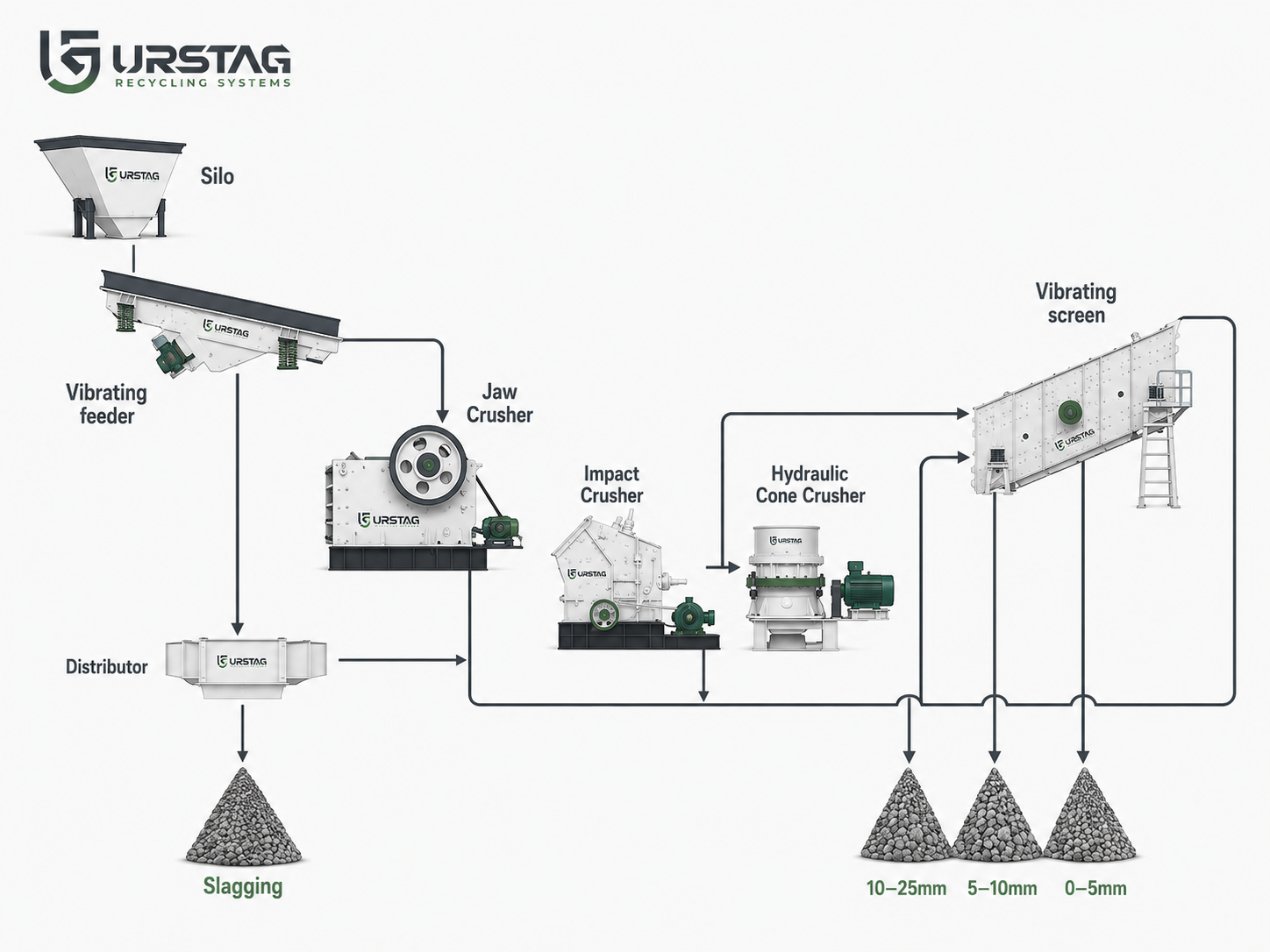
Processing stone and aggregates on a site involves four successive operations, feeding, primary crushing, secondary crushing and screening, which traditionally require four separate machines. A 4 in 1 mobile stone crusher from URSTAG integrates all four onto a single mobile chassis, turning an entire crushing flow into one unit that can move to where the material is, eliminating the transport between separate machines.
A URSTAG 4 in 1 mobile stone crusher combines the vibrating feeder, the primary jaw crusher, the secondary crusher (cone for hard rock or impact for soft rock) and the vibrating screen, delivering size-graded aggregates ready for use. Explore the full range of industrial equipment and the solutions for stone crushing.
Key Advantages of a Mobile Crushing Plant
• Four functions in one unit, a 4 in 1 mobile stone crusher integrates the vibrating feeder, the primary crusher, the secondary crusher and the vibrating screen on the same mobile chassis.
• Chassis mobility, the entire plant relocates between sites, producing aggregates directly at the material source.
• Impact or cone choice, impact crusher for soft rock, cone crusher for hard rock, depending on the material processed.
• Universal modular design, simpler production organization, shorter installation and production times.
• Productivity up to 180 t/h, configurations from 30 to 180 t/h, matched to material volume.
• Size grading, the vibrating screen separates aggregates into fractions, such as 0-5, 5-10 and 10-25 mm.
• Complete integrated flow, from feeding to graded aggregates, with no transport between separate machines.
• Optional autonomy, optional diesel generator for sites without access to the power grid.
Technical Specifications, 4 in 1 Mobile Stone Crusher (Configurations)
| Model | U4M-46C | U4M-46J | U4M-57C | U4M-57J | U4M-69C | U4M-69I |
|---|---|---|---|---|---|---|
| Total power (kW) | 132.4 | 115.4 | 232.9 | 186.9 | 252.9 | 272.9 |
| Productivity (t/h) | 30-90 | 30-70 | 55-150 | 55-110 | 80-180 | 80-180 |
| Secondary crusher | Cone | Jaw | Cone | Jaw | Cone | Impact |
Main Components
| Component | Characteristics |
|---|---|
| Vibrating feeder | Width 700-900 mm, length 2400-4000 mm |
| Primary jaw crusher | Power 30-75 kW; max feeding 210-480 mm; outlet size 40-150 mm |
| Secondary crusher (cone / impact) | Power 37-132 kW; max feeding 115-250 mm |
| Vibrating screen | Power 2×5.5 kW; separation into multiple fractions |
| Main belt conveyor | B650-B800; discharge height > 4-4.5 m |
| Hopper (volume) | 3 m³ |
| Diesel generator (optional) | 200-350 kW |
| Power supply | Three-phase; or optional diesel generator |
Applications for a Mobile Jaw and Cone Crusher
A 4 in 1 mobile stone crusher is intended for stone quarries, construction aggregate production, infrastructure sites and operators processing material on dispersed locations. Integrating the four operations on a single mobile chassis allows graded aggregates to be produced directly at the source, eliminating the cost and time of transporting material between separate machines or to a distant fixed plant.
Crushing equipment is regulated in Europe with respect to safety and CE marking; a 4 in 1 mobile stone crusher delivered in Europe is designed in line with the requirements of the Machinery Directive 2006/42/EC. For integration into a complete aggregate processing flow, see also the complete industry solutions.
The integration of the four functions is the defining advantage of a 4 in 1 mobile stone crusher: the vibrating feeder doses the material evenly, the primary jaw crusher reduces large blocks, the secondary crusher (cone or impact) refines them to the desired size, and the vibrating screen separates the finished product into fractions. All of this on a single chassis means a continuous flow, with no intermediate handling and no time lost between stages.
The choice between an impact crusher and a cone crusher makes a 4 in 1 mobile stone crusher adaptable to material hardness: the impact crusher suits soft rock and certain recycling materials, while the hydraulic cone crusher is ideal for hard, abrasive rock. This configuration flexibility allows the plant to be optimized for the specific material of each project.
The mobility of a 4 in 1 mobile stone crusher solves the major drawback of fixed crushing plants: instead of transporting raw material to a distant plant, the operator brings the unit directly to the source, quarry, demolition site or material stockpile. This dramatically reduces transport costs and enables rapid relocation as the work front advances or the project moves.
The universal modular design of a 4 in 1 mobile stone crusher simplifies production organization and shortens installation and start-up times: the standardized modules are commissioned quickly, and the integrated configuration eliminates the complex coordination of several separate machines. This modular approach reduces the time from arrival on site to the first aggregate produced.
Aggregate Fractions Produced
| Fraction | Typical use |
|---|---|
| 0-5 mm | Crushed sand, base layer |
| 5-10 mm | Fine aggregate for concrete and asphalt |
| 10-25 mm | Aggregate for concrete and foundations |
| Reject material | Automatically separated by the vibrating screen |
The Processing Flow
1. Raw material is loaded into the hopper and fed evenly by the vibrating feeder.
2. A distributor directs the material to the primary jaw crusher.
3. The primary crusher reduces large blocks to an intermediate size.
4. The material passes to the secondary crusher, cone (hard rock) or impact (soft rock).
5. The vibrating screen separates the crushed product into fractions: 0-5, 5-10 and 10-25 mm.
6. The belt conveyors discharge the graded fractions into separate stockpiles.
The entire flow is integrated on the mobile chassis, from feeding to graded aggregates. A 4 in 1 mobile stone crusher produces ready-to-use aggregates directly at the material source, with a continuous flow and minimal handling between the crushing and screening stages.
Frequently Asked Questions
Which 4 in 1 mobile stone crusher configuration should I choose?
The choice depends on the desired productivity and material hardness. The U4M configurations cover from 30 to 180 t/h, with a cone (hard rock), jaw or impact (soft rock) secondary crusher. For hard-rock quarries, the cone variants are recommended; for soft or recycling materials, the impact variants.
What is the difference between the impact and the cone crusher?
In a 4 in 1 mobile stone crusher, the impact crusher suits soft rock and certain recycling materials, offering good grain shape, while the hydraulic cone crusher is ideal for hard, abrasive rock, offering high capacity and reduced wear. The choice is made according to your material.
What productivity can I achieve?
A 4 in 1 mobile stone crusher offers a productivity of 30 to 180 t/h, depending on the configuration and material. The smaller variants (30-90 t/h) suit medium projects, and the larger ones (up to 180 t/h) suit quarries and intensive aggregate production. Actual output depends on the hardness and size of the input material.
Is the delivered equipment new?
Yes. We deliver new, unused equipment, manufactured to order according to the chosen configuration. Construction uses components from established suppliers, with CE marking where applicable, and every plant undergoes a full inspection before shipment. You receive the technical documentation and operating manuals in your language.
How easy is it to relocate between sites?
A 4 in 1 mobile stone crusher is mounted on a mobile chassis, which allows the entire plant to be transported between sites. This eliminates the transport of raw material to a fixed plant and allows the unit to be brought directly to the source, as the work front advances or the project moves.
Which aggregate fractions does it produce?
The vibrating screen of a 4 in 1 mobile stone crusher separates the crushed product into several fractions, typically 0-5 mm (crushed sand), 5-10 mm (fine aggregate) and 10-25 mm (aggregate for concrete and foundations). The number and size of the fractions are configured according to your requirements and the screens used.
Does it work without access to the power grid?
Yes, with the diesel generator option. A 4 in 1 mobile stone crusher can be equipped with an optional diesel generator (200-350 kW, depending on the configuration), which gives it energy autonomy on sites without grid access, such as remote quarries or new sites without electrical infrastructure.
Why URSTAG?
• 4 in 1 integration, vibrating feeder, primary crusher, secondary crusher and vibrating screen on a single mobile chassis.
• Mobility to the source, rapid relocation between sites, aggregate production directly at the material source.
• Crushing flexibility, impact crusher for soft rock, cone crusher for hard, abrasive rock.
• Universal modular design, simple production organization and short installation time.
• High productivity, up to 180 t/h, with size grading into multiple fractions.
• Optional autonomy, optional diesel generator for sites without a power grid.
Reducing logistics costs is one of the most concrete benefits of this configuration: transporting raw rock from the quarry to a fixed plant and then the aggregates back to the site generates high costs and emissions. Bringing the entire processing capacity to the source dramatically shortens these distances, and the graded aggregates are produced exactly where they will be used, cutting both expenses and transport footprint.
The versatility of applications covers both virgin-rock aggregate production and the recovery of construction and demolition materials: with an impact secondary crusher, the plant can process crushed concrete and reclaimed material, turning it into reusable aggregate. This dual capability, natural rock and recycled material, broadens the field of use and supports circular-economy goals in construction.
With a URSTAG 4 in 1 mobile stone crusher, which integrates feeding, primary crushing, secondary crushing and screening on a single mobile chassis, you obtain a complete aggregate production plant, able to move directly to the material source, with a productivity of up to 180 t/h and the flexibility to process both soft and hard rock.