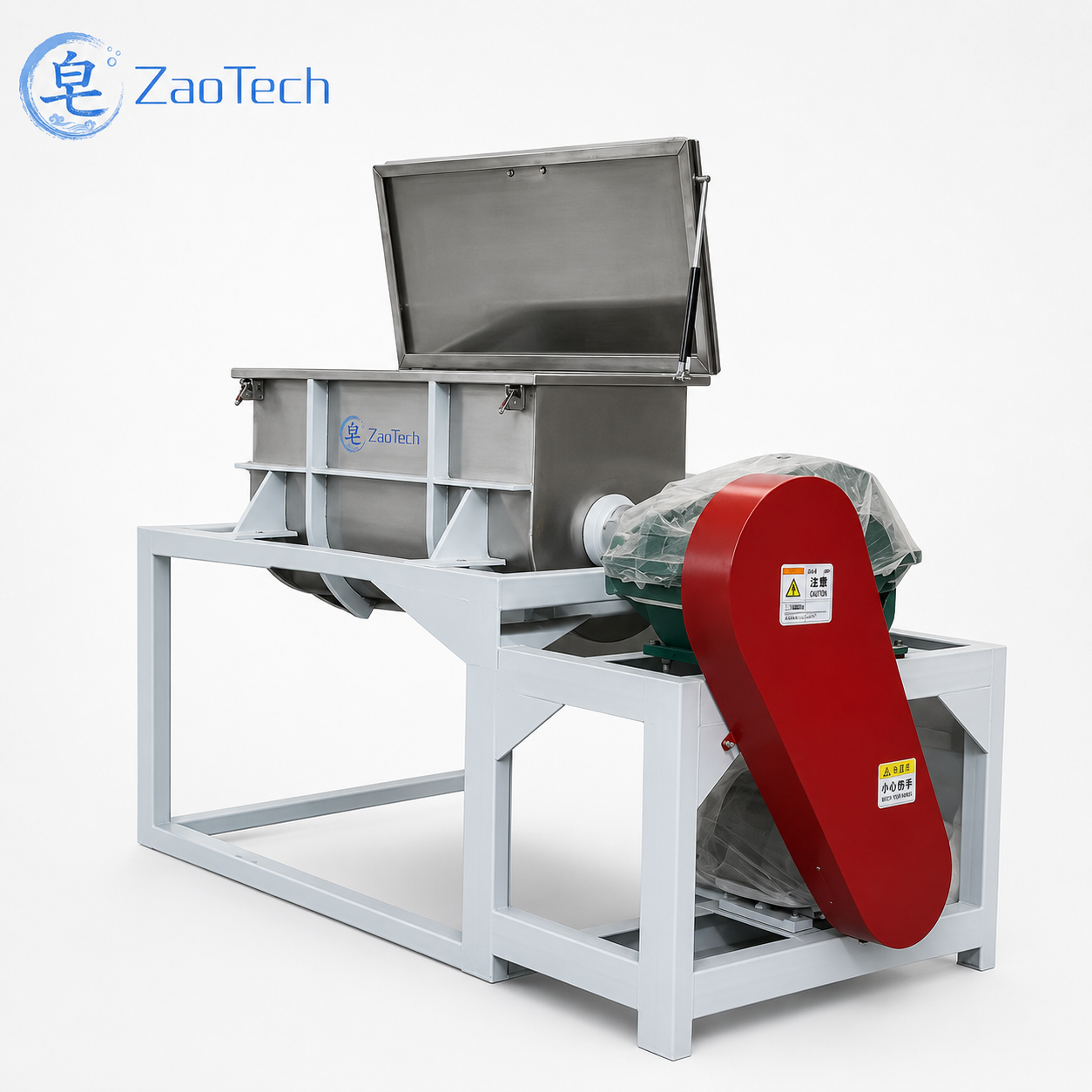
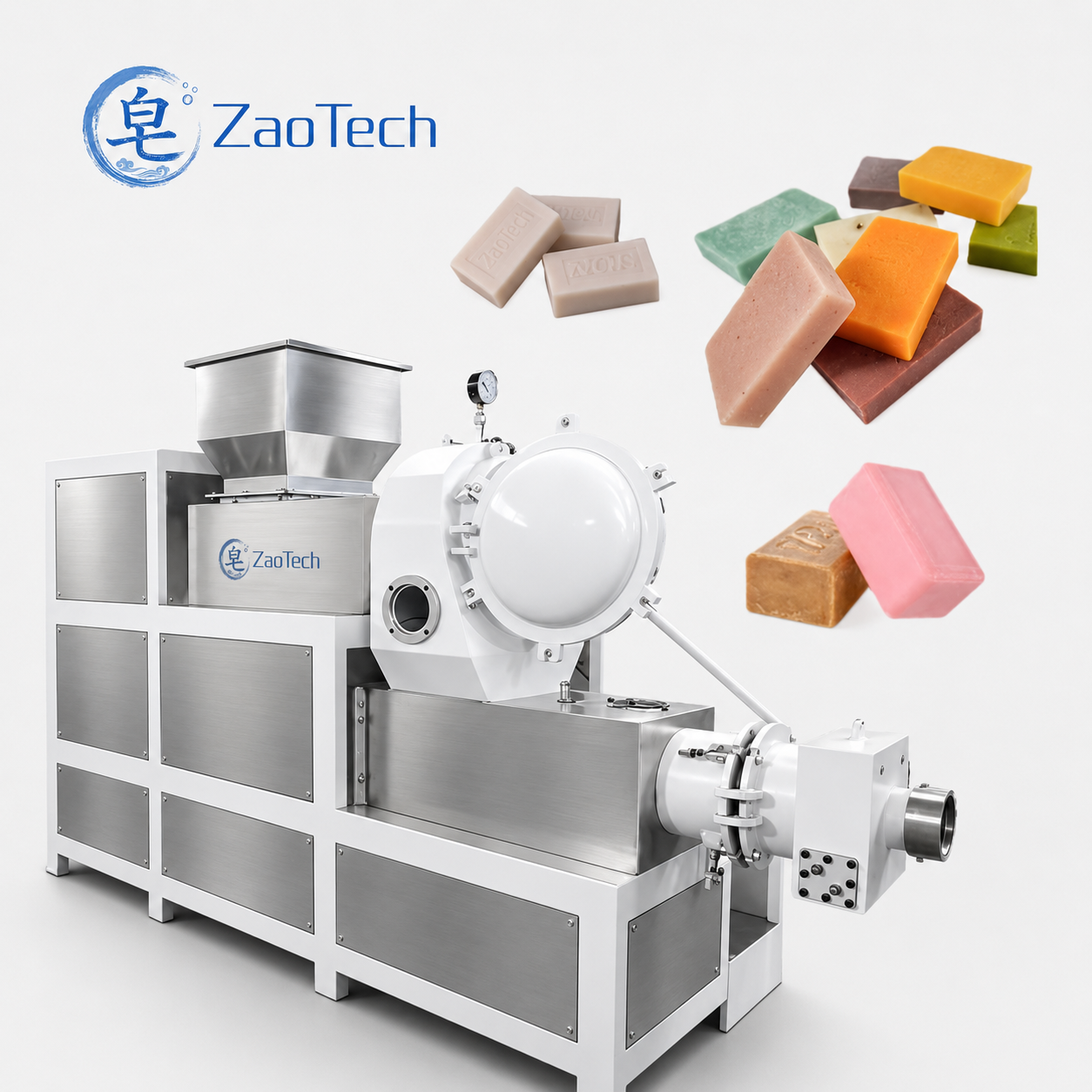
A complete bar-soap finishing line for 100 to 300 kg/h: mixing, refining, vacuum plodding, cutting and stamping in one continuous flow.
| Machine | Capacity |
| Soap mixer | 300 kg/h |
| Three-roller mill | 300 kg/h |
| Double-screw vacuum plodder | 300 kg/h |
| Cutter & stamper | 300 kg/h |
| Roller diameter (mill) | 150 mm |
| Plodder screw diameter | 180 mm |
| Cut bar length | 60–400 mm (adjustable) |
| Total installed power | ≈ 25 kW, 380 V, 50 Hz |
| Workshop area | ≥ 50 m² (10 × 5 × 3 m) |
| Operators | 2–4 persons |
| Material | Role in the bar |
| Soap noodles (soap grains) | Base soap providing the fatty-acid content |
| Pigment / colour paste | Bar colour and brand identity |
| Fragrance | Scent profile of the finished laundry bar |
| Fillers & builders (optional) | Cost control and cleaning performance |
The ZAOTECH laundry soap production line is a complete bar-soap finishing system engineered for outputs of 100 to 300 kg per hour. Starting from refined soap noodles, it mixes, refines, vacuum-plods, cuts and stamps finished laundry bars in one continuous flow. It is built for small and mid-size soap factories that want a reliable, low-headcount route into commercial laundry bar manufacturing.
This laundry soap making machine produces bars with an active fatty-acid content between 40% and 80%, and the bar dimensions, weight and embossed pattern are all configured to your specification. A typical installation runs on roughly 25 kW of installed power and is operated by two to four people, making it a practical first step for producers moving from manual molding to a true industrial soap noodle finishing line.
Designed around proven mechanical principles rather than complex electronics, this laundry soap production line stays easy to operate and easy to maintain, while still delivering the dense, well-shaped bars that retail and institutional buyers expect.
• Continuous one-flow process. Soap noodles enter the mixer and leave the line as stamped, cut bars without intermediate manual handling, so labour stays low and throughput stays steady at up to 300 kg/h.
• Wide fatty-acid window. The line handles formulations from 40% to 80% active content, covering economy laundry bars through to higher-grade household soaps on the same equipment.
• Vacuum plodding for dense bars. The twin-stage plodder de-aerates the soap mass under vacuum, giving hard, smooth bars that hold a crisp stamped logo and resist cracking.
• Fully customised bar format. Cut length is adjustable from 60 to 400 mm, and the stamping die is made to your own logo, shape and weight, from compact 100 g bars to large 400 g laundry blocks.
• Compact footprint. The core line fits a workshop of about 50 m² (10 × 5 × 3 m), excluding packing, so it suits existing premises without major building work.
• Hygienic contact surfaces. Every part that touches the soap is stainless steel, while structural frames use heavy carbon steel for rigidity and long service life.
• Scalable specification. The same architecture can be re-sized upward if your demand grows, protecting your initial investment in the laundry soap production line.
The figures below describe the standard four-machine configuration of this laundry soap production line at 300 kg/h. Power, dimensions and weights are given per individual machine so you can plan utilities, foundations and floor layout accurately.
| Machine | Capacity | Power | Dimensions (mm) | Weight |
|---|---|---|---|---|
| Soap mixer | 300 kg/h | 2.2 kW | 1500 × 1000 × 1150 | 500 kg |
| Three-roller mill | 300 kg/h | 4 kW | 975 × 820 × 950 | 600 kg |
| Double-screw vacuum plodder | 300 kg/h | 4 + 7.5 kW | 1800 × 1500 × 1650 | 1500 kg |
| Cutter & stamper | 300 kg/h | – | 1000 × 800 × 1350 | 138 kg |
| Roller diameter (mill) | 150 mm | 150 mm | 150 mm | 150 mm |
| Plodder screw diameter | 180 mm | 180 mm | 180 mm | 180 mm |
| Cut bar length | 60–400 mm (adjustable) | 60–400 mm (adjustable) | 60–400 mm (adjustable) | 60–400 mm (adjustable) |
| Total installed power | ≈ 25 kW, 380 V, 50 Hz | ≈ 25 kW, 380 V, 50 Hz | ≈ 25 kW, 380 V, 50 Hz | ≈ 25 kW, 380 V, 50 Hz |
| Workshop area | ≥ 50 m² (10 × 5 × 3 m) | ≥ 50 m² (10 × 5 × 3 m) | ≥ 50 m² (10 × 5 × 3 m) | ≥ 50 m² (10 × 5 × 3 m) |
| Operators | 2–4 persons | 2–4 persons | 2–4 persons | 2–4 persons |
Rated from 100 to 300 kg per hour, the laundry soap production line covers the output band most new and growing soap businesses need. Real throughput depends on bar weight, the fatty-acid grade of your noodles and how steadily the mixer is charged, so a heavier 250 g bar will leave the line at a different bar-per-minute rate than a slim 120 g bar.
Bar format is genuinely flexible. Cut length spans 60 to 400 mm, and a die made to your artwork lets you emboss a brand name, logo or decorative relief on every bar. The same hardware can therefore be switched between several products or private-label contracts with only a die and recipe change.
This laundry soap production line is aimed at producers of solid laundry bars for household and institutional cleaning. It suits new soap factories entering the market, contract manufacturers running private-label bars, and established brands adding a dedicated laundry line alongside toilet-soap output. Because the bar pattern is fully customisable, a single machine can serve several retail labels.
Typical end products include economy and standard laundry bars, multipurpose cleaning soaps, and detergent-blend bars where soap noodles are mixed with builders, colour and fragrance. For full-plant projects the line pairs naturally with an upstream soap saponification machine that turns oils into noodles, while smaller operations simply buy finished noodles and run only this finishing line. You can compare the complete equipment range on the soap production lines overview.
Regional distributors and exporters also favour this format because it ships in a compact set of machines and commissions quickly, letting a buyer reach saleable output soon after installation.
The line is fed with refined soap noodles, to which pigment, fragrance and functional additives are blended in the mixer. Colour pastes and powders, perfume oils, optical brighteners and fillers can all be dosed to match your formulation, and the active fatty-acid level is set between 40% and 80% by your choice of noodle grade and additive ratio.
| Material | Role in the bar |
|---|---|
| Soap noodles (soap grains) | Base soap providing the fatty-acid content |
| Pigment / colour paste | Bar colour and brand identity |
| Fragrance | Scent profile of the finished laundry bar |
| Fillers & builders (optional) | Cost control and cleaning performance |
1. Mixing. Soap noodles, colour and fragrance are loaded into the mixer, where a rotating action blends every additive evenly through the soap mass.
2. Refining. The blend passes through the three-roller mill, which grinds it to a fine, homogeneous ribbon and disperses pigment and perfume uniformly.
3. Plodding. The double-screw vacuum plodder compacts and de-airs the refined soap, then extrudes a continuous, dense bar billet through a shaping nozzle.
4. Cutting. The extruded billet is cut to the chosen bar length, anywhere from 60 to 400 mm, at line speed.
5. Stamping. Each blank is pressed in the stamper, embossing your logo and final bar shape to produce a market-ready laundry soap bar.
Two stages of the laundry soap production line do most of the work for final bar quality: the three-roller mill and the vacuum plodder. Milling reduces the soap to a fine, even texture and spreads colour and fragrance throughout, so there are no streaks or soft spots in the finished bar. The plodder then removes trapped air and compresses the mass, which is what gives the bar its hard, dense feel and clean cut faces.
Because the soap is de-aerated before shaping, the embossed logo stays sharp and the edges remain crisp rather than crumbling. The result from this laundry soap production line is a uniform, professional-looking bar that stacks and packs well and presents consistently across an entire run. This consistent, dense finish is one of the main reasons producers choose a milled-and-plodded line over simple cold-pour or hand-cut molding methods.
What output can this laundry soap production line reach?
The standard configuration runs from 100 up to 300 kg per hour. Capacity depends on bar size, formulation and how continuously the line is fed with noodles.
Does it make the soap from oil, or only finish noodles?
This line is a finishing line: it converts ready-made soap noodles into bars. To produce noodles from raw oils you add a saponification stage ahead of it.
Can I produce bars with my own logo and shape?
Yes. The cutter is adjustable from 60 to 400 mm and the stamping die is manufactured to your logo, weight and shape, so the same line can serve multiple private-label products.
Is the laundry soap production line suitable for a startup?
It is. With a small footprint, a two-to-four-person crew and a moderate power demand, it is a common first investment for businesses launching their own bar-soap brand.
How many operators and how much space are needed?
Two to four operators are typical, and the core line fits a workshop of about 50 m² measuring 10 × 5 × 3 m, excluding the packing area.
What power supply does the line require?
Around 25 kW of installed power on a 380 V, 50 Hz three-phase supply covers the four core machines of the laundry soap production line.
• Engineered for continuous duty. Heavy carbon-steel frames and stainless contact parts let the line run long production shifts with consistent bar quality.
• Process-controlled consistency. Mill refining plus vacuum plodding produce uniformly dense bars with sharp embossing, batch after batch.
• Low operating cost. A two-to-four-person crew and roughly 25 kW of draw keep labour and energy per tonne low.
• Built around your product. Bar size, weight, colour, fragrance and stamp are all configured to your formulation and brand.
• A clear upgrade path. The architecture scales, and integrates with saponification and packing equipment from the wider ZAOTECH range.
From soap noodles to a stamped, market-ready bar, this ZAOTECH laundry soap production line gives small and mid-size manufacturers a dependable, fully configurable route into commercial laundry-soap output.
Products and services that have earned the appreciation and trust of clients across industry.
with a 3-in-1 laser machine (welding + cleaning + cutting) and a smart capital decision
All delivered equipment meets European quality standards and the DNSH principle, is eligible for acquisitions through EU and PNRR funding, and includes interactive AI-powered manuals for operation, maintenance and operator training.
Media appearances, technical demos and presentations from the most important industrial trade fairs in Europe. See our technology in action.
Over 100 companies in manufacturing, logistics and industry have chosen Uzinex as their strategic partner.
All references→



„We do stainless-steel metal fabrication dedicated to restaurant kitchens. The UZINEX equipment was a radical change: modernization, an increase in production and quality.”
„I had no idea, I was completely clueless. And you started to explain to me. You told me what technologies to choose, what packaging to produce, what would work better on the market.”
„We use a single person who can operate 3-4 machines. Before, we needed 3-4 people to do the same thing.”
„We have multiple challenges in making special structures that serve our systems, and the laser welding machine solution helped us enormously.”
„Laser welding on stainless is something else, it's a completely different thing. The quality of the machines is undeniable: the samples say it all.”
„With Uzinex, I felt very well protected by the assistance they provided. When you have a whole shift stalled and you need someone to answer quickly, it matters enormously.”
„The proof that everything went well is that the equipment now works. We have over three years of experience with no problems. Or when there were issues, there was support. We're satisfied with the collaboration.”
„I can do even 5 boxes for one person, I can also do 10 boxes. Which other firms can't do. That is, they'd have to change dies, set up a whole 12-hour affair.”
„Whether I called at 2 in the morning or at 9 in the morning, the problems got solved. We're satisfied and we'll work together again.”
„A good, smooth collaboration. We always had support and help.”
„We're among the top producers in Romania for this product. I wouldn't have imagined that when I started, but things fell into place.”
„On price and quality ratio, they were the best price and the best quality on the market. We got along well and we're satisfied.”
Six technology directions we integrate turnkey: from plug & play IIoT sensors, to cobots, predictive maintenance, optical inspection, MES connectivity and custom industrial software.
See in real time how much each machine produces and how long it sits idle. We fit sensors on any equipment, new or old, and within a few hours you have the OEE dashboard on your phone. No complex wiring, no production downtime. The first concrete step toward digitalization, with ROI visible from the very first month.
Solve your labor shortage without tripling your costs. The cobot works safely alongside your people (palletizing, feeding the CNC, welding) while you recover the investment in 12-18 months. Prices 30-40% below European distributors, with installation and programming included from us.
Stop waiting for things to break. Our algorithms analyze sensor data and tell you exactly which part will fail and when, and we bring it to your production line before the breakdown. Zero unplanned downtime, zero contractual penalties, complete operational peace of mind.
Eliminate defects before they reach the customer. Our cameras inspect every part at speeds no operator can match, detecting sub-millimeter defects. They mount onto your existing line, with no modifications. Ideal if you produce for export and have strict quality clauses.
Connect your machines to your office, regardless of brand or age. Our gateway automatically translates the data from any machine into your ERP's format: no manual entry, no paper forms, no human error. The manager sees production live, the operator receives digital instructions.
Have a process that no off-the-shelf software can solve? We build custom industrial applications: from tailored SCADA panels and HMI interfaces, to production planning systems, lot traceability and automated reporting. The code is yours, it runs on your servers, with no monthly subscriptions or vendor lock-in.
Answers to the most common technical and commercial questions. Can't find what you're looking for?
Contact the team →Contact our team and receive a personalized offer within a maximum of 24 working hours.