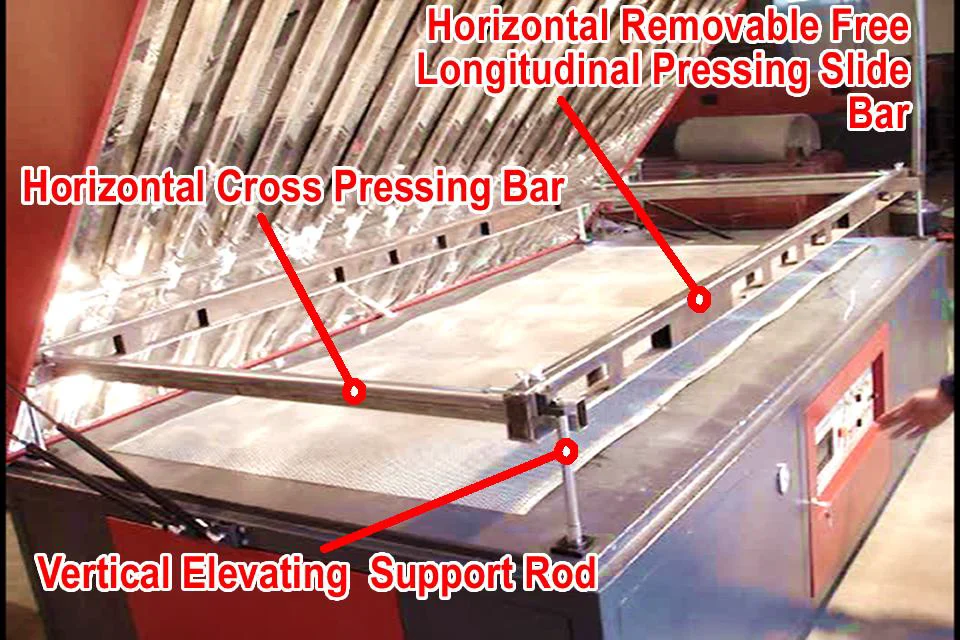
This model is a vacuum forming machine with a pressing frame, designed for acrylic signage production, where you need an affordable and versatile vacuum forming machine. It forms light box faces, acrylic channel letters and other signs on a 1300 × 2500 mm area.
With a single mould, an observation window and a silicone-sealed pressing frame, this vacuum forming machine makes flat, raised, multi-layer, curved or spherical shapes, at a forming height of up to 250 mm.
Key Advantages
• 3D forming from a single sheet, a MECVORA vacuum forming machine heats the thermoplastic sheet and draws it under vacuum onto the mould, reproducing the shape faithfully with identical results every cycle.
• Even heating, quartz tubes spread the heat evenly across the whole surface, soften the material without local deformation and shorten the cycle time.
• Single-mould economy, one mould is enough to form the part, which lowers tooling costs and production setup time.
• Blow function, blowing assists demoulding and enables spherical or domed shapes, widening the range of parts you can make on one machine.
• Multiple thermoplastics, it forms acrylic, ABS, PVC, PET and more, from sign faces and signage to packaging, trays and shells.
• Quality finish, the platform and pressing frame keep the sheet flat and sealed during forming, for smooth surfaces and precise edges.
• 1300 × 2500 mm area (4' × 8'), covers standard acrylic sheets and large sign faces from a single forming cycle.
• Adjustable pressing frame, the silicone gasket seals sheets of different sizes, and several designs can be formed at once on the same sheet.
• Observation window, the operator watches the process from outside, for visual control and consistent results.
Technical Specifications, Vacuum forming machine
| Parameter | Value |
|---|---|
| Working area | 1300 × 2500 mm (4' × 8') |
| Forming height | up to 250 mm |
| Material | acrylic |
| Method | vacuum forming, single mould |
| Pressing frame | silicone gasket, adjustable |
| Observation | transparent window |
| Shapes | flat, raised, multi-layer, curved, spherical |
| Maintenance | simple, low maintenance |
Technology and Process
Vacuum forming runs a simple, repeatable cycle: the thermoplastic sheet is clamped in the frame, heated until soft, then placed over the mould, where the vacuum draws it tightly onto the shape. After cooling, the part keeps the mould geometry, ready to be removed.
The quality of the result depends on even heating and a good sheet seal. A MECVORA vacuum forming machine uses even heating and a well-sealed pressing frame, so the surface comes out smooth and the mould details are reproduced faithfully, from sign faces to technical parts.
The cycle time depends on the material, the sheet thickness and the depth of the shape: thicker materials need longer heating, and deep shapes a more sustained vacuum pull. Once the recipe for a given product is set, it repeats identically, which makes the process predictable and easy to plan in series production.
Applications and Industries, Acrylic thermoforming
The main application is acrylic signage: light box faces, thermoformed channel letters and shop-front panels, with smooth surfaces and clean edges.
The same machine makes decorative and display shapes, shop-window elements, raised logos and brand parts, from a single carved or machined mould.
Thanks to its range of shapes (flat, raised, multi-layer, domed), the machine covers both series production and one-off parts for custom signage projects.
The machine meets the requirements applicable to industrial equipment placed on the EU market, in line with the Machinery Directive 2006/42/EC. See also our range of vacuum forming machines for other configurations.
Compatible Materials
The machine is optimised for acrylic, the standard material in thermoformed signage. Acrylic sheets of different thicknesses, clear or coloured, can be used, and on request the machine can be configured for other thermoplastics as well:
| Material | Details / notes |
|---|---|
| Acrylic (PMMA) | main material for faces and letters |
| Other thermoplastics | on request, depending on application |
How It Works
The workflow on a MECVORA vacuum forming machine is simple and repeatable, from sheet to finished part:
1. Fix the mould on the platform and clamp the thermoplastic sheet in the pressing frame.
2. Set the heating temperature and time to suit acrylic and the sheet thickness.
3. The quartz heaters soften the sheet evenly until it is pliable across the whole surface.
4. The sheet is placed over the mould and the vacuum draws it tightly onto the shape; blowing assists domed parts.
5. After cooling, the formed part is removed from the mould, ready for trimming, assembly or finishing.
Moulds, Pressing and Demoulding
The result of a thermoformed part depends on the mould and on how the sheet is pressed and removed. The pressing frame, with a sealing gasket, adjusts to different sizes and shapes, and several designs can be formed at once on the same sheet, saving material and time.
The blow function eases demoulding and enables domed or spherical shapes that are hard to get otherwise. With a single mould, hand-carved or machined, a vacuum forming machine makes flat, raised, multi-layer or curved parts, which makes it versatile for signage, packaging and technical parts.
The forming height and the working area decide which parts you can make: a large height allows deep shapes, and a generous area covers big sign faces and panels. With the right platform and saved recipes, you switch quickly from one part type to another, with minimal material waste.
After forming, the parts are trimmed to the contour and finished according to the application: sign faces are cut to size, and technical parts are adjusted for assembly. Bringing thermoforming in-house shortens the production chain and gives you full control over the final quality of every part.
Delivery, Installation and Support
A vacuum forming machine is a long-term investment, and UZINEX treats it as one. We arrange transport of the machine across Europe together with the required technical documentation, and we handle commissioning at your premises so production starts without delays or improvisation.
After installation we train your operators directly on your own machine, from the first settings on material to fine-tuning each working recipe. We stay available for service, spare parts, consumables and technical support throughout the machine's working life.
Return on Investment
Outsourcing production means longer lead times, margins shared with subcontractors and dependence on their availability. Bringing the work in-house, onto a vacuum forming machine, changes the equation: you control the deadline, the quality and the cost of every order, and the profit stays entirely with you.
For firms with a steady order flow, such a machine pays back quickly through the number of parts produced in-house, plus the new orders you can take on without depending on an outside supplier. The UZINEX team helps you estimate the right volume and configuration for your case.
Maintenance and Reliability
A production machine has to be easy to maintain to stay productive. Routine tasks, checking the heating elements, cleaning the working surfaces and verifying the protection systems, are simple and quick, and wear parts are replaced without complex intervention.
UZINEX supplies spare parts, consumables and technical support throughout the machine's life, so a well-maintained vacuum forming machine runs for years with the same precision. A simple maintenance plan reduces unplanned downtime and protects the investment.
Frequently Asked Questions
What sheet size does the machine accept?
The working area is 1300 × 2500 mm (4' × 8'), suited to standard acrylic sheets and large sign faces. Several parts can be formed at once on the same sheet.
What forming height does it reach?
The forming height is up to 250 mm, enough for channel letters, domed faces and raised shapes used in signage.
Do I need expensive moulds?
No. Forming uses a single mould, hand-carved or machined, which lowers tooling cost and allows both series and one-off parts.
What does delivery of a MECVORA vacuum forming machine include?
We arrange transport across Europe together with the technical documentation. We provide commissioning, operator training and ongoing support for service and spare parts, so your shop becomes productive quickly.
Do I need a specialised operator for this vacuum forming machine?
No. The settings are simple and saved per material and thickness, and the control panel is intuitive. A new operator reaches consistent results after short training, and the saved recipes reduce errors.
What warranty and after-sales support does UZINEX offer?
Every UZINEX machine comes with a 60-month standard manufacturer warranty, phone support and on-site service intervention in under 24 hours anywhere in Romania.
Why UZINEX?
When you choose a vacuum forming machine from UZINEX, you get more than the machine. You can discuss the right configuration any time with the UZINEX team:
• Real technical advice, we help you choose the right vacuum forming machine configuration for your materials, part sizes and production volume, not just process an order.
• Delivery across Europe, we arrange transport of the machine to your workshop, together with its technical documentation.
• Commissioning and training, we train your operators on your own machine, from the first settings to the first good part.
• Service and spare parts, we provide technical support and access to components so your production keeps running.
• Sourcing on request, if you need a configuration or consumable that isn't listed, we source it and come back with an offer.
• A long-term partner, we stay with you from installation to capacity expansion as your order book grows.
From sign faces and 3D signage to packaging, trays and shells, a vacuum forming machine turns the thermoplastic sheet into finished 3D parts, fast and repeatably. Tell the UZINEX team what you make and in what volume, and we will propose the format, forming height and configuration that fit.