
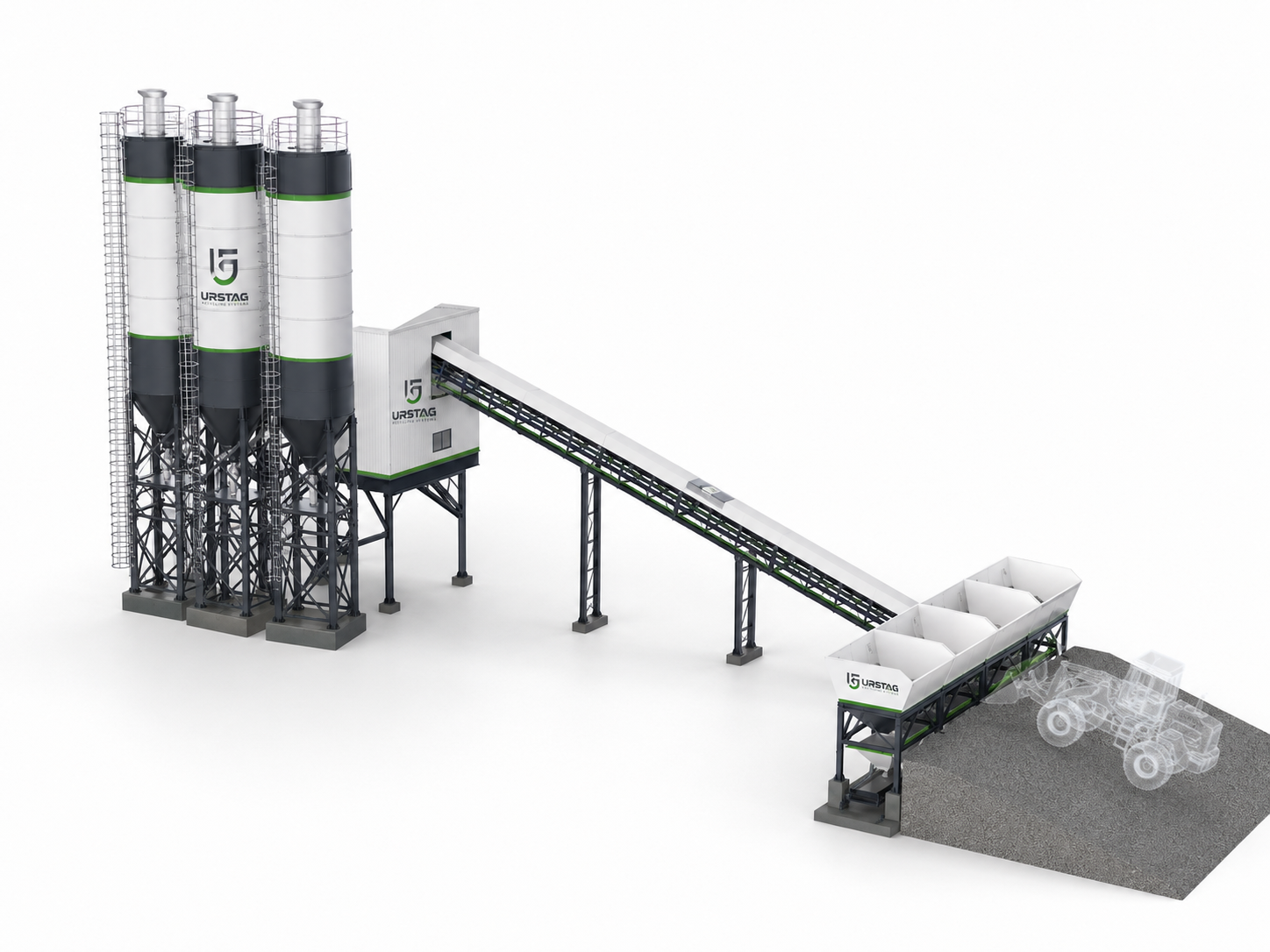
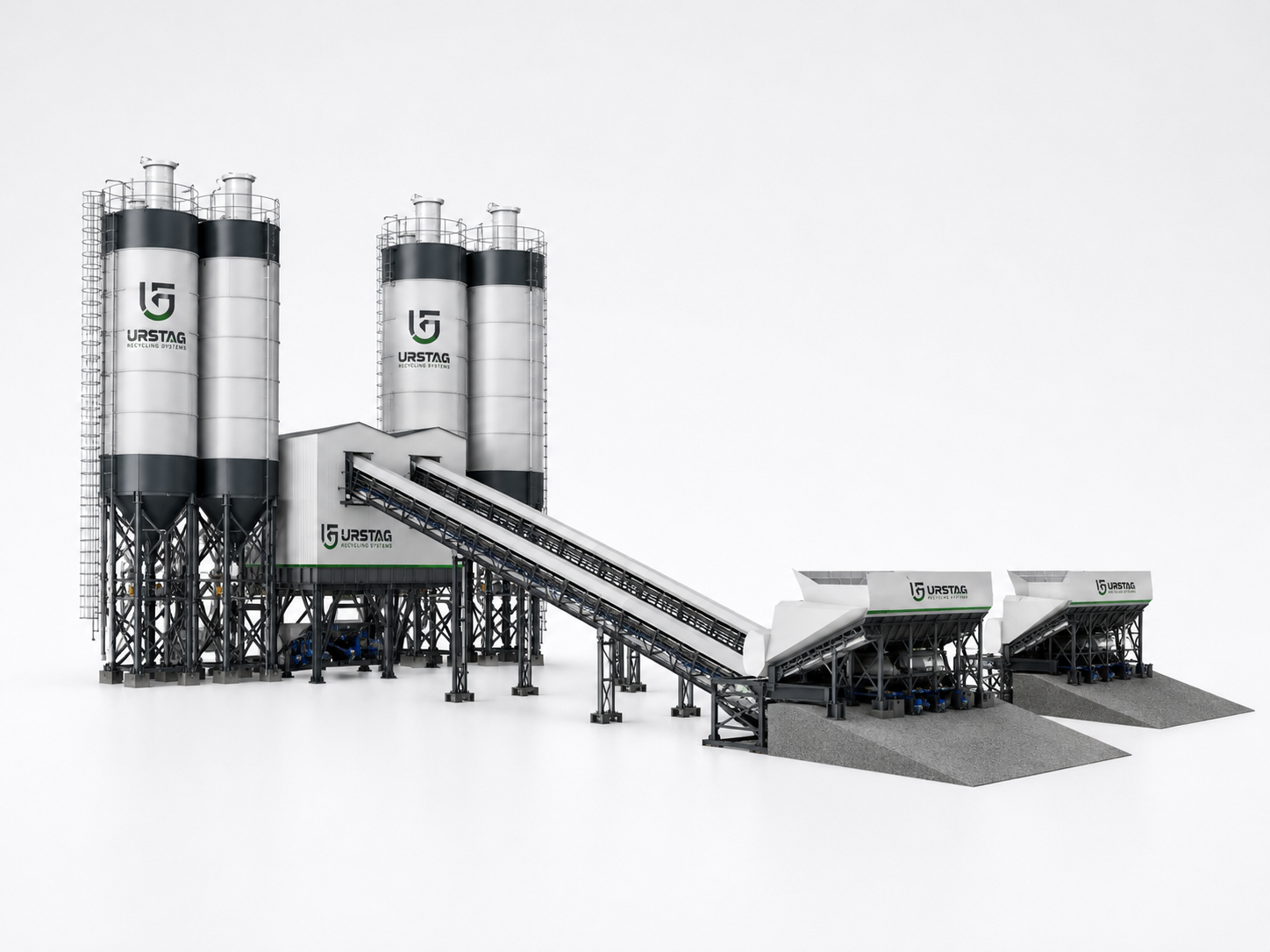
Large-scale infrastructure projects and industrial concrete production demand a fixed, robust, high-capacity installation capable of continuous operation at consistent quality. A commercial concrete batching plant from URSTAG meets these requirements through a stationary structure on a concrete foundation, full integration of batching, weighing and mixing systems, and fully computer-controlled operation, delivering uniform-quality concrete for the most demanding sites and production lines.
A URSTAG commercial concrete batching plant is available in six configurations, from 60 to 270 m³/h, each engineered for long-term, high-intensity production. The premium construction, twin-shaft forced mixer and weighing precision of ≤ ±1% ensure homogeneous concrete, batch after batch. Explore the full range of industrial equipment and the solutions for concrete production.
Key Advantages of a High Capacity Concrete Batching Plant
• Durable stationary construction, a commercial concrete batching plant is fixed on a concrete foundation, providing structural integrity and balanced force distribution, with a service life up to 30% longer than mobile or skid-mounted plants.
• Capacity from 60 to 270 m³/h, six configurations for high-intensity continuous production, matched to project scale.
• Twin-shaft forced mixer, the main mixer delivers high uniformity and adapts to multiple types of concrete.
• Precision weighing ≤ ±1%, powder, water and additive weighing systems have a low measurement error for high consistency.
• Fully computer-controlled (PC), real-time monitoring of material levels, mix recipes and equipment status, with data traceability and fault warnings.
• Complete system integration, large-capacity aggregate and powder silos ensure production continuity.
• Modular design for maintenance, easier servicing, fast spare-part replacement and reduced downtime.
• Environmental customization, custom enclosures to fit urban industrial zones and high environmental protection requirements.
Technical Specifications, Commercial Concrete Batching Plant
| Parameter | UCB-60 | UCB-90 | UCB-120 | UCB-180 | UCB-240 | UCB-270 |
|---|---|---|---|---|---|---|
| Theoretical production capacity (m³/h) | 60 | 90 | 120 | 180 | 240 | 270 |
| Mixer discharge volume (L) | 1000 | 1500 | 2000 | 3000 | 4000 | 4500 |
| Mixer feeding volume (L) | 1500 | 2250 | 3000 | 4500 | 6000 | 6750 |
| Mixer power (kW) | 18.5×2 | 30×2 | 37×2 | 55×2 | 75×2 | 90×2 |
| Discharge height (m) | 4.1 | 4.1 | 4.2 | 4.2 | 4.2 | 4.2 |
| Aggregate bin configuration (no. × volume, m³) | 4×7 | 4×15 | 4×20 | 4×25 | 4×30 | 4×30 |
| Cycle period (s) | 60 | 60 | 60 | 60 | 60 | 60 |
| Maximum aggregate size (mm) | 80/100 | 80/100 | 80/100 | 80/100 | 80/100 | 80/100 |
| Cement silo (optional) | 2×100 | 3×100 | 4×100 | 4×100 | 4×200 | 4×300 |
| Aggregate weighing accuracy | ±2% | ±2% | ±2% | ±2% | ±2% | ±2% |
| Powder weighing accuracy | ±1% | ±1% | ±1% | ±1% | ±1% | ±1% |
| Water weighing accuracy | ±1% | ±1% | ±1% | ±1% | ±1% | ±1% |
| Additive weighing accuracy | ±1% | ±1% | ±1% | ±1% | ±1% | ±1% |
| Total power (kW) | ≈110 | ≈160 | ≈220 | ≈290 | ≈340 | ≈340 |
| Control mode | Fully Automated Computer (PC) Control | Fully Automated Computer (PC) Control | Fully Automated Computer (PC) Control | Fully Automated Computer (PC) Control | Fully Automated Computer (PC) Control | Fully Automated Computer (PC) Control |
| Power supply | 220V/415V/440V/380V, 50Hz/60Hz, 3 Phases | 220V/415V/440V/380V, 50Hz/60Hz, 3 Phases | 220V/415V/440V/380V, 50Hz/60Hz, 3 Phases | 220V/415V/440V/380V, 50Hz/60Hz, 3 Phases | 220V/415V/440V/380V, 50Hz/60Hz, 3 Phases | 220V/415V/440V/380V, 50Hz/60Hz, 3 Phases |
Applications for an Automated Concrete Mixing Plant
A commercial concrete batching plant is intended for ready-mix concrete producers, large infrastructure sites, precast factories and operators supplying long-term projects. The stationary construction is ideal for permanent operations or for deployment near transport hubs or close to aggregate sources, shortening material transport distances and optimizing logistics costs.
Concrete production equipment is regulated in Europe with respect to safety and CE marking; a commercial concrete batching plant delivered in Europe is designed in line with the requirements of the Machinery Directive 2006/42/EC. For integration into a complete concrete production flow, see also the complete industry solutions.
High-intensity continuous production is the strength of a commercial concrete batching plant: the UCB-60 to UCB-270 configurations support outputs from 60 to 270 m³/h, covering everything from mid-size sites to the largest infrastructure projects, highways, bridges, dams and industrial complexes. The short 60-second cycle period ensures a steady flow of concrete to meet the supply demands of major works.
The concrete consistency produced by a commercial concrete batching plant is ensured by the combination of the twin-shaft forced mixer and precision weighing: the twin-shaft mixer vigorously blends aggregates, cement, water and additives into homogeneous concrete; weighing with an error of ≤ ±1% for powders, water and additives ensures the recipe is followed exactly, batch after batch. This consistency is essential for high-quality structural concrete.
The durability of the stationary construction sets a commercial concrete batching plant apart from mobile or skid-mounted units: fixed installation on a concrete foundation provides a stable base, distributes forces in a balanced way and reduces vibration wear. Core components are designed with high redundancy and a low probability of failure, resulting in a service life up to 30% longer and superior long-term availability.
Complete integration of storage and supporting systems maximizes the production continuity of a commercial concrete batching plant: large-capacity aggregate and powder silos provide sufficient reserves for uninterrupted operation, while precise integration of batching, weighing and mixing under automated control maintains high product consistency. This integration reduces refilling downtime and optimizes plant throughput.
Configuration Selection Guide
| Model | Capacity (m³/h) | Recommended application |
|---|---|---|
| UCB-60 | 60 | Mid-size sites, local concrete production |
| UCB-90 | 90 | Ready-mix production, urban works |
| UCB-120 | 120 | Large projects, precast |
| UCB-180 | 180 | Large-scale infrastructure |
| UCB-240 | 240 | Intensive works, highways, bridges |
| UCB-270 | 270 | Largest projects, dams, industrial complexes |
Operational and Economic Advantages
Energy efficiency at system level is optimized in a well-engineered commercial concrete batching plant: motors, conveying systems and the mixer are sized and coordinated for optimal energy consumption across the whole plant. When producing large volumes of concrete continuously, this optimization lowers the energy cost per cubic metre, contributing to the overall economics of the operation over its long service life.
Operational reliability is critical for a high-capacity installation: an unplanned stoppage of a commercial concrete batching plant interrupts concrete supply to the entire site. The robust construction, high-redundancy core components and planned preventive maintenance, supported by computerized status monitoring, ensure high availability, essential for meeting the supply contracts of large infrastructure projects.
The adaptability of a commercial concrete batching plant to different concrete types is a key strength: the twin-shaft forced mixer handles a wide range of mixes, from standard structural concrete to specialized formulations. With recipe management through the computer control system, an operator can switch between concrete types quickly, meeting the varied demands of large projects from a single installation.
Logistics optimization is a significant benefit of a stationary commercial concrete batching plant: positioning the plant near transport hubs or aggregate sources shortens material transport distances and reduces logistics costs. For long-term operations, this strategic placement delivers continuous savings over the project lifetime, while the durable stationary construction supports years of high-intensity production.
How It Works
1. Aggregates are stored in dedicated bins and batched according to the mix recipe.
2. Powders (cement, additions) are fed from the large-capacity silos.
3. The weighing systems precisely measure aggregates, powders, water and additives.
4. The weighed components are transferred into the twin-shaft forced mixer.
5. The mixer vigorously blends the materials into homogeneous concrete within the 60-second cycle.
6. The concrete is discharged at the discharge height into mixer trucks; the PC system coordinates the entire process.
The fully computer-controlled system coordinates batching, weighing, mixing and discharge, monitoring each stage in real time. A properly operated commercial concrete batching plant produces consistent-quality concrete at high output, with complete production data traceability and automated fault warnings.
Frequently Asked Questions
Which commercial concrete batching plant capacity should I choose?
The choice depends on the required concrete output and project scale. UCB-60 and UCB-90 suit mid-size sites and local production; UCB-120 and UCB-180 suit large projects and precast; UCB-240 and UCB-270 suit the most intensive infrastructure works. The exact capacity is determined by your supply demand.
What does fully computer-controlled (PC) operation mean?
The entire commercial concrete batching plant is coordinated by a computer system that monitors material levels, mix recipes and equipment status in real time. The system provides production data traceability, automated fault warnings and recipe management, ensuring precise, repeatable production that can be supervised by a small operating team.
How is concrete consistency and quality ensured?
Consistency is ensured by the twin-shaft forced mixer, which blends materials vigorously and homogeneously, and by precision weighing with an error of ≤ ±1% for powders, water and additives. This combination ensures the recipe is followed exactly, batch after batch, essential for the high-quality structural concrete a commercial concrete batching plant produces.
Is the delivered equipment new?
Yes. We deliver new, unused equipment, manufactured to order according to the chosen configuration. Construction uses components from established suppliers, with CE marking where applicable, and every plant undergoes a full inspection before shipment. You receive the technical documentation and operating manuals in your language.
How long do installation and commissioning take?
Installing a commercial concrete batching plant involves preparing the concrete foundation, assembling the structure and systems, and commissioning. Transport, assembly, commissioning and operator training are included and carried out by a specialized team, so your installation becomes operational in a planned and controlled manner.
Can the plant be customized?
Yes. A commercial concrete batching plant supports custom configurations: capacity from UCB-60 to UCB-270, cement silo sizing, aggregate bin configuration and custom enclosures to fit urban industrial zones and meet high environmental protection requirements.
What maintenance does the plant require?
The modular design and fixed component layout allow easier maintenance, fast spare-part replacement and reduced downtime. Planned preventive maintenance, supported by computerized monitoring of equipment status, ensures high long-term availability of the commercial concrete batching plant.
With a URSTAG commercial concrete batching plant, fixed for high-capacity continuous production, with a twin-shaft forced mixer, precision weighing of ≤ ±1% and fully computer-controlled operation, you obtain uniform-quality concrete for the most demanding infrastructure projects, backed by premium engineering and high long-term availability.
Why URSTAG?
URSTAG is a premium brand of recycling equipment, with over 15 years of experience. You don't just get a machine, you get a solution engineered by specialists, built from top-tier components and backed by a team that supports you from design through commissioning.
• European engineering, every machine and every complete line is designed by our engineering teams in Europe, with a focus on reliability, safety and energy efficiency.
• Premium components, we build on motors and automation from industry leaders: Siemens, Schneider Electric, ABB, WEG, SEW-Eurodrive, NORD Drivesystems and Bonfiglioli.
• Over 15 years of experience, we know how materials and machines behave in real-world operation, and we configure each solution for your flow and volume.
• New equipment, configured for you, we supply new units, made to order for your application, with complete technical documentation.
• Delivery, installation and training included, we handle transport, commissioning and operator training, with support throughout the equipment's life.
As a premium brand, URSTAG relies on European engineering, top-tier components and experience. You choose a partner that supports your production long term, with equipment built to run reliably in demanding industrial environments.