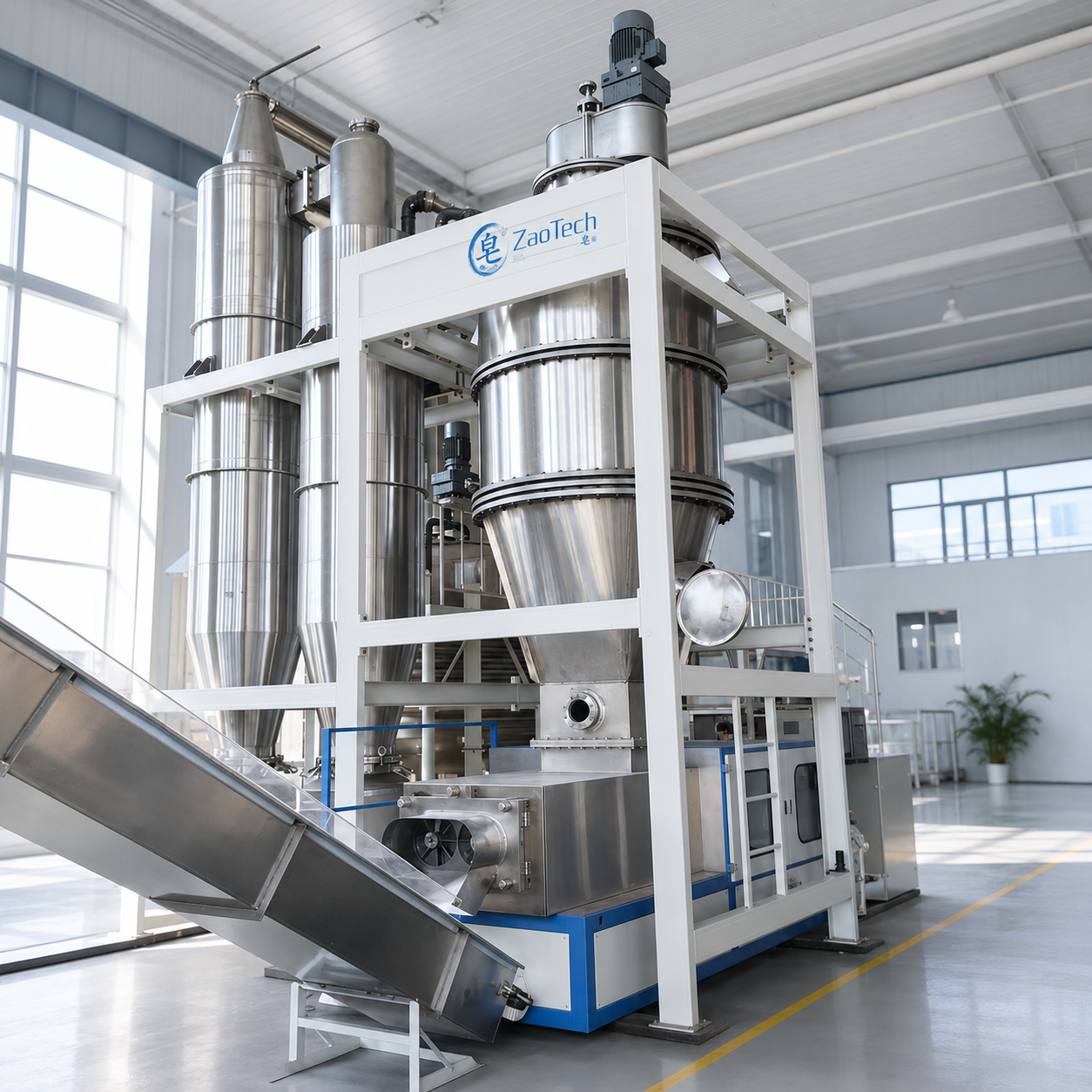
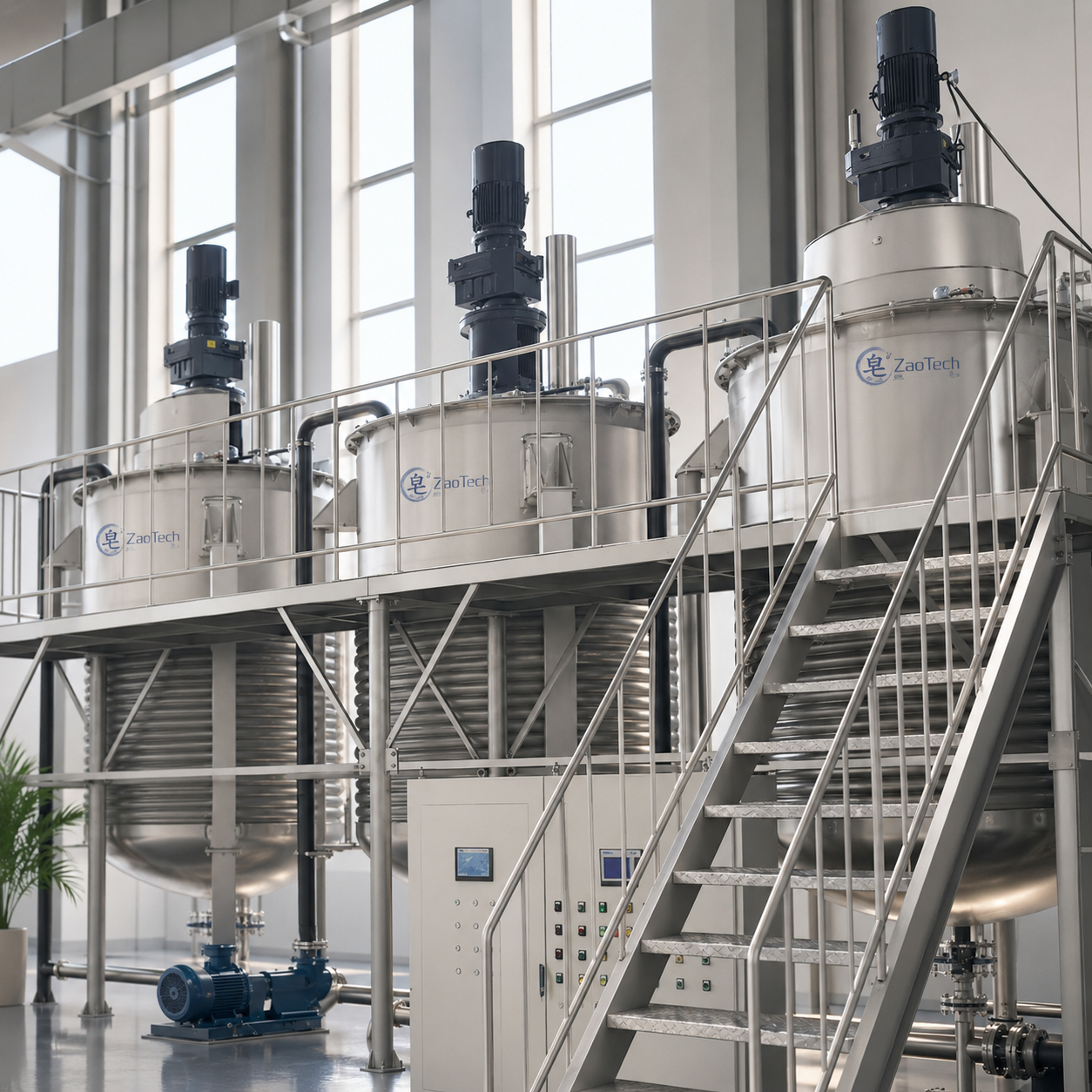
A large-scale, steam-heated plant that turns palm oil and other fats into laundry soap in one uninterrupted flow, with no water-draining step.
| Process type | Continuous saponification, no water-draining |
| Steam boiler | 2 MT/h, 1.25 MPa |
| Installed electricity | ≈ 280 kW/h, 380 V, 50 Hz |
| Circulating water (vacuum drying) | 15 m³ process water |
| Workshop area | > 300 m² (35 × 8 × 7 m) |
| Suitable oils | Palm oil, palm stearin, palm fatty acid, palm kernel oil, vegetable & animal fats |
| Alkali | Caustic soda, NaOH 97–99% |
| Other inputs | Clean water, sodium chloride (NaCl) |
| Optional additives | Spices, pigments, titanium dioxide, talc |
| Line output | Soap noodles and finished stamped bars |
| Input | Role |
| Palm oil / stearin / fatty acid / palm kernel oil | Fatty base of the soap |
| Caustic soda (NaOH 97–99%) | Alkali for saponification |
| Sodium chloride (NaCl) | Process salt |
| Pigments, titanium dioxide, talc (optional) | Colour, whiteness and texture |
The ZAOTECH continuous saponification plant is a large-scale, steam-heated system that turns palm oil and other fats into laundry soap in one uninterrupted flow. Oils are melted, saponified continuously with no water-draining step, vacuum-dried and cooled, then milled into noodles and extruded, stamped and cut into bars. It is engineered for high-volume producers who need a true continuous process rather than batch reactors.
As a palm oil soap plant, it is built around serious infrastructure: a 2 MT/h steam boiler at 1.25 MPa, roughly 280 kW/h of installed electrical load, and a 15 m³ circulating-water system for the vacuum drying stage. The plant occupies a workshop of more than 300 m², reflecting its industrial scale and continuous output.
By saponifying without draining off lye-water, this continuous saponification plant keeps glycerine and soap together and removes the handling losses of older boiled processes, making it an efficient backbone for large laundry-bar manufacturing.
• Truly continuous process. Oils flow through melting, saponification, drying and milling without stopping for batch reactions, giving high, steady output for large producers.
• No water-draining. Continuous saponification keeps soap and glycerine together rather than draining lye-water, reducing losses and simplifying effluent handling.
• Steam-heated reaction. A 2 MT/h, 1.25 MPa boiler delivers stable process heat for consistent saponification across the whole run.
• Vacuum drying and cooling. Soap is dried and cooled under vacuum with a 15 m³ circulating-water system, producing firm, low-moisture noodles ready for extrusion.
• Broad oil flexibility. Palm oil, palm stearin, palm fatty acid, palm kernel oil and other vegetable and animal fats can all be processed.
• End-to-end line. The continuous saponification plant runs straight through to noodle milling, vacuum extruding, stamping and cutting into finished bars.
• Designed for scale. Around 280 kW/h of load and a 300 m²-plus workshop support genuinely industrial throughput.
The table lists the principal utilities and process stages of this continuous saponification plant. Use it to plan the boiler house, electrical supply, cooling water and the large workshop this plant requires.
| Parameter | Specification |
|---|---|
| Process type | Continuous saponification, no water-draining |
| Steam boiler | 2 MT/h, 1.25 MPa |
| Installed electricity | ≈ 280 kW/h, 380 V, 50 Hz |
| Circulating water (vacuum drying) | 15 m³ process water |
| Workshop area | > 300 m² (35 × 8 × 7 m) |
| Suitable oils | Palm oil, palm stearin, palm fatty acid, palm kernel oil, vegetable & animal fats |
| Alkali | Caustic soda, NaOH 97–99% |
| Other inputs | Clean water, sodium chloride (NaCl) |
| Optional additives | Spices, pigments, titanium dioxide, talc |
| Line output | Soap noodles and finished stamped bars |
The defining feature of this continuous saponification plant is its uninterrupted flow. Melted oils and caustic soda are fed continuously into the saponification stage; because there is no water-draining, the reaction proceeds straight to a soap mass that carries its glycerine through to drying. This is what allows large, steady throughput compared with stop-start batch kettles.
After reaction, the soap is dried and cooled under vacuum to the right moisture for milling. It is then ground into noodles, vacuum-extruded into a dense billet, and stamped and cut into bars, so a single continuous saponification line spans the whole journey from raw palm oil to packaged-ready laundry soap.
This continuous saponification plant is aimed at large laundry-soap manufacturers, palm-oil processors integrating downstream into soap, and industrial groups supplying regional markets at high volume. It is the right choice where output and process efficiency outweigh the simplicity of small batch equipment.
Typical products are solid laundry bars and bulk soap noodles produced from palm-based oils. The plant can supply its own finishing section or feed noodles to separate finishing lines, and it complements a smaller laundry soap production line used for additional bar formats. See the full machinery range on the soap production lines overview.
For exporters and large domestic suppliers, owning a continuous plant standardises both the chemistry and the product, which supports consistent quality across very large order volumes.
The plant processes palm-family oils and other fats through classic saponification with caustic soda. Sodium chloride and clean water are used in the process, and optional additives such as pigments, titanium dioxide and talc tailor the colour and properties of the finished bar.
| Input | Role |
|---|---|
| Palm oil / stearin / fatty acid / palm kernel oil | Fatty base of the soap |
| Caustic soda (NaOH 97–99%) | Alkali for saponification |
| Sodium chloride (NaCl) | Process salt |
| Pigments, titanium dioxide, talc (optional) | Colour, whiteness and texture |
1. Oil melting. Palm and other fats are melted and prepared for continuous feeding into the reaction stage.
2. Continuous saponification. Oils and caustic soda react continuously, with no water-draining, to form a soap mass.
3. Vacuum drying and cooling. The soap is dried and cooled under vacuum using the circulating-water system to reach milling moisture.
4. Milling. The dried soap is milled into noodles of uniform texture.
5. Vacuum extruding. Noodles are compacted and extruded into a dense billet.
6. Stamping and cutting. The billet is stamped and cut into finished laundry bars.
The continuous, no-drain design of this saponification plant is its main efficiency lever: keeping soap and glycerine together avoids the yield losses and effluent of drained processes, while steam heating and vacuum drying keep moisture and texture under tight control.
That control carries through to the bar. Low, consistent moisture and even milling give a hard, uniform laundry bar with a clean stamped face, reproduced reliably across the plant's large continuous output.
A continuous saponification plant is a major installation, and the supporting infrastructure must be planned alongside the machinery. The plant occupies a hall of more than 300 m² laid out as 35 × 8 × 7 m, with the height reflecting tall reaction and drying columns and the boiler and cooling systems that serve them.
Three utilities define the project. A 2 MT/h steam boiler at 1.25 MPa supplies process heat; an electrical supply of about 280 kW/h at 380 V, 50 Hz powers the drives and pumps; and a 15 m³ circulating-water system serves the vacuum drying stage. These need to be sized and located early in the design.
With the boiler house, electrical room and cooling water in place, the continuous saponification plant runs as a steady, largely automated flow, which is what makes its high output practical for a large operation.
How is a continuous saponification plant different from batch saponification?
It saponifies oils in an uninterrupted flow rather than in separate kettle batches, which supports much higher, steadier output for large producers.
What does "no water-draining" mean?
The process does not drain off lye-water, so soap and glycerine stay together. This reduces losses and simplifies effluent compared with older drained methods.
Which oils can it process?
Palm oil, palm stearin, palm fatty acid and palm kernel oil, plus other vegetable and animal fats, all with caustic soda at 97–99%.
What utilities does the plant need?
A 2 MT/h, 1.25 MPa steam boiler, about 280 kW/h of electrical load, a 15 m³ circulating-water system, and a workshop above 300 m².
Does it produce finished bars or only noodles?
It runs through to finished bars via milling, vacuum extruding, stamping and cutting, and can also supply soap noodles in bulk.
What soaps is it best suited to?
It is optimised for high-volume solid laundry bars made from palm-based oils.
Why does the plant need a steam boiler?
Steam at 2 MT/h and 1.25 MPa supplies the stable process heat the continuous saponification reaction and drying stages require.
How much electrical load should I plan for?
About 280 kW/h on a 380 V, 50 Hz supply, covering the drives, pumps and vacuum systems across the plant.
What role does the circulating water play?
The 15 m³ circulating-water system cools the vacuum drying stage, helping set firm, low-moisture noodles before milling.
Does the plant drain off lye-water?
No. The continuous saponification plant keeps soap and glycerine together with no water-draining step.
Which additives can be dosed in?
Optional spices, pigments, titanium dioxide and talc can be added to tailor colour and properties.
Is the process largely automated?
Yes. Once utilities are in place, the continuous flow runs as a steady, largely automated operation.
What end products result?
The plant yields soap noodles and, through its finishing section, stamped finished laundry bars.
What workshop height is required?
The hall is laid out as 35 × 8 × 7 m, so generous height is needed for the tall reaction and drying columns.
• High continuous output. An uninterrupted flow process suits the largest laundry-soap operations.
• Efficient chemistry. No water-draining keeps soap and glycerine together and cuts effluent and losses.
• Controlled drying. Steam heat and vacuum drying give firm, low-moisture noodles and uniform bars.
• Oil flexibility. Processes the full palm family plus other vegetable and animal fats.
• Complete line. Spans raw oil through to stamped, finished laundry bars in one plant.
For manufacturers operating at scale, this ZAOTECH continuous saponification plant delivers an efficient, steam-heated, end-to-end route from palm oil to high-volume finished laundry soap.
Products and services that have earned the appreciation and trust of clients across industry.
with a 3-in-1 laser machine (welding + cleaning + cutting) and a smart capital decision
All delivered equipment meets European quality standards and the DNSH principle, is eligible for acquisitions through EU and PNRR funding, and includes interactive AI-powered manuals for operation, maintenance and operator training.
Media appearances, technical demos and presentations from the most important industrial trade fairs in Europe. See our technology in action.
Over 100 companies in manufacturing, logistics and industry have chosen Uzinex as their strategic partner.
All references→




„We do stainless-steel metal fabrication dedicated to restaurant kitchens. The UZINEX equipment was a radical change: modernization, an increase in production and quality.”
„I had no idea, I was completely clueless. And you started to explain to me. You told me what technologies to choose, what packaging to produce, what would work better on the market.”
„We use a single person who can operate 3-4 machines. Before, we needed 3-4 people to do the same thing.”
„We have multiple challenges in making special structures that serve our systems, and the laser welding machine solution helped us enormously.”
„Laser welding on stainless is something else, it's a completely different thing. The quality of the machines is undeniable: the samples say it all.”
„With Uzinex, I felt very well protected by the assistance they provided. When you have a whole shift stalled and you need someone to answer quickly, it matters enormously.”
„The proof that everything went well is that the equipment now works. We have over three years of experience with no problems. Or when there were issues, there was support. We're satisfied with the collaboration.”
„I can do even 5 boxes for one person, I can also do 10 boxes. Which other firms can't do. That is, they'd have to change dies, set up a whole 12-hour affair.”
„Whether I called at 2 in the morning or at 9 in the morning, the problems got solved. We're satisfied and we'll work together again.”
„A good, smooth collaboration. We always had support and help.”
„We're among the top producers in Romania for this product. I wouldn't have imagined that when I started, but things fell into place.”
„On price and quality ratio, they were the best price and the best quality on the market. We got along well and we're satisfied.”
Six technology directions we integrate turnkey: from plug & play IIoT sensors, to cobots, predictive maintenance, optical inspection, MES connectivity and custom industrial software.
See in real time how much each machine produces and how long it sits idle. We fit sensors on any equipment, new or old, and within a few hours you have the OEE dashboard on your phone. No complex wiring, no production downtime. The first concrete step toward digitalization, with ROI visible from the very first month.
Solve your labor shortage without tripling your costs. The cobot works safely alongside your people (palletizing, feeding the CNC, welding) while you recover the investment in 12-18 months. Prices 30-40% below European distributors, with installation and programming included from us.
Stop waiting for things to break. Our algorithms analyze sensor data and tell you exactly which part will fail and when, and we bring it to your production line before the breakdown. Zero unplanned downtime, zero contractual penalties, complete operational peace of mind.
Eliminate defects before they reach the customer. Our cameras inspect every part at speeds no operator can match, detecting sub-millimeter defects. They mount onto your existing line, with no modifications. Ideal if you produce for export and have strict quality clauses.
Connect your machines to your office, regardless of brand or age. Our gateway automatically translates the data from any machine into your ERP's format: no manual entry, no paper forms, no human error. The manager sees production live, the operator receives digital instructions.
Have a process that no off-the-shelf software can solve? We build custom industrial applications: from tailored SCADA panels and HMI interfaces, to production planning systems, lot traceability and automated reporting. The code is yours, it runs on your servers, with no monthly subscriptions or vendor lock-in.
Answers to the most common technical and commercial questions. Can't find what you're looking for?
Contact the team →Contact our team and receive a personalized offer within a maximum of 24 working hours.