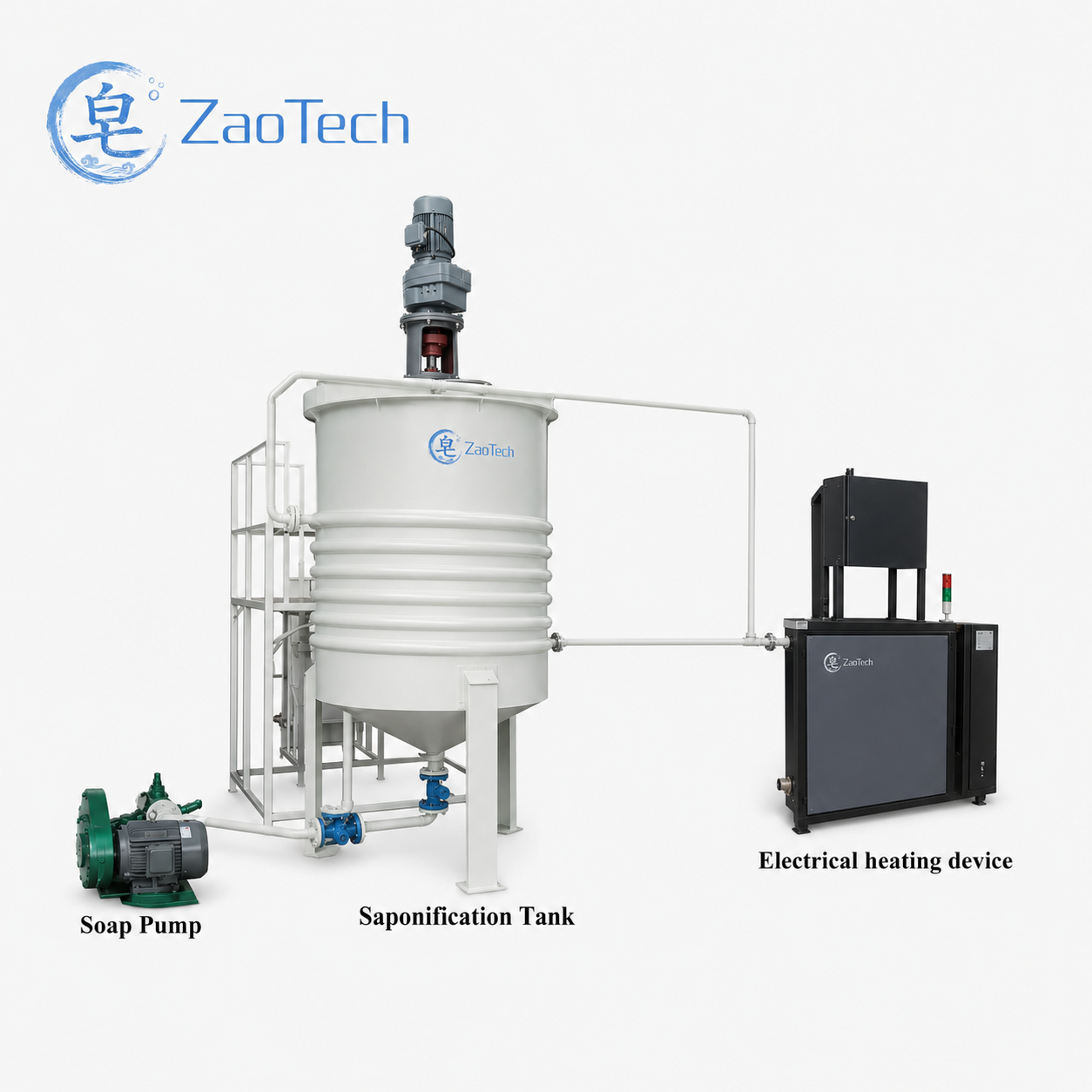
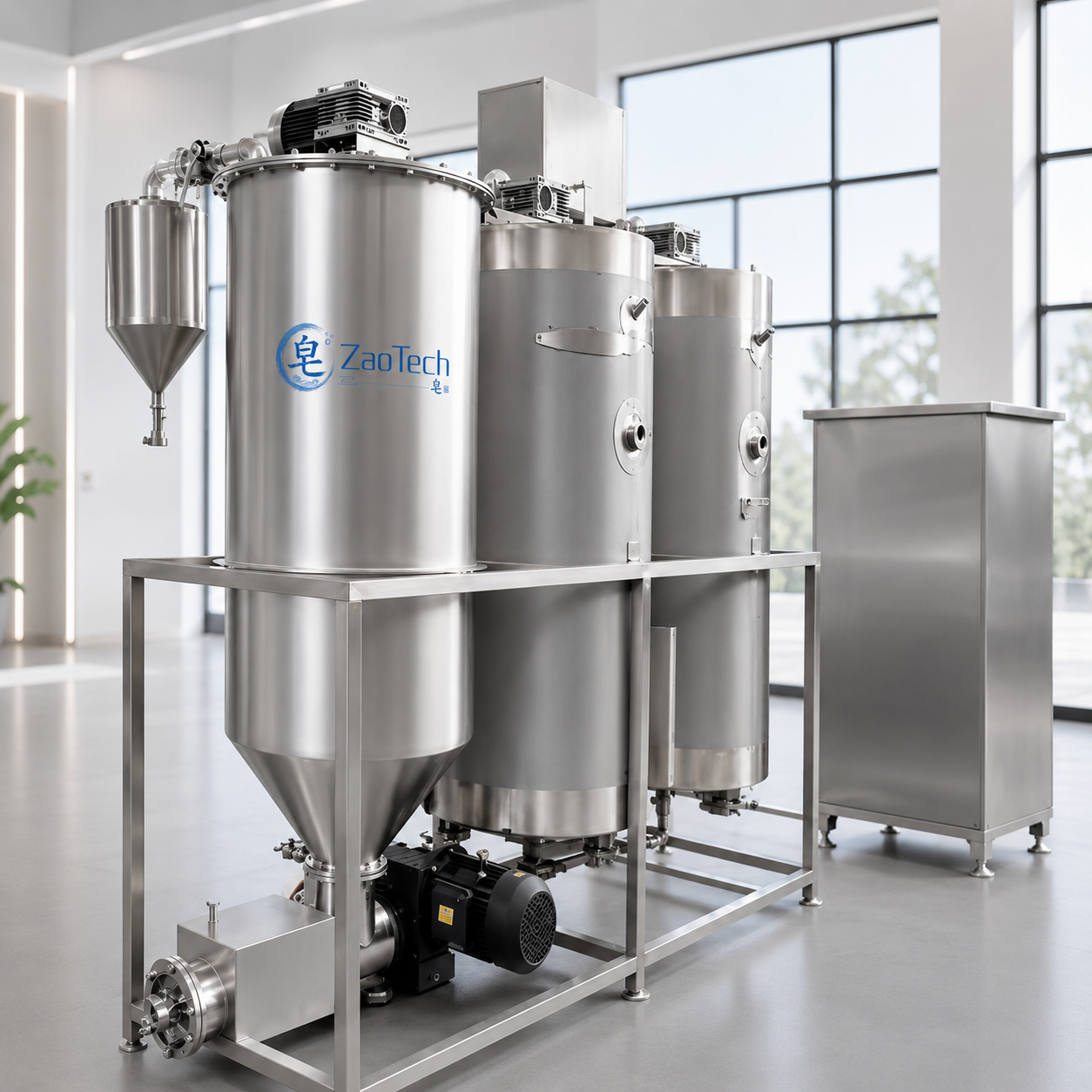
The industrial front end of an oil-to-bar factory: melts oils, doses caustic soda, then dries and mills soap base into noodles at 1000 to 1500 kg/h.
| Parameter / module | Specification |
| Saponification capacity | 1000–1500 kg/h |
| Oil-melting tank | 3 m³, melts and mixes oils, fed by oil pump |
| Metered oil input | Oil flow meter + control switch, 3 kW |
| Soda-melting pool | 3 m³, with pipes and valves |
| Soda solution pump | Metered dosing to high tank, 3 kW |
| High-placed soda tank | 1 m³, with measuring scale |
| Installed power | > 100 kW, 380 V, 50 Hz |
| Workshop area | ≥ 250 m² (25 × 10 × 3.5 m) |
| Operators | 4–6 persons |
| Output of stage | Dried soap noodles for the finishing line |
| Material | Role |
| Palm oil / palm kernel oil / coconut oil | Fatty base of the soap |
| Caustic soda (NaOH) | Alkali that drives saponification |
| Pigment | Bar colour, added in finishing |
| Fragrance | Scent, added in finishing |
The ZAOTECH soap saponification machine converts raw oils and caustic soda into soap base, then dries and mills it into soap noodles ready for finishing. Rated for 1000 to 1500 kg per hour, it is the front end of a true oil-to-bar factory, letting producers control quality and cost from the very first reaction rather than buying noodles from a third party.
This saponification equipment works in clear stages: oils such as palm, palm kernel and coconut oil are melted and metered into a stirred saponification tank with caustic soda, the resulting soap base is discharged and dried, and the dried soap is cut into noodles. Those noodles then feed a finishing line of mixer, three-roller grinder, vacuum plodder, stamper and conveyors with their own controllers.
Because it gives full command of formulation, a soap saponification machine is the natural choice for manufacturers who want to set their own fatty-acid blend, additive package and bar quality at industrial scale instead of depending on purchased soap base.
• Full control from oil to noodle. Running saponification in-house lets you fix the oil blend, alkali ratio and additives yourself, so finished bar quality is set at the source rather than inherited from bought-in base.
• Industrial throughput. The line is built around a 1000–1500 kg/h reaction and drying capacity, suiting medium and large soap factories and contract manufacturers.
• Metered, repeatable dosing. Oil and soda are transferred through pumps with flow meters and control switches, so each batch receives a consistent, measured charge of oil and caustic soda.
• Natural-drying soap base. The discharged liquid soap base is dried before being cut into noodles, producing a stable feedstock for the downstream finishing line.
• Integrated finishing line. Mixing, grinding, vacuum extruding, stamping and cutting follow on directly, so the soap saponification machine forms part of a continuous oil-to-bar chain.
• Flexible oil base. Palm oil, palm kernel oil and coconut oil are all suitable, giving freedom to optimise the recipe around local oil prices and the bar grade you want.
• Stainless wetted parts. Surfaces in contact with hot soap and lye are built for the duty, supporting long, hygienic production runs.
The table summarises the main process modules and utilities of this soap saponification machine in its 1000–1500 kg/h configuration. Use it to plan tank rooms, alkali handling, power and the workshop footprint.
| Parameter / module | Specification |
|---|---|
| Saponification capacity | 1000–1500 kg/h |
| Oil-melting tank | 3 m³, melts and mixes oils, fed by oil pump |
| Metered oil input | Oil flow meter + control switch, 3 kW |
| Soda-melting pool | 3 m³, with pipes and valves |
| Soda solution pump | Metered dosing to high tank, 3 kW |
| High-placed soda tank | 1 m³, with measuring scale |
| Installed power | > 100 kW, 380 V, 50 Hz |
| Workshop area | ≥ 250 m² (25 × 10 × 3.5 m) |
| Operators | 4–6 persons |
| Output of stage | Dried soap noodles for the finishing line |
In a single integrated flow, this soap saponification machine melts and blends the oils, doses caustic soda into a stirred reactor, and discharges a saponified soap base. The base is dried naturally and cut into soap noodles, which become the feedstock for milling, plodding and stamping into bars.
The downstream finishing line is conventional and robust: a mixer blends colour and fragrance into the noodles, a three-roller grinder refines the mass, a vacuum plodder extrudes a dense billet, and a stamper and cutter form the final bars. Conveyors and controllers tie the stages together so the plant runs as one system.
This soap saponification machine is intended for medium and large producers of laundry and toilet bar soap who want to make their own soap base. It suits established factories scaling up, new plants that prefer full vertical integration, and contract manufacturers supplying multiple brands from a single in-house base.
Typical outputs are laundry bars and toilet soaps built on palm and palm-kernel formulations, plus soap noodles sold on to other finishers. The saponification stage feeds directly into bar finishing, and many operators run it alongside a dedicated laundry soap production line for the downstream bars. The full machinery range is shown on the soap production lines overview.
For producers exporting finished soap, controlling the saponification step also makes it easier to certify and standardise the product, since the recipe and process are entirely in-house.
The reactor is charged with vegetable oils and caustic soda; the chemistry of this stage is classic saponification, where fats react with alkali to form soap. Pigment and fragrance are added downstream in the finishing mixer to colour and scent the bars.
| Material | Role |
|---|---|
| Palm oil / palm kernel oil / coconut oil | Fatty base of the soap |
| Caustic soda (NaOH) | Alkali that drives saponification |
| Pigment | Bar colour, added in finishing |
| Fragrance | Scent, added in finishing |
1. Oil melting. Oils are melted and blended in the 3 m³ oil tank and transferred by pump toward the reactor.
2. Soda preparation. Caustic soda is dissolved in the 3 m³ soda pool and pumped up to the 1 m³ high tank, where a measuring scale supports accurate dosing.
3. Saponification. Metered oil and soda enter the stirred tank, where the automatic mixer drives the reaction into a soap base.
4. Drying. The discharged liquid soap base is dried naturally to a workable solid.
5. Noodle cutting. The dried soap is cut into noodles, the standard feedstock for the finishing line.
6. Finishing. Noodles are mixed, ground, vacuum-plodded, then stamped and cut into bars.
The value of a dedicated soap saponification machine is consistency. Metered oil and soda charges, a stirred reactor and a controlled drying step give a soap base of stable composition, which in turn yields uniform noodles and predictable bar quality further down the line.
Because the base is made to your own recipe, you can tune hardness, lather and additive loading deliberately, and reproduce the same result across long production runs and multiple shifts.
Installing a soap saponification machine at this scale is a process-plant project, so plan the building early. The line needs a hall of at least 250 m² laid out as 25 × 10 × 3.5 m, with separate zones for oil storage and melting, caustic-soda preparation, the saponification reactor, and the drying and noodle-cutting area.
Utilities matter just as much: more than 100 kW of installed power on a 380 V, 50 Hz supply, safe bunding and handling for caustic soda, and good ventilation. With these in place, a four-to-six-person crew can run the soap saponification machine and its finishing line as one continuous operation.
What capacity does this soap saponification machine offer?
It is configured for 1000 to 1500 kg per hour of soap base, making it suitable for medium and large factories rather than small workshops.
Which oils can be used?
Palm oil, palm kernel oil and coconut oil are all suitable, together with caustic soda. The exact blend is chosen to match your target bar grade and local oil costs.
Does the machine also make finished bars?
The saponification stage makes soap base and noodles. A finishing line of mixer, grinder, vacuum plodder, stamper and cutter then turns those noodles into bars.
How much space and power are required?
Plan for a workshop of at least 250 m² (25 × 10 × 3.5 m) and an installed power supply above 100 kW at 380 V, 50 Hz.
How many operators run the line?
Four to six operators are typical for the full saponification and finishing chain at this capacity.
Why saponify in-house instead of buying soap noodles?
In-house saponification gives full control of recipe and quality and removes dependence on bought-in base, which usually improves both consistency and cost at scale.
How long does the soap base take to dry?
The discharged base is dried naturally before cutting, so drying time depends on your ambient conditions and layout; allow dedicated space for this stage.
Can the finishing line run on its own?
Yes. The mixer, grinder, plodder and stamper can run as an independent finishing line if you process bought-in noodles alongside your own base.
What is the saponification machine's hourly output?
It processes 1000 to 1500 kg per hour of soap base, depending on the oil blend and operating conditions.
Which alkali does it use?
It uses caustic soda to saponify palm, palm-kernel and coconut oils into soap base.
• Complete front-end solution. Oil melting, soda dosing, reaction, drying and noodle cutting are integrated into one coherent stage.
• Recipe ownership. You set the oil blend and additive package, so bar quality is engineered in from the first reaction.
• Industrial-scale build. Sized for 1000–1500 kg/h continuous operation in medium and large plants.
• Metered, repeatable process. Pumped, flow-metered dosing keeps batches consistent shift after shift.
• Seamless integration. Feeds directly into ZAOTECH finishing lines for an end-to-end oil-to-bar factory.
By bringing saponification, drying and noodle production together, this ZAOTECH soap saponification machine lets manufacturers own their soap base and build a fully integrated, large-scale bar-soap operation.
Products and services that have earned the appreciation and trust of clients across industry.
with a 3-in-1 laser machine (welding + cleaning + cutting) and a smart capital decision
All delivered equipment meets European quality standards and the DNSH principle, is eligible for acquisitions through EU and PNRR funding, and includes interactive AI-powered manuals for operation, maintenance and operator training.
Media appearances, technical demos and presentations from the most important industrial trade fairs in Europe. See our technology in action.
Over 100 companies in manufacturing, logistics and industry have chosen Uzinex as their strategic partner.
All references→



„We do stainless-steel metal fabrication dedicated to restaurant kitchens. The UZINEX equipment was a radical change: modernization, an increase in production and quality.”
„I had no idea, I was completely clueless. And you started to explain to me. You told me what technologies to choose, what packaging to produce, what would work better on the market.”
„We use a single person who can operate 3-4 machines. Before, we needed 3-4 people to do the same thing.”
„We have multiple challenges in making special structures that serve our systems, and the laser welding machine solution helped us enormously.”
„Laser welding on stainless is something else, it's a completely different thing. The quality of the machines is undeniable: the samples say it all.”
„With Uzinex, I felt very well protected by the assistance they provided. When you have a whole shift stalled and you need someone to answer quickly, it matters enormously.”
„The proof that everything went well is that the equipment now works. We have over three years of experience with no problems. Or when there were issues, there was support. We're satisfied with the collaboration.”
„I can do even 5 boxes for one person, I can also do 10 boxes. Which other firms can't do. That is, they'd have to change dies, set up a whole 12-hour affair.”
„Whether I called at 2 in the morning or at 9 in the morning, the problems got solved. We're satisfied and we'll work together again.”
„A good, smooth collaboration. We always had support and help.”
„We're among the top producers in Romania for this product. I wouldn't have imagined that when I started, but things fell into place.”
„On price and quality ratio, they were the best price and the best quality on the market. We got along well and we're satisfied.”
Six technology directions we integrate turnkey: from plug & play IIoT sensors, to cobots, predictive maintenance, optical inspection, MES connectivity and custom industrial software.
See in real time how much each machine produces and how long it sits idle. We fit sensors on any equipment, new or old, and within a few hours you have the OEE dashboard on your phone. No complex wiring, no production downtime. The first concrete step toward digitalization, with ROI visible from the very first month.
Solve your labor shortage without tripling your costs. The cobot works safely alongside your people (palletizing, feeding the CNC, welding) while you recover the investment in 12-18 months. Prices 30-40% below European distributors, with installation and programming included from us.
Stop waiting for things to break. Our algorithms analyze sensor data and tell you exactly which part will fail and when, and we bring it to your production line before the breakdown. Zero unplanned downtime, zero contractual penalties, complete operational peace of mind.
Eliminate defects before they reach the customer. Our cameras inspect every part at speeds no operator can match, detecting sub-millimeter defects. They mount onto your existing line, with no modifications. Ideal if you produce for export and have strict quality clauses.
Connect your machines to your office, regardless of brand or age. Our gateway automatically translates the data from any machine into your ERP's format: no manual entry, no paper forms, no human error. The manager sees production live, the operator receives digital instructions.
Have a process that no off-the-shelf software can solve? We build custom industrial applications: from tailored SCADA panels and HMI interfaces, to production planning systems, lot traceability and automated reporting. The code is yours, it runs on your servers, with no monthly subscriptions or vendor lock-in.
Answers to the most common technical and commercial questions. Can't find what you're looking for?
Contact the team →Contact our team and receive a personalized offer within a maximum of 24 working hours.