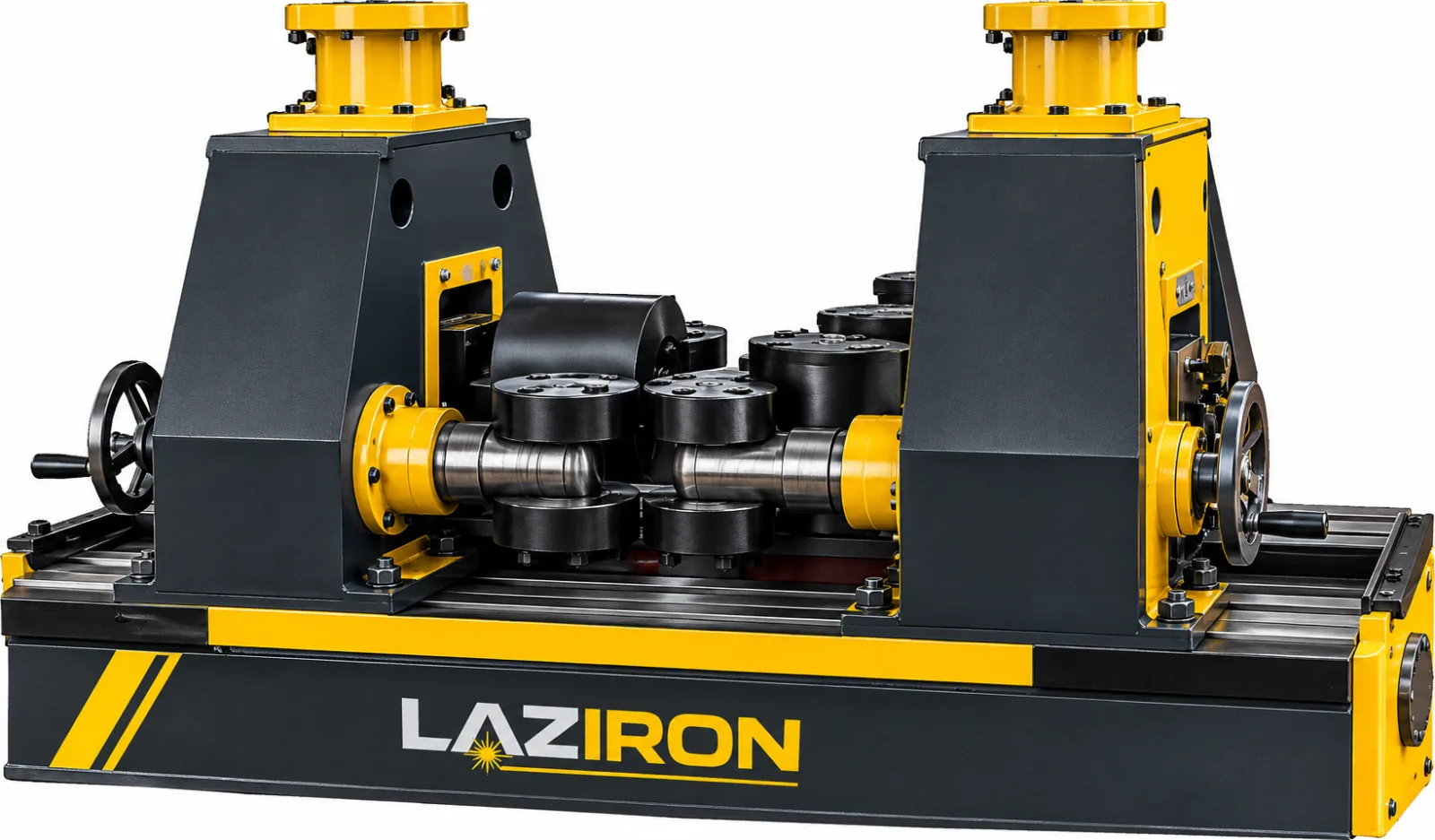
Hydraulic H-beam straightening machine for post-weld work: corrects angular flange distortion on 200–2000 mm flanges at 4.8 m/min. 60-month warranty.
| Flange width | 200–2000 mm |
| Flange thickness | 6–40 mm / 6–60 mm / 6–80 mm (depending on version) |
| Web height | 200–2000 mm |
| Straightening speed | 4.8 m/min |
| Power | 40 kW |
A hydraulic H-beam straightening machine solves a problem every steel structure fabricator knows: after the web is welded to the flanges, the transverse shrinkage of the weld pulls the flange and leaves it tilted, with angular distortion. LAZIRON HYJ is the machine dedicated to this correction. The freshly welded H or I beam passes between three rollers, and the flange receives a reverse, hydraulically controlled deformation that brings it back flat. The machine handles flanges and webs between 200 and 2000 mm and flange thicknesses up to 80 mm, depending on the version.
In the production flow, HYJ sits right after the welding station and before drilling, cutting to length, shot blasting or painting. It replaces manual straightening with flame and press, an operation that is slow, depends on the operator's experience and is hard to repeat from one part to the next. The beam comes out with its flanges perpendicular to the web, ready for further processing or for assembly on site. See the full range of machines for H-beam and box girder fabrication, from assembly to welding and straightening.
• Controlled hydraulic force: the hydraulic system applies precise, metered pressure, so the distorted flange is brought back to the required dimensions without being overstressed and without local flame heating.
• Consistent results across the whole batch: a hydraulic H-beam straightening machine repeats the same correction from one beam to the next. The original shape of the section is restored, and the structural integrity needed for later machining or assembly stays intact.
• Adjustment for every part: the distance between the pressing roller and the drive roller is set according to flange thickness and the measured degree of distortion. You adjust the upper and lower rollers and get the best correction for that beam.
• Wide range of sections: flange width and web height can vary between 200 and 2000 mm, so the same machine covers light hall beams and tall beams for overhead cranes or platforms.
• Three thickness versions: flanges of 6–40 mm, 6–60 mm or 6–80 mm. You choose the version that matches the sections you produce, without paying for capacity you do not need.
• Steady pace of 4.8 m/min: the drive roller pulls the beam continuously, so a 12 m beam passes through the machine in a few minutes, not in hours of manual flame work.
• Less manual correction work: straightening becomes a machine operation with clear parameters, not a craft that depends on a single experienced fitter on the night shift.
• Compact construction: the machine takes up little space on the line and fits easily between welding and finishing operations, without reorganizing the hall.
| Parameter | Value |
|---|---|
| Model | LAZIRON HYJ |
| Flange width | 200–2000 mm |
| Flange thickness | 6–40 mm / 6–60 mm / 6–80 mm (depending on version) |
| Web height | 200–2000 mm |
| Straightening speed | 4.8 m/min |
| Power | 40 kW |
The main user is the steel construction plant that produces welded H and I beams from plate: industrial halls, logistics warehouses, multi-storey buildings with a steel frame, platforms and trestles. In all these projects, an H-beam with a tilted flange causes problems during erection: bolted joints do not close, end plates do not sit over their full surface, and gaps have to be compensated on site. A hydraulic H-beam straightening machine eliminates these deviations while the beam is still in the factory.
The machine is also useful for manufacturers of crane runway girders, of girders for road and pedestrian bridges and of heavy structures for the energy industry. Where steel beams have thick flanges of 40–80 mm, post-weld distortion is large and manual correction takes many hours. The right HYJ version handles these sections without heating. The equipment is delivered with CE-certified components, in line with the requirements of the Machinery Directive 2006/42/EC.
On a complete beam line, HYJ works after the assembly machine and after the welding gantry. For lines that need straightening in a horizontal position, see also the horizontal H-beam straightening machine, and for the welding before straightening, the H-beam welding gantry.
Demand comes mainly from industrial and logistics halls, factory extensions and infrastructure projects, where beams welded from plate are increasingly replacing standard rolled sections. A fabricator who welds their own beams chooses web height and flange thickness by calculation, not by the rolling mill's catalogue, but needs a machine that brings the flanges back flat after welding. This is where HYJ fits in, as a fixed stage of the production flow.
The workflow on a hydraulic H-beam straightening machine is short and easy for a new operator to learn:
1. Measuring the distortion: the operator checks the welded beam and notes the flange thickness and how much the flange has tilted relative to the web.
2. Setting the rollers: the distance between the pressing roller and the drive roller is set according to flange thickness and the measured angular distortion.
3. Feeding the beam: the H or I beam is brought to the machine entry, aligned with the rollers.
4. Passing between the three rollers: the drive roller pulls the beam at 4.8 m/min, and the hydraulic pressure bends the flange in the direction opposite to the welding distortion.
5. Checking and fine adjustment: if an area of the flange is still tilted, the distance between the upper and lower rollers is corrected and the beam makes another pass.
6. Discharge: the straight beam moves on to drilling, cutting, shot blasting or painting.
The difference from the traditional method shows quickly in production. Flame straightening requires an experienced worker, heats the material locally and leaves the result up to each fitter. On an order of dozens of beams, the deviations add up, and some parts come back to the workshop after the first dimensional check. With HYJ, the correction is done mechanically, cold, with the same pressure for the same distortion, so a beam from the first day looks the same as one from the last day of the order.
Line pace matters too. The welding station delivers beams at a steady tempo, and if straightening stays manual, it becomes the bottleneck of the whole flow. At a speed of 4.8 m/min, the machine keeps up with welding, and beams no longer pile up in intermediate storage waiting for correction. For plants working two or three shifts, this means less floor space taken up in the hall, fewer overhead crane handling operations and delivery dates you can promise with more confidence.
A third gain concerns measurable quality at acceptance. A client who checks the perpendicularity of the flanges to the web receives beams with the same deviation across the whole batch, not good parts mixed with parts corrected in a hurry. Dimensional inspection reports become simpler, and discussions with site supervisors come down to what really matters.
• Delivery, installation and commissioning, with operator training on your own parts.
• 60-month warranty and service with on-site response in under 24 hours in Romania (24–72 hours in other countries).
• Technical documentation for EU-funded, PNRR and public procurement projects.
Products and services that have earned the appreciation and trust of clients across industry.
with a 3-in-1 laser machine (welding + cleaning + cutting) and a smart capital decision
All delivered equipment meets European quality standards and the DNSH principle, is eligible for acquisitions through EU and PNRR funding, and includes interactive AI-powered manuals for operation, maintenance and operator training.
Media appearances, technical demos and presentations from the most important industrial trade fairs in Europe. See our technology in action.
Over 100 companies in manufacturing, logistics and industry have chosen Uzinex as their strategic partner.
All references→
„We do stainless-steel metal fabrication dedicated to restaurant kitchens. The UZINEX equipment was a radical change: modernization, an increase in production and quality.”
„I had no idea, I was completely clueless. And you started to explain to me. You told me what technologies to choose, what packaging to produce, what would work better on the market.”
„We use a single person who can operate 3-4 machines. Before, we needed 3-4 people to do the same thing.”
„We have multiple challenges in making special structures that serve our systems, and the laser welding machine solution helped us enormously.”
„Laser welding on stainless is something else, it's a completely different thing. The quality of the machines is undeniable: the samples say it all.”
„With Uzinex, I felt very well protected by the assistance they provided. When you have a whole shift stalled and you need someone to answer quickly, it matters enormously.”
„The proof that everything went well is that the equipment now works. We have over three years of experience with no problems. Or when there were issues, there was support. We're satisfied with the collaboration.”
„I can do even 5 boxes for one person, I can also do 10 boxes. Which other firms can't do. That is, they'd have to change dies, set up a whole 12-hour affair.”
„Whether I called at 2 in the morning or at 9 in the morning, the problems got solved. We're satisfied and we'll work together again.”
„A good, smooth collaboration. We always had support and help.”
„We're among the top producers in Romania for this product. I wouldn't have imagined that when I started, but things fell into place.”
„On price and quality ratio, they were the best price and the best quality on the market. We got along well and we're satisfied.”
Six technology directions we integrate turnkey: from plug & play IIoT sensors, to cobots, predictive maintenance, optical inspection, MES connectivity and custom industrial software.
See in real time how much each machine produces and how long it sits idle. We fit sensors on any equipment, new or old, and within a few hours you have the OEE dashboard on your phone. No complex wiring, no production downtime. The first concrete step toward digitalization, with ROI visible from the very first month.
Solve your labor shortage without tripling your costs. The cobot works safely alongside your people (palletizing, feeding the CNC, welding) while you recover the investment in 12-18 months. Prices 30-40% below European distributors, with installation and programming included from us.
Stop waiting for things to break. Our algorithms analyze sensor data and tell you exactly which part will fail and when, and we bring it to your production line before the breakdown. Zero unplanned downtime, zero contractual penalties, complete operational peace of mind.
Eliminate defects before they reach the customer. Our cameras inspect every part at speeds no operator can match, detecting sub-millimeter defects. They mount onto your existing line, with no modifications. Ideal if you produce for export and have strict quality clauses.
Connect your machines to your office, regardless of brand or age. Our gateway automatically translates the data from any machine into your ERP's format: no manual entry, no paper forms, no human error. The manager sees production live, the operator receives digital instructions.
Have a process that no off-the-shelf software can solve? We build custom industrial applications: from tailored SCADA panels and HMI interfaces, to production planning systems, lot traceability and automated reporting. The code is yours, it runs on your servers, with no monthly subscriptions or vendor lock-in.
Answers to the most common technical and commercial questions. Can't find what you're looking for?
Contact the team →Contact our team and receive a personalized offer within a maximum of 24 working hours.