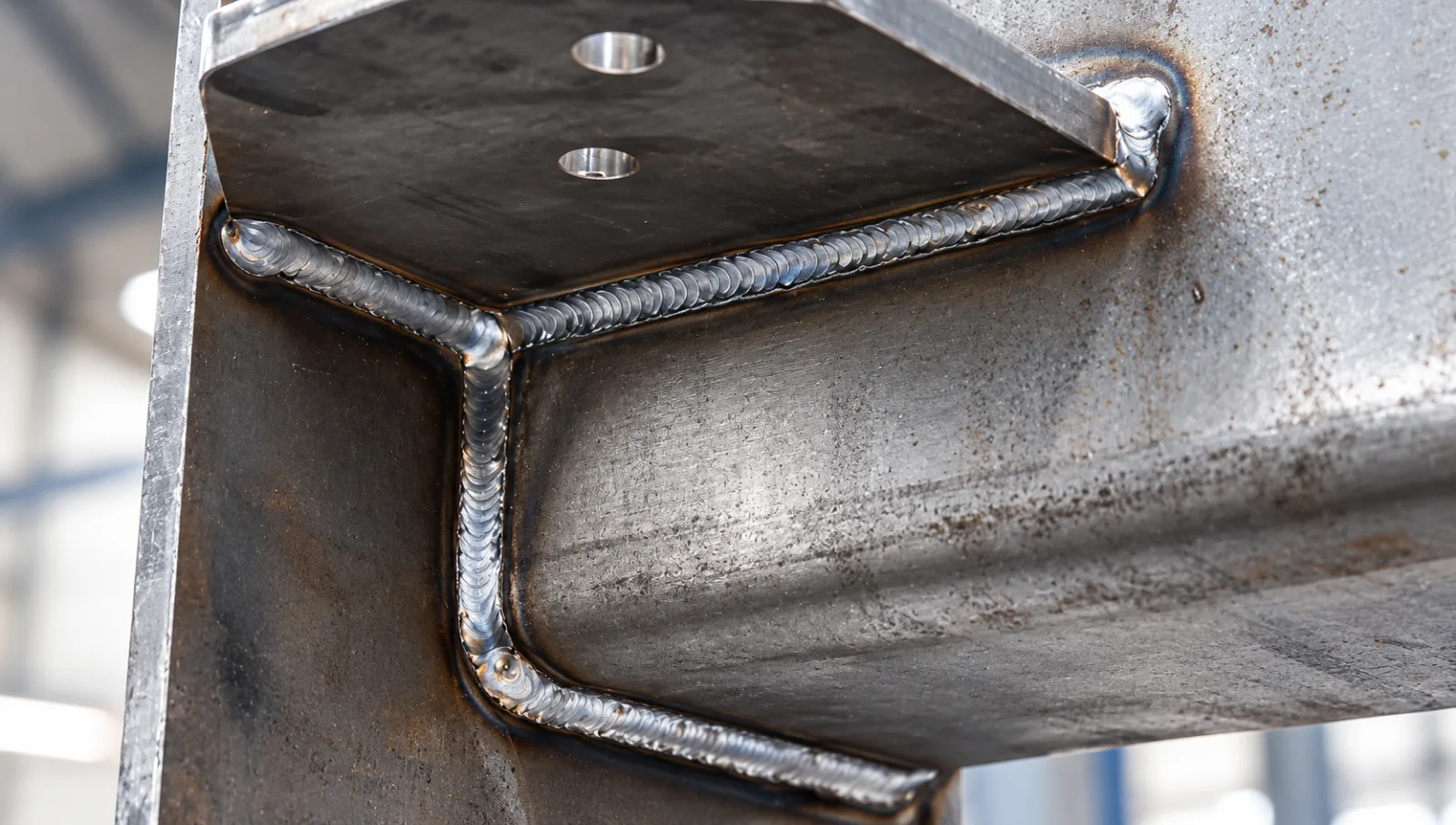
Welding robot for H-beams and crane runway girders, programmed directly from the BIM model (STEP, IFC), with a line laser sensor. 60-month warranty.
| Effective welding area | 10 m (length) × 1.2 m (width) × 0.5 m (height) |
| Vision sensor | Line laser vision sensor |
| Welding mode | Welding driven by BIM model (STEP, IFC format) |
| Welded plate thickness | 6–18 mm |
| Welding positions | Horizontal welding, vertical welding (automatic corner wrapping) |
| Compatible parts | Intermediate plates (stiffeners) on H-beams, crane runway girders, main seams of H-beams, platform beams, roof beams |
| Footprint | 12 m (length) × 0.85 m (width) |
A welding robot for beams solves two problems every steel structure plant feels: the shortage of qualified welders and the quality differences between seams made by different people on different shifts. LAZIRON ZZHJ-R-BC-12 is an automatic welding robot for steel structure components. The robotic arm follows programmed paths and parameters, and every seam comes out the same. Programming is done directly from the part's BIM model (STEP or IFC), and a line laser vision sensor reads the actual joint before welding.
In the production flow, the robot works after the beam has been assembled and tacked, where the stiffeners (intermediate plates), the main seams of H-beams and the details of crane runway, platform and roof beams are welded. It takes repetitive work off manual welders and leaves them on the joints that really need a human hand. See the full range of machines for H-beam and box girder fabrication, from assembly to welding and straightening.
• Programming directly from BIM: welding paths are generated from the part's 3D model (STEP, IFC), so you no longer program each beam point by point. The model the designer has already made becomes the robot's program.
• Line laser sensor: the welding robot identifies the actual position of the joint and corrects its path according to the part, not the drawing. Normal assembly deviations no longer spoil the seam.
• Consistent seams: the same weld, with the same parameters, from the first to the last beam in the order. The risk of human error drops sharply, and quality control becomes simpler, because robotic welding means recorded parameters, not estimated ones.
• Higher productivity: a welding robot works continuously, without fatigue, with higher welding speeds and a constant production pace throughout the shift.
• Horizontal and vertical welding: with automatic corner wrapping, for continuous seams around stiffeners, without unnecessary starts and stops.
• 10 m working area: the effective welding area of 10 m × 1.2 m × 0.5 m covers long beams in a single setup.
• Versatility: the robot can be programmed for several arc welding processes, for example MIG and TIG, and for different materials.
• Better safety: operators spend less time in the welding area, away from fumes, radiation and spatter.
| Parameter | Value |
|---|---|
| Model | LAZIRON ZZHJ-R-BC-12 |
| Effective welding area | 10 m (length) × 1.2 m (width) × 0.5 m (height) |
| Vision sensor | Line laser vision sensor |
| Welding mode | Welding driven by BIM model (STEP, IFC format) |
| Welded plate thickness | 6–18 mm |
| Welding positions | Horizontal welding, vertical welding (automatic corner wrapping) |
| Compatible parts | Intermediate plates (stiffeners) on H-beams, crane runway girders, main seams of H-beams, platform beams, roof beams |
| Footprint | 12 m (length) × 0.85 m (width) |
The footprint of only 12 m × 0.85 m allows the robot to be placed along an existing beam line, without a dedicated cell blocking an entire bay of the hall.
The main application is welding steel beams in structure plants: stiffeners on H-beams, the main seams between web and flanges, crane runway girders for overhead cranes, platform beams and roof beams for halls. On an industrial hall project, the same types of stiffeners repeat hundreds of times, and a welding robot executes them identically, from the BIM model the engineering office prepared for fabrication anyway.
Welding robots of this type are also used in the automotive and aerospace industries, in shipbuilding and in construction, wherever welds are complex, volumes are large and quality control is essential. For shipyards and their subcontractors, an industrial robot for welding brings repeatability on structural elements with many seams. The equipment is delivered with CE-certified components, in line with the requirements of the Machinery Directive 2006/42/EC.
The robot complements machines that weld long seams automatically. The gantry handles the main welds along the full length, and the robot takes over the stiffeners and details. See also the H-beam welding gantry and the multi-channel H-beam production line.
The workflow on a welding robot programmed from BIM starts in the engineering office, not next to the part:
1. Exporting the model: the designer exports the beam from the BIM model in STEP or IFC format.
2. Generating the paths: the welding paths for stiffeners and main seams are obtained from the model, without manual point-by-point programming.
3. Placing the beam: the assembled and tacked beam is positioned in the 10 m × 1.2 m × 0.5 m working area.
4. Scanning the joints: the line laser sensor reads the actual position of each joint and corrects the path relative to the model.
5. Welding: the robot executes the horizontal and vertical seams, with automatic corner wrapping, on 6–18 mm plates.
6. Discharge: the welded beam goes on to straightening, drilling or painting, and the next one enters the cell.
The part that changes factory work the most is the first step. The BIM model already exists for the shop drawings, and now it also becomes the source of the welding program. You no longer need a robot programmer spending whole days next to each new beam type. When the project changes, you update the model, and the robot receives the new paths from the same file, without redoing the program from scratch.
What happens to people matters too. A good welder remains valuable, but their time moves to complicated joints, repairs and quality control. Repetitive work, where fatigue and haste lead to defects, is taken over by a welding robot. For plants that cannot find qualified welders, this means capacity maintained without impossible hiring.
• Delivery, installation and commissioning, with operator training on your own parts.
• 60-month warranty and service with on-site response in under 24 hours in Romania (24–72 hours in other countries).
• Technical documentation for EU-funded, PNRR and public procurement projects.
Products and services that have earned the appreciation and trust of clients across industry.
with a 3-in-1 laser machine (welding + cleaning + cutting) and a smart capital decision
All delivered equipment meets European quality standards and the DNSH principle, is eligible for acquisitions through EU and PNRR funding, and includes interactive AI-powered manuals for operation, maintenance and operator training.
Media appearances, technical demos and presentations from the most important industrial trade fairs in Europe. See our technology in action.
Over 100 companies in manufacturing, logistics and industry have chosen Uzinex as their strategic partner.
All references→



„We do stainless-steel metal fabrication dedicated to restaurant kitchens. The UZINEX equipment was a radical change: modernization, an increase in production and quality.”
„I had no idea, I was completely clueless. And you started to explain to me. You told me what technologies to choose, what packaging to produce, what would work better on the market.”
„We use a single person who can operate 3-4 machines. Before, we needed 3-4 people to do the same thing.”
„We have multiple challenges in making special structures that serve our systems, and the laser welding machine solution helped us enormously.”
„Laser welding on stainless is something else, it's a completely different thing. The quality of the machines is undeniable: the samples say it all.”
„With Uzinex, I felt very well protected by the assistance they provided. When you have a whole shift stalled and you need someone to answer quickly, it matters enormously.”
„The proof that everything went well is that the equipment now works. We have over three years of experience with no problems. Or when there were issues, there was support. We're satisfied with the collaboration.”
„I can do even 5 boxes for one person, I can also do 10 boxes. Which other firms can't do. That is, they'd have to change dies, set up a whole 12-hour affair.”
„Whether I called at 2 in the morning or at 9 in the morning, the problems got solved. We're satisfied and we'll work together again.”
„A good, smooth collaboration. We always had support and help.”
„We're among the top producers in Romania for this product. I wouldn't have imagined that when I started, but things fell into place.”
„On price and quality ratio, they were the best price and the best quality on the market. We got along well and we're satisfied.”
Six technology directions we integrate turnkey: from plug & play IIoT sensors, to cobots, predictive maintenance, optical inspection, MES connectivity and custom industrial software.
See in real time how much each machine produces and how long it sits idle. We fit sensors on any equipment, new or old, and within a few hours you have the OEE dashboard on your phone. No complex wiring, no production downtime. The first concrete step toward digitalization, with ROI visible from the very first month.
Solve your labor shortage without tripling your costs. The cobot works safely alongside your people (palletizing, feeding the CNC, welding) while you recover the investment in 12-18 months. Prices 30-40% below European distributors, with installation and programming included from us.
Stop waiting for things to break. Our algorithms analyze sensor data and tell you exactly which part will fail and when, and we bring it to your production line before the breakdown. Zero unplanned downtime, zero contractual penalties, complete operational peace of mind.
Eliminate defects before they reach the customer. Our cameras inspect every part at speeds no operator can match, detecting sub-millimeter defects. They mount onto your existing line, with no modifications. Ideal if you produce for export and have strict quality clauses.
Connect your machines to your office, regardless of brand or age. Our gateway automatically translates the data from any machine into your ERP's format: no manual entry, no paper forms, no human error. The manager sees production live, the operator receives digital instructions.
Have a process that no off-the-shelf software can solve? We build custom industrial applications: from tailored SCADA panels and HMI interfaces, to production planning systems, lot traceability and automated reporting. The code is yours, it runs on your servers, with no monthly subscriptions or vendor lock-in.
Answers to the most common technical and commercial questions. Can't find what you're looking for?
Contact the team →Contact our team and receive a personalized offer within a maximum of 24 working hours.