There is a moment in the life of every industrial entrepreneur who wants to buy a laser welding machine. The sales representative comes. Brings the datasheet. Shows you a few video clips in which a six-millimetre steel plate turns into a perfect bead in thirty seconds. You are convinced. You make the one gesture that seems the most responsible possible. You go to the shop floor and ask your welder with twenty years of experience. Let me show you something, you say, what do you think of this machine.
At that moment, without knowing it, you have already lost the decision. What comes next, whether the machine ends up in your factory or not, is the consequence of a single question put to a single person, at the wrong moment, without you understanding what they are actually evaluating. They are not evaluating the machine. They are evaluating something else. And in this article we will break down every layer of the confusion until you see, at the end, why your initial question was the worst thing you could have done and what you should have asked instead.
The brutal reality that nobody says openly is this. Your welder's opinion about a laser welding machine is, statistically, the worst predictor of the success of a purchase of 25,000, 50,000 or 120,000 euros. And if you rely on it, it costs you in a way that never shows up in Excel. It shows up in lost orders, in hidden refusals, in passive sabotage, in qualification certificates postponed endlessly and, ironically, in a machine that sits covered with a sheet of plastic in a corner of the shop for three years.
This article is about how the unconscious psychology of an experienced welder works when they are asked a question about a technology that makes their work four times faster. It is about the three objections you will surely hear, regardless of the supplier, regardless of the brand, regardless of the machine's specifications. And it is about who should actually be in the room when you sign a contract that will radically change the economics of your shop for the next five years.
The welder does not evaluate the machine. They evaluate the threat.
There is a fundamental cognitive error that we all make when we ask a specialist about a new technology. We assume that the specialist is evaluating the technology. In reality, the specialist is evaluating the implications of the technology for their own position, for the skills accumulated over two decades, for the residual value of their expertise on the labour market in your region.
This evaluation happens unconsciously. Your welder does not wake up in the morning planning to sabotage the purchase. Their brain simply, when it sees a laser gun that produces in an hour what they do in an eight-hour shift, triggers a cascade of cognitive reactions that have absolutely nothing in common with the technical performance of the machine. It has to do with one thing. With them.
A TIG welder with twenty years of experience has invested, cumulatively, more than 40,000 hours in perfecting a manual technique. They learned to feel the material. They learned to compensate for thermal deformation. They learned to read the electric arc like a musical score. For them, every bead is a craft execution in which personal expertise is the decisive variable. Their pay, their status in the shop, their value on the labour market, everything rests on this hierarchy of manual skill.
Now the laser appears. A junior with three days of training can pull beads that, visually, are indistinguishable from theirs. And in many applications they are even better. Faster. More precise. With less thermal deformation. With scrap reduced to fractions of a percent. The machine does not ask for weaving. It does not ask for manual oscillation. It does not ask for stabilisation pauses. It does not ask for the accumulated intuition that they built with decades of effort.
What do you think the welder answers when you ask whether to buy the machine? Their answer is logical, articulate, full of technical terms, full of objections that sound credible, full of examples from their personal experience. But their answer is not an evaluation. It is a defence. A defence of a world in which they are indispensable. And if you confuse one with the other, you have lost not only the purchase, but also an opportunity to transform your shop that you will not have again in the next five years.
TIG, MIG, MMA. And then the laser. Three different languages, one confused translator.
There is an additional technical problem that needlessly complicates any discussion between an entrepreneur and a welder about the laser. Conventional electric welding, whatever the variant, be it TIG, MIG or MMA, operates on the same fundamental physics. An electric arc between an electrode and the workpiece melts the filler material and the workpiece, and the molten metal solidifies to form the bead. The parameters that matter are amperage, voltage, shielding gas, travel speed, distance, angle. A good TIG welder is, in general, also a good MIG welder and a decent MMA welder. The technique differs, the physics does not.
Laser welding does not use an electric arc. It uses a coherent beam of photons with a wavelength of around 1080 nm, focused through a precision lens into a spot of a fraction of a millimetre. The energy that reaches the material does not come from electron collisions, but from the absorption of photons by the crystalline structure of the metal. At power densities above 10^6 W per square centimetre, the system enters the keyhole regime. That is, a channel of metal vapour forms inside the workpiece through which the beam penetrates far beyond the depth of a conventional TIG weld from the same energy input.
This is not a technical nuance that a welder learns over a weekend. It is a completely different mental model. Everything they learned about thermal control, about expansion, about cooling, about how to read a bead under raking light, becomes partly irrelevant and partly misleading. The control parameters are no longer amperage and gas, but laser power, pulse duration, beam oscillation speed, focal distance, assist gas pressure, beam propagation mode, the ratio between spot width and travel speed.
Ask a welder with twenty years of TIG to evaluate a laser and what you will get is an evaluation made with the grammar of another language. What they call insufficient penetration is, in fact, a lack of keyhole configuration. What they call a gun that is too bulky is, in fact, an optical capillary with an integrated cooling system that has nothing in common with the weight of their aluminium torch. What they call an unnatural movement is exactly the movement required by the physics of the beam, not by the motor habits they formed over two decades.
The question that should be asked is not how the laser compares with TIG. The question that should be asked is whether the technology solves the production problem you have. And that the welder cannot answer, because production problems are not their problems. They are yours.
The three objections you will surely hear. And why all of them are wrong.
Regardless of the supplier, regardless of the brand, regardless of the specifications of the laser welding machine you are evaluating, your experienced welder will raise three objections. You can bet on them. We have heard them at hundreds of factories, in hundreds of discussions, from hundreds of welders with hundreds of years of cumulative experience. There are three objections. Always three. And each of them is a rhetorical trap, not a technical evaluation.
Objection one. The gun is too big.
This is the first objection. It appears in the first five minutes. It is visual. It is immediate. The welder takes the laser gun in their hand, weighs it on the palm, moves it through space, tries two or three typical welding gestures, and delivers the verdict. Too big. Too heavy. I will not be able to move with it. It does not fit into that niche on the panel.
Here is the comparison that is never made. A typical portable laser gun, like those from WyLaser, RayDiode, ANBE or equivalents, weighs between 1.5 and 2 kilograms. At the tip it has an optical capillary, a focusing lens, an integrated water cooling system and an assist gas nozzle. The umbilical cable is most often suspended from a balancing arm, which means the effective weight on the wrist stays that of the gun itself.
A TIG torch with its cable, the coolant connector and the gas hose, with the argon cylinder attached to the stand behind the welder, has an effective weight in the welder's hand that is similar or even greater. The difference is that the welder has learned to stop perceiving the weight of the TIG torch. It has become invisible. It has become a second hand. The laser gun, in the first ten minutes, is new. It is uncomfortable. It is foreign. And their brain declares it too heavy.
But the paradox, which only someone who has observed dozens of transitions knows, is that the laser gun, being wider and better ergonomically contoured, offers more support in the palm, distributes the weight better on the wrist and tires less than a TIG torch after a week of getting used to it. Long welds on a linear bead, which with TIG require pauses to recalibrate position and regain the angle, can last several minutes without a pause with the laser, because the movement is more uniform and better supported by the geometry of the gun.
The perception of too big in the first ten minutes is, statistically, completely reversed after three days of real use on production parts. It is just that your welder will not reach those three days if you buy on the basis of their objection from the first ten minutes.
Objection two. It does not weld in depth.
The second objection comes after the welder tests the machine on a real part. They will choose, instinctively, a thick plate. They will set the laser as they would set a TIG, that is, in conduction mode. They will pull a bead. They will turn the part over. They will look at the penetration. And they will declare the verdict. It does not weld in depth. It does not compare with TIG. It does not withstand static load.
The confusion is fundamental and almost impossible to explain to a welder who does not want to listen. TIG welding, at 250 amperes on a 4-millimetre stainless steel plate, penetrates about 3 millimetres in a single pass. It is a heat transfer by conduction, in which heat flows from the surface inward at moderate speed. To obtain large penetration, the welder increases the amperage, slows the speed and accepts amplified thermal deformation as an inevitable cost of the technology.
Laser welding in conduction mode penetrates, on the same plate, only 1 to 1.5 millimetres. It looks like a disaster, by comparison. But if you change the parameters to enter keyhole mode, which means a power density above 10^6 W per square centimetre, the beam vaporises the metal in the spot area, creates a vapour channel and penetrates 5, 8, up to 15 millimetres in a single pass, depending on the effective laser power. A 1.5 kW laser in keyhole produces beads with a depth that with TIG would require 400 amperes and major thermal deformation of the part.
The problem is that your welder will not set the machine in keyhole. They will set it in conduction, because it is closer to what they know. And they will conclude that the laser does not weld in depth, when in fact they have not welded in depth with the laser. Those are two completely different statements.
And in 90% of real manufacturing applications, you do not even need large depths. For sheet of 1 to 4 millimetres, which is the predominant size in the metal furniture industry, in serial metal fabrication, in light structures, in car panels, in food containers, in cabins for industrial equipment, the laser in conduction mode is more than sufficient. And for applications in which you really need large penetration, you choose from the start a 2 kW, 3 kW or 6 kW machine. The problem is not the technology. The problem is the wrongly chosen specification.
Objection three. I cannot get used to the movement.
The third objection is the most honest of all. It is the only one in which the welder says literally what they feel, without rhetorical packaging. And it is, paradoxically, exactly the reason why you should not ask them. Twenty years of TIG movement, in which they learned to weave, to oscillate at a frequency calibrated empirically, to make thermal stabilisation pauses, to advance with a specific tilt angle, are twenty years of deeply rooted motor patterns.
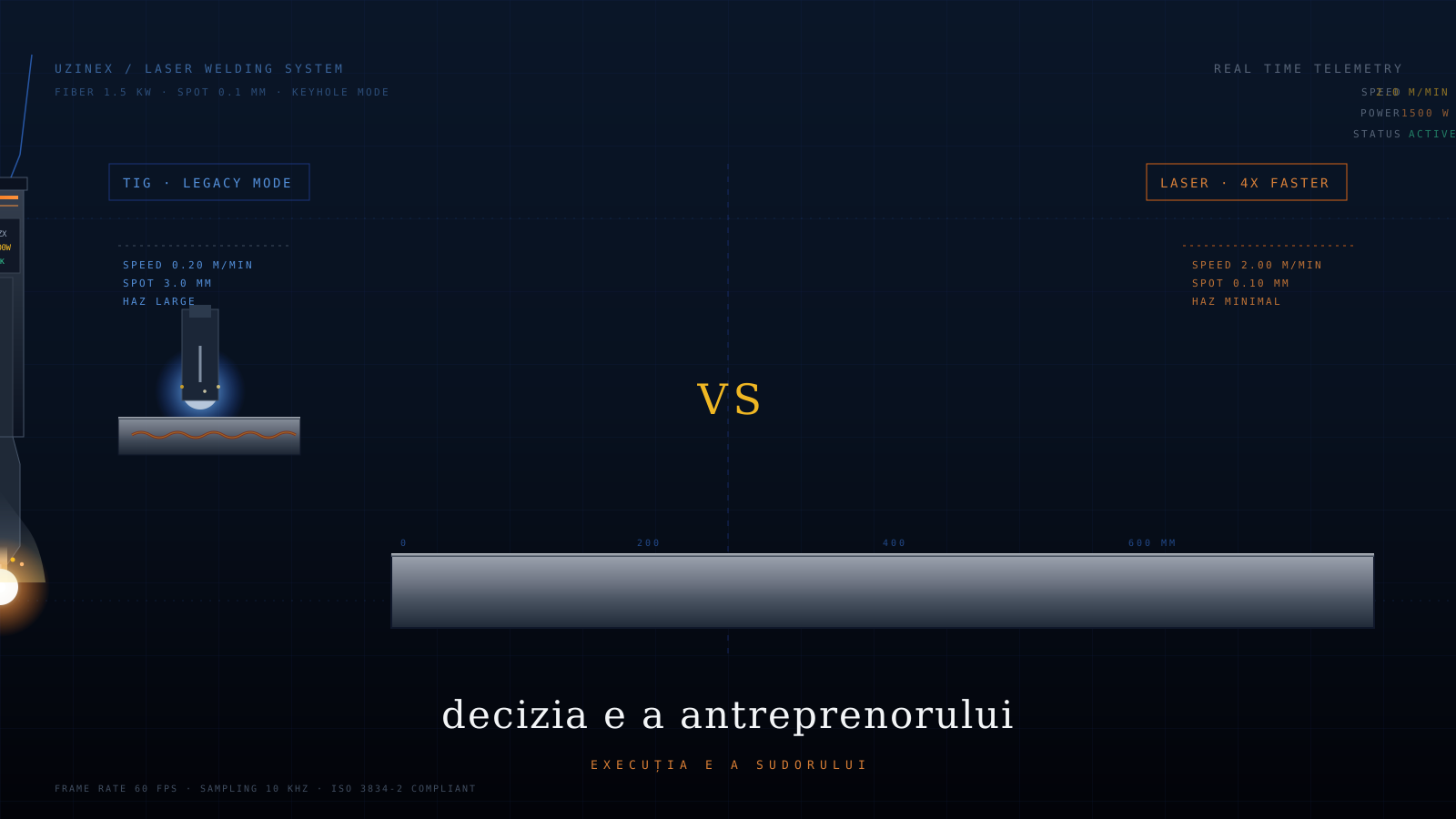
The laser asks for exactly the opposite. It asks for a linear, fast, constant movement. It asks for a travel speed of 1 to 3 metres per minute, compared with the 10 to 30 cm per minute of a well-tuned TIG. It asks for fine oscillation generated automatically by the gun head through galvanometers, not manually. It asks for the absence of the pauses they made with TIG to avoid overmelting.
For someone who has done TIG for two decades, every gesture goes against their trained intuition. Their hand wants to oscillate, but the laser asks for linear movement. Their hand wants to advance at 20 cm per minute, but the laser asks for 2 metres per minute. Their hand wants to pause when it sees too much light, but the laser asks for continuous flow. And their brain interprets this as a wrong technology, not as a new technology that requires a different set of reflexes.
A junior with no previous experience, who learns directly on the laser, has no competing patterns. They learn the correct movement from day one. They become productive in three working days. A senior welder learns the same movement in three weeks, if they ever learn it completely. The statistics that equipment integrators have are brutal. Almost half of the senior welders who start using the laser never reach the productivity level of a junior with one month of experience on the same machine.
The paradox of experience. Why a beginner becomes a laser operator faster than your foreman.
This is the strategic implication that few factories internalise. When you buy a laser welding machine, you do not only buy a machine. You buy a new type of operator. The ideal operator for the laser is not the senior welder. It is a 22-year-old, with no formed motor patterns, with digital reflexes from game consoles, open to procedural learning, without nostalgia for the old technique.
This means that buying a laser is, secretly, a human resources decision before it is a technical decision. It means the hiring strategy changes. It means the skills matrix of the shop changes. It means the pay structure changes. It means the role of the mentor on the floor changes. A senior TIG welder, in 2026 in Romania, costs between 6,000 and 12,000 lei net per month, depending on region and qualification. A junior laser operator, after three months of training, costs between 4,500 and 7,000 lei net for the same output or, more often, for double the output.
The hidden costs are asymmetric and always appear on the side you do not expect. A senior welder who works badly on the laser but well on TIG will prefer to weld TIG. They will find credible reasons. The machine is badly tuned. The material is of poor quality. The light is insufficient. They will end up using the laser five hours a week, while spending the other 35 on their trusted TIG. Your 60,000-euro machine will, statistically, run at 12% of nominal capacity. And the payback calculated at 16 months will become a real payback at 80 or 120 months, if it ever comes.
A junior operator who has learned only the laser has no technological alternative. Your machine, under a junior dedicated exclusively to the laser, will run at 90% of nominal capacity. The difference between the two scenarios, over three years, is between losing the investment and paying it back completely with a substantial margin. Over five years, it is between a missed decision and a decision that changed the competitive position of your factory on the market.
What the welder asks you versus what you should ask yourself.
Here is the difference that decides everything. The welder asks you things that concern execution and are valid only at the level of execution. What amperage it has. What gas it uses. How the consumables are changed. How heavy the gun is. Whether the oscillation is smooth. Whether they can see the arc through their mask. All these questions are legitimate. But none of them helps you decide whether the purchase makes financial and strategic sense for your factory.
The questions you should ask yourself, with a sheet of paper in front of you and the calculator open, are completely different. In how long does the investment pay back on the basis of my current volume of welding orders. How many person-hours per month do I save. What is my defect rate on TIG today and what will it become on the laser. How many orders do I lose annually because I cannot deliver in two weeks beads that with TIG take four. How does my cost structure change if I move 60% of the welding volume to the laser. What is the impact on electricity, on shielding gas consumption, on part deformation and on scrap.
The welder cannot answer any of these questions. And this is not a criticism. It is an observation about their professional role. The welder answers about the bead. The entrepreneur answers about the business. Confusing them is the most expensive strategic error you can make in the life cycle of your company.
The democratic decision. A case study from Brașov.
There is a factory making metal subassemblies for the HVAC industry in the Brașov area that made, in 2023, a decision it later regretted publicly at a management conference. They had to buy a 1.5 kW laser for welding 1.5-millimetre-thick stainless steel panels. The supplier had come with the technical specification, with the ROI calculated at 16 months, with a demo done at the site itself. The owner, with the best intention in the world, decided that it was such an important purchase that it had to be decided democratically. They called a meeting with all eight welders on the floor.
The result of the vote was five to three against the purchase. The five senior welders, with more than 15 years of TIG each, voted against. The three juniors, with under 5 years of experience and more open to new technology, voted for. The owner, respecting the team's vote, gave up the purchase and ordered instead two additional TIG machines and an external trainer programme for advanced techniques.
A year later, a competitor from Cluj received, through SEAP, a contract of 180,000 euros for the delivery of stainless steel panels for a network of county hospitals. The delivery deadline was six weeks. With TIG, it would have been impossible to meet without tripling the team of welders, which was impossible without a massive investment in recruitment and training. The competitor, who had bought the 1.5 kW laser that the Brașov factory had refused only eight months earlier, delivered in four weeks with a team of three junior operators. The Brașov factory did not even apply to the tender, because it knew it could not meet the deadline.
The owner later admitted publicly at a management conference in one short sentence. The question I should have asked was not whether the team wants the laser. The question was whether I can take contracts that I now refuse if I have the laser. And the team could not answer that, because the team does not see the refused orders. It sees only the orders received and their daily execution.
Who should actually be in the room when you sign.
Purchase decisions for industrial equipment above 50,000 euros are not unilateral decisions. That is correct. What is not correct is who should be in the room. And the presence of the welder in this room, before the contract is signed, is one of the most widespread mistakes in contemporary Romanian industry.
The decision room should have four functional roles. The finance director, who evaluates payback, cash flow, tax impact, VAT deductibility and the possibility of European funding through PNRR or the Just Transition Programme. The production director, who evaluates integration into the current flow, transition downtime, the impact on weekly planning and on existing delivery deadlines. The maintenance manager, who evaluates the total cost of ownership, critical spare parts, the technical qualification needed for interventions and the availability of the supplier's local support. The quality manager, who evaluates the conformity of the beads with the applicable standards, namely ISO 3834-2, EN 1090 or AWS D17.1 if we are talking about structural components.
The senior welder is not in this room. Period. The senior welder comes after the purchase, in the implementation phase, as a user. Not as a decision maker. The difference is crucial for the final result. A user adapts to a decision already taken. A decision maker influences a decision that is not yet final. Confusing the two roles means corrupting the decision process. And a corrupted process produces, predictably, corrupted results.
This does not mean ignoring the welder. It means consulting them in the right window, with the right questions, after the strategic decision has already been taken. Questions such as how do we integrate the machine into your current flow, what training do you prefer, what complementary tools should we order with it. Never questions such as which machine should we buy or whether we should buy.
How to test the machine without letting the welder reject it in the first 10 minutes.
There is a demo protocol that works. Hundreds of integrators have tested it in thousands of factories. Its effectiveness depends on one fundamental principle. The first demo is never done with the senior welder. Never. There is no exception. No special case. No negotiated variant.
Step one. The initial demo is done with an operator designated specifically for it. It can be a junior from another factory whom you bring in for a day, it can be a trainer from the supplier, it can even be you, the entrepreneur, with an hour of video pre-training. The aim is not to show how it works in the hands of your best welder. The aim is to show how it works at baseline. If it is good at baseline, the later scenario with a dedicated operator will be even better.
Step two. The data is collected as data, not as opinions. Bead speed in metres per minute. Penetration measured in millimetres with a calliper. Thermal deformation measured against a reference part. The rate of visible defects over the first 10 metres of bead. Assist gas consumption per linear metre. Total time from loading the part to finishing the bead. These numbers are compared directly with the current TIG performance in your factory, measured with the same instrument on the same day. They are not compared with your welder's opinions. They are not compared with nostalgia. They are compared with data.
Step three. The senior welder enters the process only after step two, after you have the data in hand. And you do not ask them what their opinion is, because their answer will be determined by the psychological patterns described in the sections above. You present the data and you literally say the following. Look, the machine produces four times faster and with half the deformation. We are buying. The question I want you to answer is how we integrate this into the shop so that you remain indispensable on TIG for the critical beads and delicate repairs, while the laser covers the serial volume where it is objectively better.
Here you change the fundamental frame. You do not ask them to evaluate the technology. You ask them to find their role again in a world in which the technology is already decided. This saves their status, saves your purchase and saves your professional relationship with a valuable person you want to keep. All three at once, with no compromise in any direction.
Conclusion. The decision belongs to the entrepreneur. The execution belongs to the welder.
The most expensive confusion in contemporary Romanian industry is the confusion between the two roles. The entrepreneur makes the decision. The welder executes it. Reversing them, under the pretext of respect for technical expertise, is a leadership error with costs quantifiable in euros and in lost orders per year.
Respect for technical expertise is expressed through consultation in the right role. Not through transferring the strategic decision to someone who, structurally, does not see what you see. You see the annual profit and loss. You see the monthly cash flow. You see the tenders you cannot apply to. You see the customers you lose to faster competitors. The welder sees the individual bead. That is their work. That is their value. And that is what we protect if we give them the right role in the decision, namely the role of excellent executor of a decision that was correctly taken by someone else.
The practical conclusion is a single one. The next time the sales representative of a laser welding machine supplier walks into your factory, you do not take them straight to the shop floor. You take them to your office. With the finance director next to you. With the production director on the other side. With the quality manager at the table. With an Excel open on the big screen. With an A4 sheet on which you have written the questions that truly matter. And you call the welder after you have signed the contract. Not before. Never before.
Your laser welding machine, if you buy it on the right criteria and introduce it with the right implementation protocol, has an ROI of between 12 and 24 months, depending on your order volume and your cost structure. And if you buy it on the basis of the senior welder's objections, it has an ROI that is never reached, because the machine sits in the corner of the shop under a plastic sheet for three years, while they keep pulling TIG beads at 20 cm per minute, exactly as they did 20 years ago, exactly as they will do 20 years from now, exactly as their brain teaches them to do.
The decision is the entrepreneur's. It always has been. And if you hand it to someone who should not take it, it is not their fault. It is yours. And the price for this confusion is not paid by the welder. You pay it, in lost orders, in competitors who overtake you, and in a plastic sheet that covers, in the corner of the shop, exactly the machine that could have changed the trajectory of your company.