The most expensive mistake when buying a fiber laser is not the price of the machine, it is the wrongly chosen power. Undersized, the laser becomes the bottleneck of production; oversized, you pay for years for a source you do not use. This guide asks the questions in the right order and shows, on real equipment ranges, where each power class sits.
The basic rule: power is chosen by your part, not by the catalogue
Three variables decide everything: the material cut predominantly (carbon steel, stainless steel, aluminium), the thickness you cut routinely (not the maximum thickness cut once a year) and the production volume (cutting hours per shift). A larger source cuts the same thickness faster and opens up new thicknesses; the question is whether your workflow makes use of the difference.
A useful benchmark from practice: if more than 80% of your production sits below a certain thickness, size the source for that thickness at economical speed, not for the exceptions. Exceptions are outsourced or cut more slowly.
1.5–3 kW: entry into the technology
The 1.5–3 kW class covers the thin and medium sheet of metal fabrication workshops at the start: panels, enclosures, decorative cut-outs, small-series parts. The advantages are an accessible purchase cost, low consumption and high tolerance for operators in training.
In the UZINEX catalogue, this area is covered by the economy fiber laser for workshops (designed exactly for small workshops or those at the start of the road) and by the basic configurations of the WyCut S Series platform, whose sources start at 1.5 kW.
For those who sell to end customers, the decisive argument of this class remains the finish: the clean laser edge, with no deburring, is visible in the product. It is exactly on this advantage that the workshop in the Geomar Pitești case study pivoted.
6 kW: the standard of serious workshops
The 6 kW source has become, in market practice, the most sought-after balance: it cuts the usual metal fabrication thicknesses comfortably, keeps good speeds on thin sheet and stays reasonable on consumption. For most Romanian workshops moving from plasma or guillotine to laser, 6 kW is the starting point of the discussion.
It is not a theoretical figure: the oldest documented UZINEX references run on exactly this class. AIRONE Inox has produced premium HoReCa equipment for years on a 6 kW fiber laser, with zero major service interventions, a track record that says more than any data sheet.
12 kW and above: intensive production
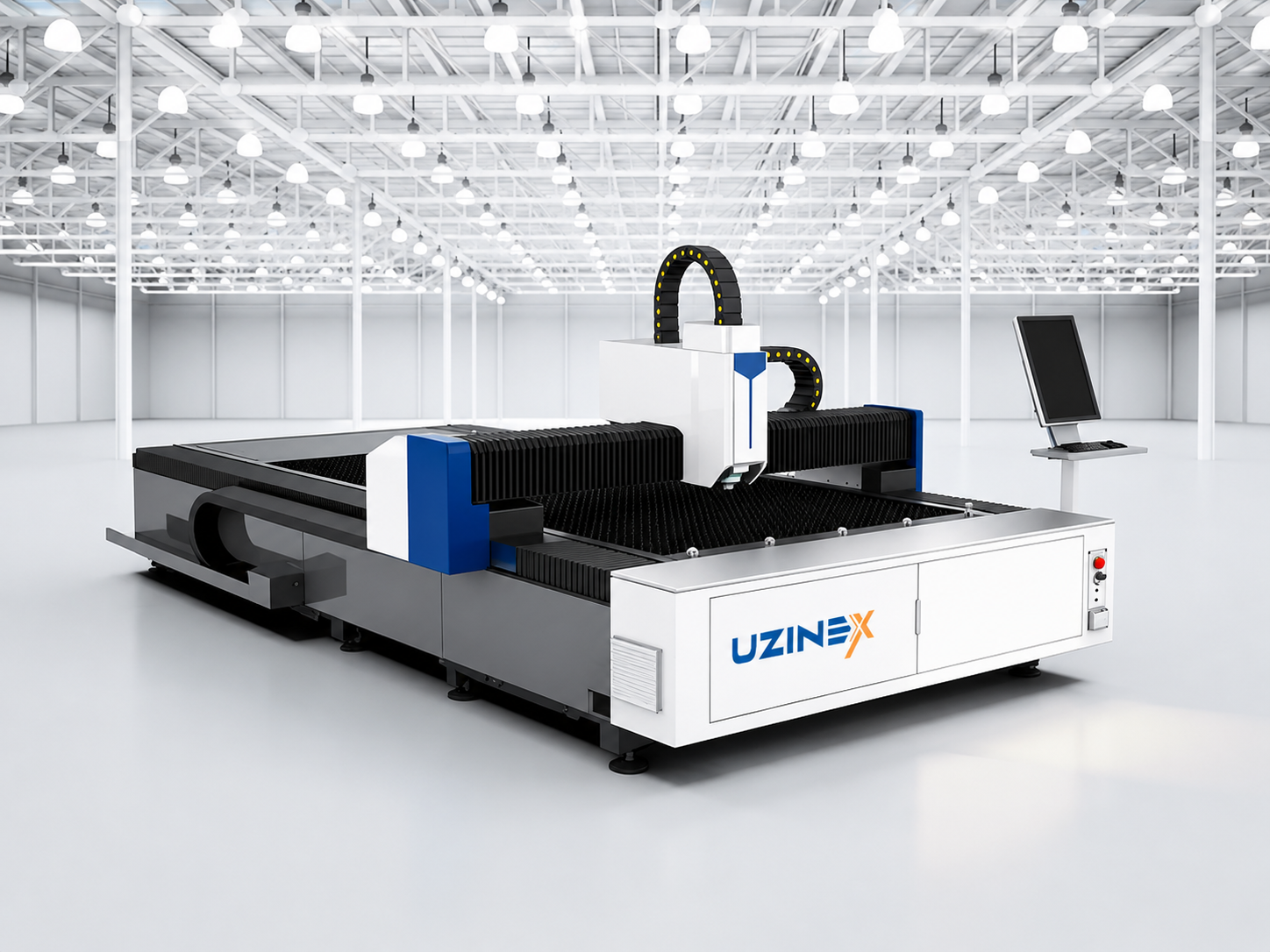
From 12 kW up we are talking about production, not a workshop: large thicknesses cut at economical speed, thick plate from welded construction, multi-shift working schedules. The WyCut S Series platform goes up to 30 kW (carbon steel up to 40 mm, stainless steel up to 25 mm, aluminium up to 20 mm, cutting speeds up to 140 m/min), and for non-stop operation with an automatic pallet changer there is the fully enclosed WyCut FE series, with the same range of sources.
The top of the range (the high-speed series with 40–80 kW sources and 5G accelerations) only makes sense where the laser is the heart of a factory and every second per part translates into money. If you get to ask this question, the correct discussion is no longer about kW, but about the complete flow: loading automation, part sorting, integration with bending.
The classic traps in choosing power
- “I'll take a bigger one, to be covered.” A source used at 30% of capacity means tied-up capital and higher fixed consumption. The money of the difference almost always finds a better place in a proper extractor, a pallet changer or training.
- “The maximum thickness on the data sheet = my working thickness.” The maximum cuttable thickness and the economically cuttable thickness are two different things. Always ask for the speeds on YOUR thickness, not the catalogue maximums.
- “All sources are the same.” The source, the cutting head and the motion system work together. The same power on different platforms gives different results; that is why the integrator matters, not just the figure.
- “I choose alone, on paper.” The correct test is cutting your real parts. Send the drawings and materials: the configuration is validated on them.
What correct sizing looks like, step by step
The process every UZINEX customer goes through before the offer: the inventory of real parts (material, thickness, monthly quantities), the calculation of cutting times on 2 to 3 power classes, the overlay with the working schedule (one shift? three?), then the check of the total cost (purchase, consumption, gas, consumables) on each variant. Only at the end is the source chosen. Most of the time the result surprises: the productivity difference between two neighbouring classes justifies the price jump only above a certain volume, and that threshold is calculated, not guessed.
Power does not come alone: table format and automation
The power decision drags two sister decisions after it. The first: the table format. A large source is pointless if your standard sheet does not fit or, conversely, if you pay for a 6-metre table for 40 cm parts; the platforms in the catalogue range from the classic 3015 format to 8025, and material scrap drops visibly when the table format matches your sheet formats. The second: the degree of automation, from the pallet changer (you load the next sheet while the machine cuts) to loading towers for overnight work. The practical rule: at one shift a day, the pallet changer is usually enough; the discussion about full automation begins with the second shift.
The five questions to ask any supplier
- “What is the cutting speed on MY thickness and material?”: not catalogue maximums; ask for the platform's real cutting table.
- “What total installed power does the complete system have?”: source + chiller + extractor + drives; that is what the connection is sized on, not the kW of the source.
- “What happens when it stops?”: the contractual intervention time, not the verbal promise. At UZINEX: a standard 60-month warranty and on-site intervention in under 24 hours nationwide.
- “Who trains my operators and how long does it take?”: training at commissioning is included in UZINEX deliveries; that is also where you get the machine's interactive AI manual.
- “Can I see an identical machine in production?”: verifiable references beat any showroom demonstration.
What you get at delivery, whatever the power class
At UZINEX, the package does not depend on how large the source is: transport and commissioning are included in the price across Romania, installation is done by in-house engineers, operators leave trained, and the equipment goes straight into the standard 60-month warranty, with phone support and parts guaranteed. The difference between classes stays where it should: in productivity, not in the quality of support.
And the financing?
A fiber laser finances well: it is an asset with a clear resale value, so leasing partners accept it easily. Through the 10 UZINEX financial partners, leasing or equipment credit is typically approved in days, with a down payment from 0%, and for larger projects there are European funds and government schemes, with the technical file prepared by our team.
The practical conclusion
Choose the power for 80% of your production, not for the exceptions. Below 3 kW you enter the technology with minimal risk; at 6 kW you cover the serious metal fabrication workshop, the class with the longest documented references; from 12 kW up we are talking about intensive production and the whole flow deserves discussion. The complete catalogue of fiber lasers is organised exactly on these classes, and if you want the correct shortcut, send your parts to a UZINEX engineer and you get a reasoned sizing, with figures on your materials.