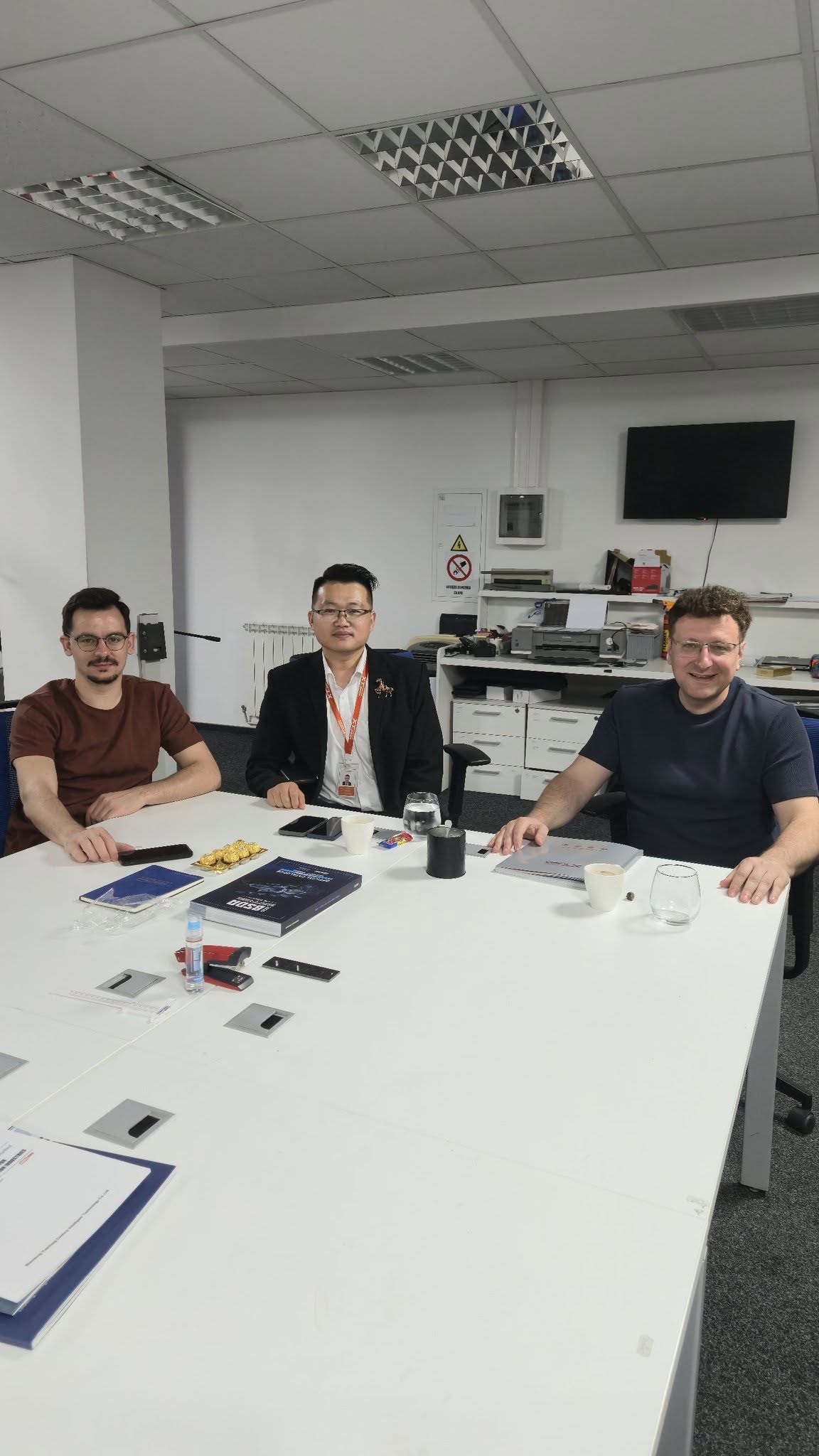
Hank came to see us all the way from China. He crossed half the globe for a few hours at a table in Iași. We drank coffee, talked about lasers, about the market and about an idea that hung in the air all day: the possibility that his company might open a European branch together with Uzinex right here in Iași.
For now, we only talked. But sometimes that is how things begin.
What stayed with me after Hank left, though, was something else.
Around the second coffee he told me: “I could never lead a team of Europeans.”
I asked him why.
He told me how in China people work 12 hours a day, six days a week. How if you are late to the office three times, you are out. No discussion, no warnings. Three late arrivals, done. How every quarter the team is evaluated and the weakest one leaves. Guaranteed. Every quarter, someone.
Listening to him, the irony came to mind: some people still say Europeans do not have a good standard of living. Ha.
But the thing that stopped me was something else. Hank is in the top 5 in his company. This was not someone barely keeping afloat complaining. It was a winner who nevertheless lives with the fear that next quarter someone might overtake him. Multiplied over years, that means constant, uninterrupted pressure, with no release valve. And for those who are not in the top 5, the situation is far harsher than we can imagine.
For him, the idea of leading people who have free weekends, who take holidays, who leave the office at five in the afternoon or who work from home seemed simply impossible to manage. He did not look down on us. He just did not understand how it works.
I explained how in Europe the logic is different: an employee who works 40 focused hours, rested, with a clear mind, often delivers more than an exhausted one who sits 60 hours at the office. I talked to him about productivity per hour, about burnout, about how a two-week holiday makes you better when you come back. He listened politely, nodded, but I do not think I convinced him. He probably does not believe me in the same way that I cannot imagine a quarterly meeting where they announce who was the weakest among us and who leaves on the spot.
I walked him around Iași, showed him the city, and at the end I wanted to give him a gift.
And here came the hardest part of the day.
Finding in 2026 a gift that is not Made in China is harder than it sounds. Five shops, three shopping centres, two craft fairs. The T-shirt with the Dacian wolf is printed in Yiwu. The watch from an “elegant” boutique: China. The expensive pen from a select stationery shop: China. The beer trophies, the rustic wood table decorations, the photo frames: all China.
In the end I gave him a lucky wooden horseshoe, handmade in Romania (2026 is the Year of the Horse in their zodiac) and a small bottle of homemade țuică. Two simple objects, without impressive packaging, but ones he cannot buy at home.
It was an interesting day.
And I was left with a question that I kept turning over until the evening.
Hank, with his 12 hours a day × 6 days, with the quarterly evaluation that slowly cuts down his colleagues, with the constant fear that he may be next, Hank indirectly produces what we buy every day. Almost everything I tried to give him as a gift was made under his regime. We have weekends, holidays, eight hours, remote work, and we consume the result of their work.
That is the quality of life we have. Built, in part, on the backs of people who have neither the time, nor the energy, nor the security to think about their own quality of life.
I do not think the solution is to copy the Chinese model: that would be naive and inhuman. But I do not think either that the European model, which appeared over 30 years of post-Cold War peace and prosperity, is set in stone forever. China is only the first big “so what” that we have to answer. More will come.
I do not know the answer.
But I know that a wooden horseshoe made by hand in Romania is worth more in the world than you think when you buy it. And Hank, I hope he comes back to Iași.