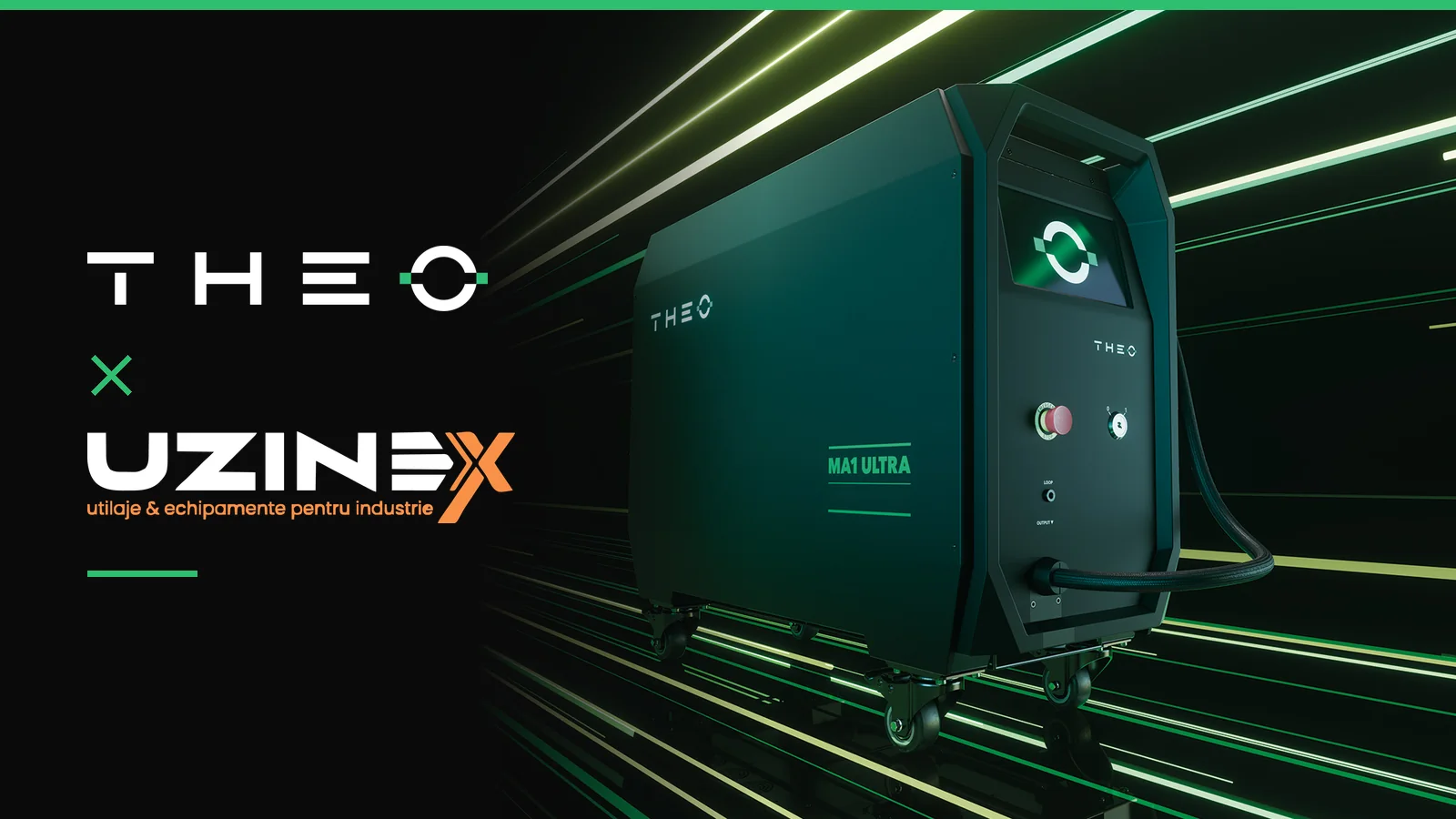
- On 11 November 2026, at TECHNOVERS Expo 2026 in Iași, visitors stripped paint from a steel plate themselves with the UZINEX 200–300 W pulsed laser.
- A 100 ns pulse at 200 W and 100 kHz carries 2 mJ and about 20 kW of peak power; heat penetrates the steel only about 2 µm.
- Fluence is set between the ablation threshold of the paint and that of the steel, so the process stops by itself at the metal.
- A pulsed laser suits sensitive surfaces and precision work; a 1,000–3,000 W continuous laser suits heavy rust removal and large areas.
On 11 November 2026, UZINEX exhibited at TECHNOVERS Expo 2026, the technology and innovation exhibition organised by the Gheorghe Asachi Technical University of Iași, held at Palas Mall Iași in the Digital Innovation Zone. We brought a 200–300 W pulsed laser cleaning machine and let visitors strip paint from a steel plate themselves, supervised by our team.
This article explains, at engineering level, what happened on that plate: why the paint disappears in a few passes, why the steel underneath stays cool and intact, and how to choose between a pulsed and a continuous laser for rust removal, paint removal or oxide cleaning.
What is laser cleaning
Laser cleaning (also called laser blasting or laser ablation cleaning) is the process in which a 1064 nm fibre laser beam removes rust, paint, oil or oxides from metal by ablation: the surface layer absorbs the energy and vaporises, while the base metal keeps its dimensions. It works without abrasive media, without solvents and without contact, with the fumes extracted at source. There are two families of laser cleaning machines: the pulsed laser (100–300 W, nanosecond pulses, minimal heat input) and the continuous laser (1,000–3,000 W, high throughput on rust and large surfaces).
What we demonstrated at the UZINEX stand
The sample was chosen to be readable from a few steps away: a steel plate coated with orange spray paint. Every pass of the laser head leaves behind a strip of matt grey steel, and the contrast between orange and metal shows exactly where the beam worked. In the videos, a member of our team and a visitor operate the machine, both wearing laser safety glasses for the laser wavelength, while the flexible duct of the fume extractor sits a few centimetres from the work zone.
What visitors saw without any explanation: the paint disappears, the plate stays flat and cool to the touch right after the pass, and there is no sand, abrasive dust or solvent on the table. The rest of the article explains why.
How pulsed laser cleaning works
The source is an ytterbium-doped fibre laser with a 1064 nm wavelength, emitting pulses of 10–200 nanoseconds at a frequency adjustable between 1 and 1,000 kHz. The cleaning mechanism is called laser ablation: the energy of a pulse reaches the paint layer so quickly that the layer heats above its vaporisation temperature before the heat can flow into the metal. The vapour and plasma formed at the surface expand abruptly and detach the layer as fine particles, which the extraction system captures.
Two numbers describe every pulse. Pulse energy is average power divided by frequency: at 200 W and 100 kHz, E = 200 W / 100,000 Hz = 2 mJ. Peak power is energy divided by duration: 2 mJ in 100 ns means about 20 kW, a hundred times the average power. The peak does the work and vaporises the paint, while the low average keeps the part cool.
Why the steel stays cool follows from the thermal diffusion length, the distance heat travels during one pulse: L ≈ 2·√(α·τ). For carbon steel the thermal diffusivity α is about 1.2·10⁻⁵ m²/s; with τ = 100 ns this gives L ≈ 2 µm. Heat reaches only the first few micrometres of the metal and dissipates into the plate during the roughly 10 µs pause before the next pulse.
Fluence and the process window
The second design parameter is fluence, the energy per unit area of the spot: F = E / A. With a 0.5 mm spot the area is π·d²/4 ≈ 0.0020 cm², and 2 mJ on this area gives about 1 J/cm².
Organic paints and pigments strongly absorb 1064 nm radiation and have an ablation threshold below that of steel, which reflects a large part of the beam. The process engineer sets the fluence between the two thresholds. In this window the process is self-limiting: the beam removes the paint layer by layer, and when it reaches the metal, the energy stays below the metal's ablation threshold. On the TECHNOVERS plate this was directly visible: the cleaned areas look matt grey, with no melting and no temper colours.
Fluence is set from three quantities: average power, frequency (which changes the energy per pulse) and spot diameter, adjustable by optical zoom between 0.5 and 3 mm. Low frequencies give energetic pulses for thick layers; high frequencies give fine pulses for delicate cleaning.
Scanning: the galvo scanner and spot overlap
The handheld head contains a galvanometer scanner: an electrically driven mirror oscillates and traces the spot along a line, hundreds of times per second. The operator holds the head 50–100 mm from the part and moves it slowly, perpendicular to the line. The result is a uniformly cleaned strip, as long as consecutive spots overlap.
Overlap along the scan line is 1 − v / (f · d), where v is the spot speed, f the frequency and d the spot diameter. At f = 100 kHz, d = 0.5 mm and v = 10 m/s, the ratio v / (f · d) is 0.2, so overlap is 80%. Below roughly 50%, uncleaned bands appear between spots; above 90%, local heating rises and throughput drops. That is why, at commissioning, we set the scan speed for the customer's specific combination of coating and material.
Pulsed or continuous laser cleaning machine
Both technologies clean with a laser, but they deliver energy differently. A continuous wave (CW) laser of 1,000–3,000 W has high throughput on heavy rust and large surfaces and heats the part more. A pulsed laser of 100–300 W works more slowly, with minimal heat input, and is the right choice for sensitive surfaces, moulds, thin parts and restoration.
| Parameter | Pulsed laser | Continuous laser (CW) |
|---|---|---|
| Average power | 100, 150, 200 or 300 W | 1,000, 1,500, 2,000 or 3,000 W |
| Emission | Pulses of 10–200 ns, 1–1,000 kHz | Continuous beam |
| Heat input into the part | Minimal, heat penetrates a few µm | Higher, grows with exposure time |
| Typical throughput | 0.3–3 m²/h (patina, fine oxides, mould deposits) | 1–25 m²/h (rust 1–15, paint 5–12, oil 15–25) |
| Spot | 0.5–3 mm | 1–6 mm |
| Cooling | Air only at 100–200 W, 220 V supply | Air and water, with chiller |
| Typical applications | Moulds, bronze, thin parts, electronics, restoration | Steel structures, heavy rust removal, weld preparation |
In the UZINEX range, the two options are the handheld pulsed laser cleaning machine, the one we brought to TECHNOVERS, and the continuous laser rust removal machine. The full range is in the laser cleaning machines category.
Laser cleaning vs sandblasting
Laser cleaning replaces abrasive blasting in many applications. The engineering differences are clear:
- Consumables and waste. Sandblasting consumes shot, corundum or sand and produces waste mixed with paint. The laser consumes electricity, and the only waste is the fume captured in the extractor filter.
- Selectivity. The beam works only where it is aimed. Adjacent areas, threads and sealing surfaces stay untouched, without elaborate masking.
- Part geometry. The laser keeps dimensions and edges, which is why it is used on moulds and precision tooling, where abrasive would round the edges.
- Anchor profile. Blasting creates the surface roughness some anti-corrosion coating systems require. The laser cleans down to bare metal without creating the same profile, so the coating specification decides the method for heavy-duty coatings.
- Weld preparation. For removing oxides, oil and paint from the joint area, the laser is fast and leaves the metal ready to weld, with no abrasive dust in the weld pool. Shops that weld and clean the same part often use 3-in-1 laser welding machines, which clean with the same torch.
Laser cleaning safety
A laser cleaning machine is Class 4 laser equipment. At the stand we applied the same rules as in production: laser safety glasses with the right optical density for 1064 nm (EN 207) for anyone in the work zone, a marked-off area around the table and filtered extraction next to the spot. Fumes from paint contain organic compounds and metal oxides, so capture at source is part of the process. At delivery, operator training covers parameter setting, eye and skin protection and filter maintenance.
TECHNOVERS Expo 2026 in numbers and pictures
The exhibition brought together more than 50 inventions presented by students, pupils and researchers, as reported (in Romanian) by Știrile ProTV on 12 November, with solutions for agriculture, the environment and industry: drones, robots, energy projects and the university's Formula Student single-seater.
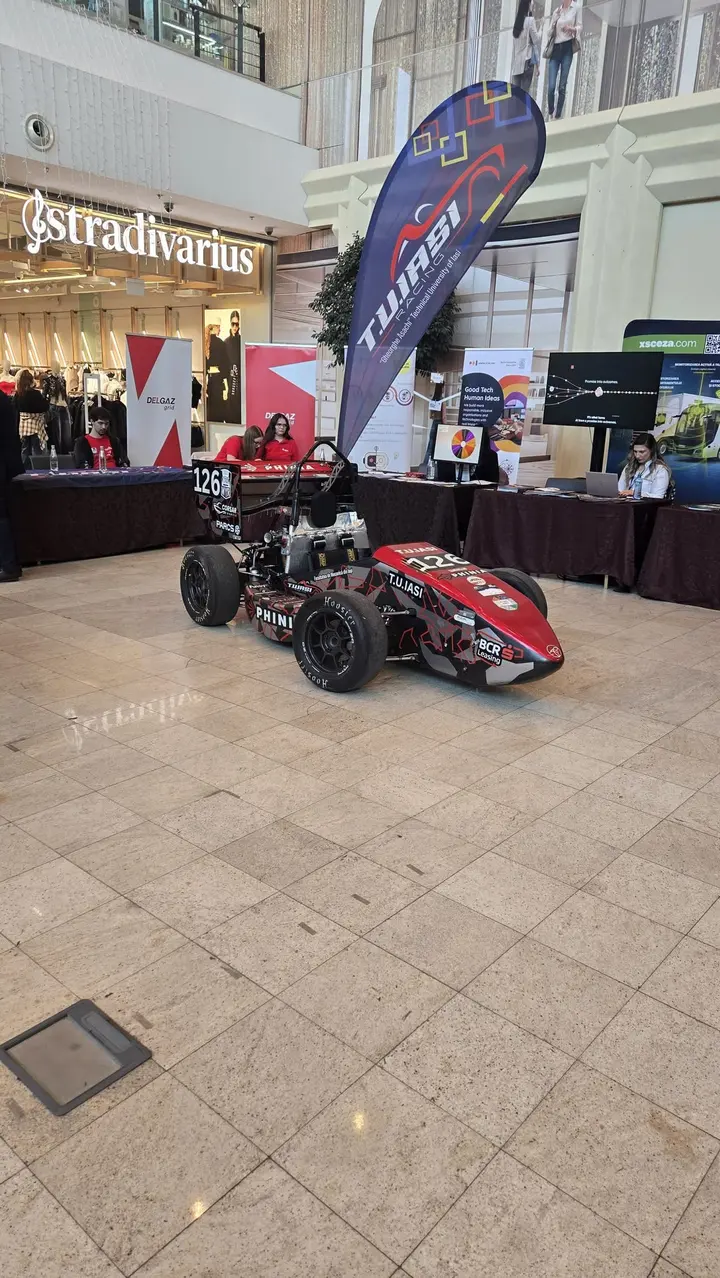
This audience matters to us: today's students are the process engineers, technologists and production managers who will specify equipment for factories in a few years. At the stand we discussed process parameters, the limits of each technology and how an idea moves from the lab to a line that runs three shifts.
What UZINEX does beyond laser cleaning
The laser cleaning machine was the equipment on the stand. UZINEX covers the whole production floor: laser technology for cutting, welding and cleaning, CNC machines and metalworking equipment, complete production lines, recycling solutions, industrial automation and energy systems. For a laser cutting line, the laser configurator gives a starting configuration in a few minutes.
As a laser systems integrator and industrial solutions integrator, we run the project end to end: we define the technical solution around the customer's parts and volumes, configure the equipment, deliver, install, commission, train the operators and provide technical support. The warranty is 60 months, with on-site response within 24 hours in Romania and 24–72 hours in other countries, and financing is available through leasing or loans, with the pro forma prepared by us.
Thank you to the Gheorghe Asachi Technical University of Iași for the invitation and to everyone who stopped by the stand and took the laser in hand. Developing an industrial project or modernising a production process? Write to us and we will build the technical solution together.
Frequently asked questions
What is laser cleaning?
Laser cleaning, also called laser blasting, removes rust, paint, oil and oxides from metal with a 1064 nm fibre laser beam. The surface layer absorbs the energy and vaporises, while the base metal keeps its dimensions. It works without abrasive, without solvents and without contact, with fume extraction at source.
Does laser paint removal damage the steel underneath?
With correct parameters the steel stays intact. Fluence is set between the ablation threshold of the paint and the higher threshold of the steel, so the process stops by itself at the metal. With a 100 ns pulse, heat penetrates the steel about 2 micrometres.
What is the difference between a pulsed and a continuous laser cleaning machine?
A pulsed laser (100–300 W) delivers energy in 10–200 ns pulses with minimal heat input, for moulds, thin parts, bronze and restoration, at 0.3–3 m²/h. A continuous laser (1,000–3,000 W) cleans 1–25 m²/h depending on the contaminant, for heavy rust, paint and large surfaces, and heats the part more.
Can laser cleaning replace sandblasting?
The laser replaces blasting for selective cleaning, moulds, weld preparation and wherever abrasive and dust are a problem. For anti-corrosion coating systems that require an anchor profile, the coating specification decides, because blasting creates that roughness and the laser cleans to bare metal without creating it.
How fast is laser rust removal?
A continuous laser cleans 15–25 m²/h of oil and grease, 8–15 m²/h of weld oxides, 5–12 m²/h of paint in 1–2 coats and 1–15 m²/h of rust, depending on thickness. A pulsed laser works at 0.3–3 m²/h, on surfaces where precision matters more than speed.
What protection does laser cleaning require?
The machine is Class 4 laser equipment. Anyone in the work zone wears glasses with the right optical density for 1064 nm (EN 207), the area is marked off, and fumes are captured with filtered extraction next to the spot, because burnt paint releases organic compounds and metal oxides.