On 26 June 2026, UZINEX won the competitive procedure for the delivery of a complete end-of-life tyre and rubber waste recycling line, the UZ-2500, with a processing capacity of 2,500 kg/h. The supply contract is already signed, and the equipment goes into production on the basis of a firm schedule for delivery, assembly and commissioning at the beneficiary's site in Botoșani County.
The award was made under the “MultiReMaterial” project (MySMIS code 350032), under the procurement code CPV 42914000-6 (recycling equipment), and the beneficiary of the line is LARA AKMATEKS S.R.L. of Botoșani. The UZ-2500 line is a circular economy investment: it turns end-of-life tyres into rubber granules and powder that can be reused industrially, recovers the steel wire from the beads and separates the textile fibres, with a high degree of purity on each fraction.
What UZINEX won
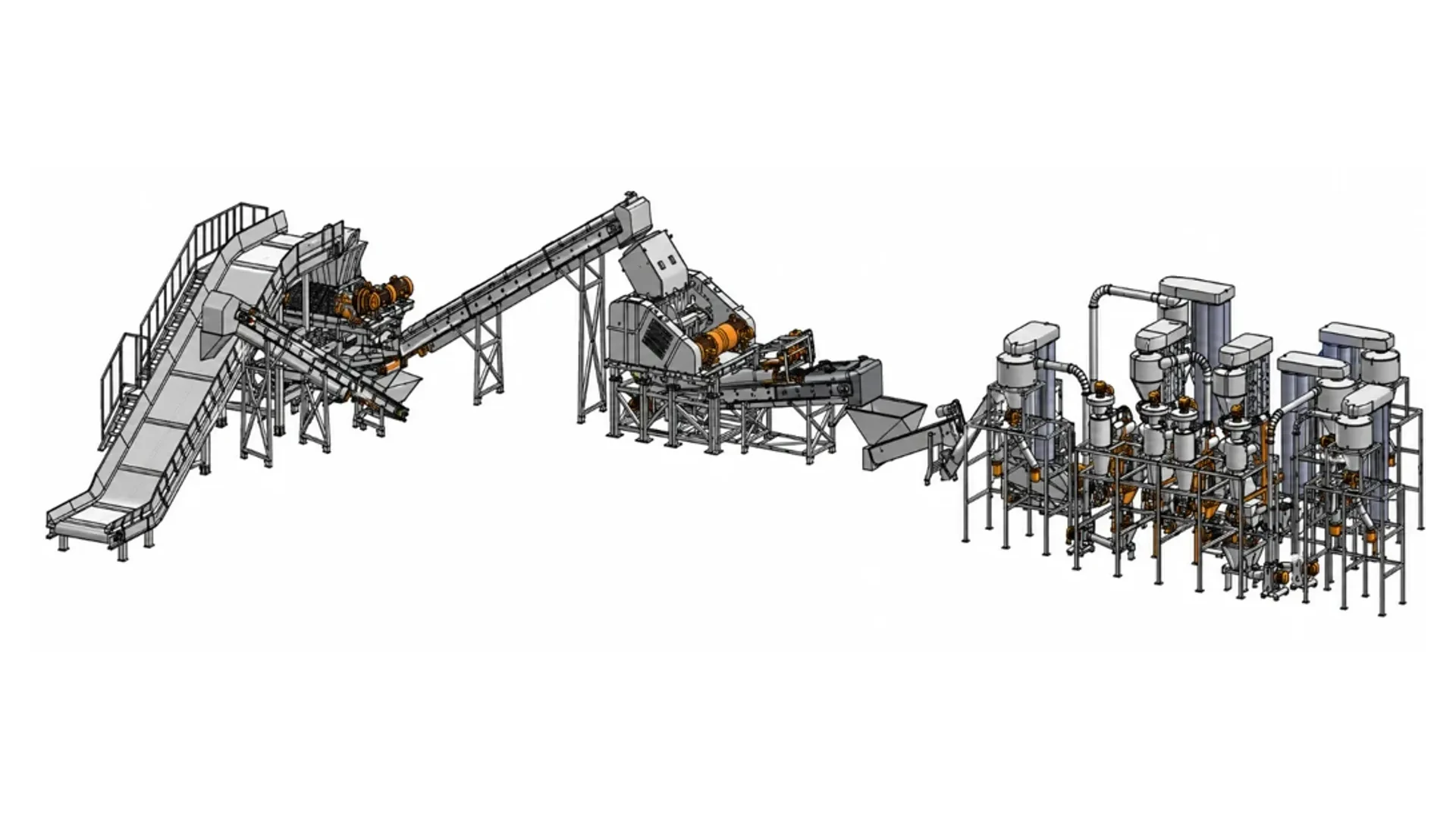
UZINEX supplies an integrated, turnkey technology line, not separate machines. All machines in the flow are matched in size and function and controlled centrally from a single automation system, so that the tyre goes in whole at one end of the line and comes out as sorted granules and fine powder at the other end. In short, what is in the contract:
- The UZ-2500 rubber recycling line, capacity 2,500 kg/h, for car, truck and passenger tyres with a diameter of up to 1,200 mm.
- The complete process flow: removal of the steel bead, cutting, shredding, size reduction, fine granulation, magnetic separation of the steel, separation of the textile fibres and dust removal.
- A centralised command and control system through a programmable logic controller (PLC), with video monitoring of the line.
- Transport, assembly and commissioning included, DDP delivery to the beneficiary's site (Incoterms DDP).
- 60-month warranty, operator training, an operating manual in Romanian and complete technical documentation.
The competitive procedure is part of the category of procurements financed from European funds for the 2021-2027 programming period, with the payment and reimbursement request mechanism regulated by Government Emergency Ordinance no. 133/2021, as amended and supplemented. For the beneficiary, this means new, unused equipment, eligible for financing, delivered according to a strict technical specification.
What the UZ-2500 rubber recycling line does
The UZ-2500 line processes whole end-of-life tyres and produces recycled rubber in the form of granules of 1-3 mm, 3-4 mm and 4-5 mm, plus rubber powder of 0.1-0.8 mm. The output grain size falls in the range of about 5-40 mesh. The resulting material is sellable as is: the granules go into protective mats, sports surfaces, moulded tiles and pavers, and rubber-modified asphalt mixes, and the fine powder into technical compounds and reclaimed rubber products.
Beyond rubber, the line recovers two by-products with value of their own. The steel wire extracted from the beads and from the rubber mass is collected separately, as scrap that can be sold, at a recovery purity of over 97%. The textile fibres (nylon) are separated with a dedicated ZigZag-type system, so that the rubber granules stay clean. In practice, from an end-of-life tyre almost all three component materials are recovered.
How the line works, step by step
The process flow has 10 stages, all integrated and centrally controlled. The tyre travels through the line with no manual handling between machines, which means constant throughput and low labour consumption (the line is served by 1-2 operators).
- Intake and preparation. The bead extraction machine (debeader) removes the thick steel wire rings from the bead area, protecting the knives of the downstream machines. Oversized tyres (up to Ø 2,000 mm) are first cut into blocks with a crocodile-type hydraulic shear.
- Primary shredding. The metal belt carries the material to the twin-shaft shredder, which breaks the tyres into fragments of about 60 × 60 mm. A disc screen sorts the fragments under 60 mm; pieces that are too large are returned automatically to the shredder for another pass.
- Size reduction (rasping). The rasper reduces the fragments under 60 mm to rubber granules under 20 mm, preparing the material for metal separation and fine granulation.
- Magnetic separation of the steel. On the belt to the magnetic separator, the steel wire is extracted from the rubber mass with a separation purity of ≥ 99.8%, the steel being collected separately as a by-product that can be sold.
- Fine granulation (crushing). The material is dosed through a screw feeder into the granulator (the rubber crusher), which provides the capacity of 2,500 kg/h and brings the rubber to the final grain size of about 5-40 mesh.
- Transport and refining. The granulated rubber is transported pneumatically (blowers and a collection cyclone) and passed through a roller magnetic separator, which retains about 1% of remaining fine wire, improving the purity of the product.
- Screening and size sorting. The vibrating screen separates the finished product into fractions: granules of 1-3 mm, 3-4 mm and 4-5 mm, and powder of 0.1-0.8 mm. Fractions that are too large are recirculated for another grinding.
- Separation of the textile fibres. The ZigZag-type nylon separator removes the fibres from the granules, with a purity of ≥ 99.8%, resulting in clean recycled rubber, free of textile impurities.
- Collection and discharge. The resulting fractions are directed through hoppers (a “one-of-two” system) and blowers to the discharge and packing points, by grade.
- Auxiliary and control systems. A pulse-jet dust removal system captures dust and fine fibres throughout the line. The cooling tower keeps the equipment at operating temperature, and the platform with stairs and railings provides access for operation and maintenance.
Main technical specifications
The UZ-2500 line is sized for continuous industrial operation, safely and reliably, in compliance with environmental regulations. The essential parameters of the line:
| Parameter | Specification |
|---|---|
| Processing capacity | 2,500 kg/h |
| Material processed | end-of-life car, truck and passenger tyres |
| Tyre diameter at input | up to 1,200 mm |
| Output grain size | approx. 5-40 mesh |
| Finished product | granules 1-3 / 3-4 / 4-5 mm and powder 0.1-0.8 mm |
| Rubber purity | ≥ 99% |
| Purity of recovered steel wire | ≥ 97% |
| Total installed power | 578.02 kW |
| Electrical supply | 850 KVA |
| Operating voltage | 380 V / 50 Hz |
| Operating staff | 1-2 operators |
Main components and automation
The reliability of a recycling line is decided at the level of critical components and automation. On the UZ-2500, the electrical and control side uses top-tier international brands, and the motors, gearboxes and bearings come from established industrial manufacturers.
| Component | Detail |
|---|---|
| Electrical components | Schneider, Siemens PLC |
| Touch panel (HMI) | Siemens |
| Motors, gearboxes, bearings | renowned industrial manufacturers |
| Control | programmable logic controller (PLC) with overload detection and alarms |
| Monitoring | control cabin with a video system over the line |
| Compliance | CE safety standards |
The control system automatically detects overload and, when needed, runs forward and reverse rotation on the shredder, with an emergency stop button on the critical machines. In addition to the mechanical guarding of dangerous areas and the emergency stop systems, the line complies with occupational health and safety (OHS) legislation.
Delivery, assembly and warranty
UZINEX delivers the line DDP to the beneficiary's site in Botoșani, with transport, assembly and commissioning included. The warranty and support package covers the long-term operation of the equipment.
- Standard 60-month warranty from commissioning.
- Technical assistance for emergency interventions, with free replacement of parts with a manufacturing defect (excluding consumables).
- Service intervention time of at most 24 hours from notification.
- Technical support for the whole life of the equipment, plus 1 spare set of consumables for 24 months.
- Operator training, an operating manual in Romanian and complete technical documentation at delivery.
Why it matters: tyre recycling in Romania
End-of-life tyres are a waste stream that legislation treats as a priority. Romania transposes the European obligations on waste management and extended producer responsibility, which pushes the market towards domestic rubber recycling capacity. A line like the UZ-2500 turns an environmental problem into a secondary raw material: rubber granules and powder have steady demand in construction, sports infrastructure and the compounds industry.
For an economic operator, a capacity of 2,500 kg/h means a significant volume of tyres diverted from storage, plus three sales streams in parallel: rubber granules by fraction, fine powder and recovered steel. The circular economy model thus also becomes a business model, supported by European funding through projects such as “MultiReMaterial”.
Frequently asked questions about the UZ-2500 line
What capacity does the rubber recycling line won by UZINEX have?
The UZ-2500 line processes 2,500 kg/h of end-of-life car, truck and passenger tyres, with a diameter of up to 1,200 mm.
What finished products result?
Rubber granules of 1-3 mm, 3-4 mm and 4-5 mm, rubber powder of 0.1-0.8 mm (approx. 5-40 mesh), plus steel wire and textile fibres recovered separately.
What purity does the recycled rubber have?
The rubber purity is ≥ 99%, and that of the recovered steel wire ≥ 97%. The magnetic separations and the ZigZag textile separator reach a purity of ≥ 99.8% at their dedicated stages.
Who is the beneficiary and under what framework was the award made?
The beneficiary is LARA AKMATEKS S.R.L. of Botoșani, through a competitive procedure in the “MultiReMaterial” project (MySMIS code 350032), under CPV 42914000-6.
What does the delivery include?
DDP delivery to the beneficiary's site, transport, assembly and commissioning included, a 60-month warranty, operator training and technical documentation in Romanian.
About UZINEX
UZINEX is an industrial equipment integrator in Romania: recycling lines, fiber laser cutting systems, CNC machines, automation, robotic welding and material handling. We deliver turnkey, with transport, installation, training and in-house service, and we stand behind the equipment for its entire service life. For projects with European funding, we take the customer from the specification and offer through to commissioning and acceptance.